
How Much Do Mobile Games Make: Ads, Purchases and Our Own Numbers
How much do mobile games make? I see it in my own payouts. I have been making games since 2019, and our first six ate about $15,900 and brought in $50 of revenue. Today our mobile line is ads in dozens of games, purchases, subscriptions on Amazon, paid user acquisition and constant tests. As I wrote in April 2026: "Mobile is about numbers, paid installs and constant tests."
Ruble amounts in this article are converted to dollars at the Bank of Russia rate for October 22, 2026, about 82 rubles per dollar.
I check the market against analyst reports, and the rest comes from our own games' numbers with dates, including the failures.
I share how our mobile games are doing, month by month and quarter by quarter, as it happens.
Our mobile games' income as it happens
Evgeny on XHow much do mobile games make: the market and how the money splits
The market is huge, but almost all the money goes to the top percent of games.
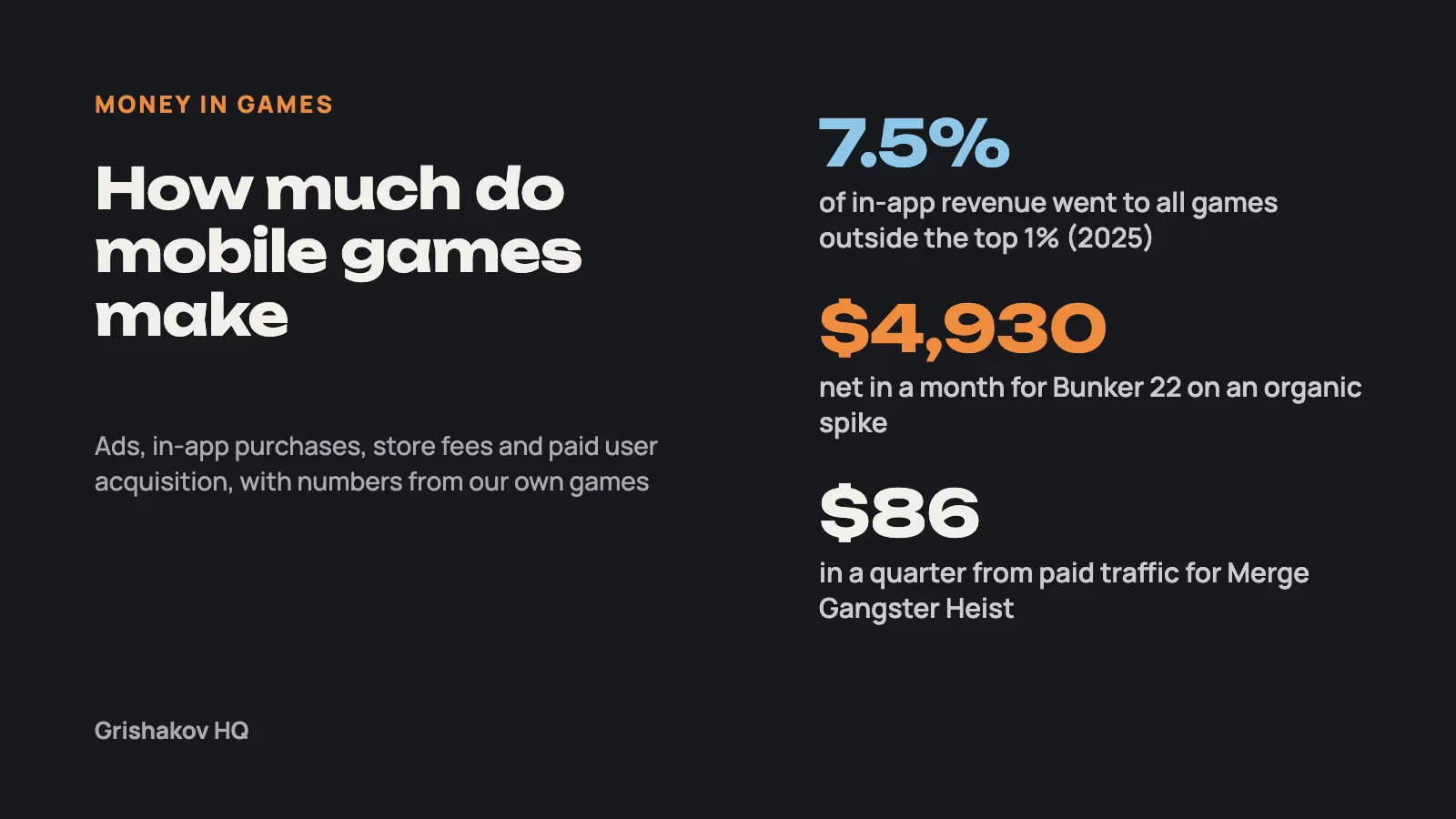
According to Newzoo, mobile games made $113.3B in 2025, 56% of all spending on games worldwide. Sensor Tower also counted how it is split: games outside the top 1% were left with 7.5% of in-app purchase revenue. More than 90% of purchase money goes to one percent of games, and everyone else shares what is left.
Analysts do not publish the median revenue of a mobile game in open reports. To me that is more honest than any average: most games simply do not earn. So from here on, our own numbers.
How much do indie mobile games make: our games' numbers
For us the range runs from $50 for all our first games to several thousand dollars net a month for a single game, and the same game can grow for years and then drop to zero.
| Game or platform | When | How much |
|---|---|---|
| Our first six games | up to April 2020 | about $15,900 spent and $50 in revenue |
| Bunker 22 | December 2022 | $1,600 in revenue, all organic |
| Bunker 22 | April 2025 | $4,930 net profit for the month, on an organic spike |
| Merge Gangster Heist | Q1 2026 | $86 from paid installs for the quarter, before salaries |
| Nuclear Day | a quarter, post of August 4, 2026 | $15,887 projected profit, before team costs |
| Our Amazon line | a month, post of August 5, 2025 | $25,064 in revenue and $7,800 net |
| 34 of our games on RuStore | July 2025 | about $1,880 in revenue, about $1,476 after the store fee and tax |
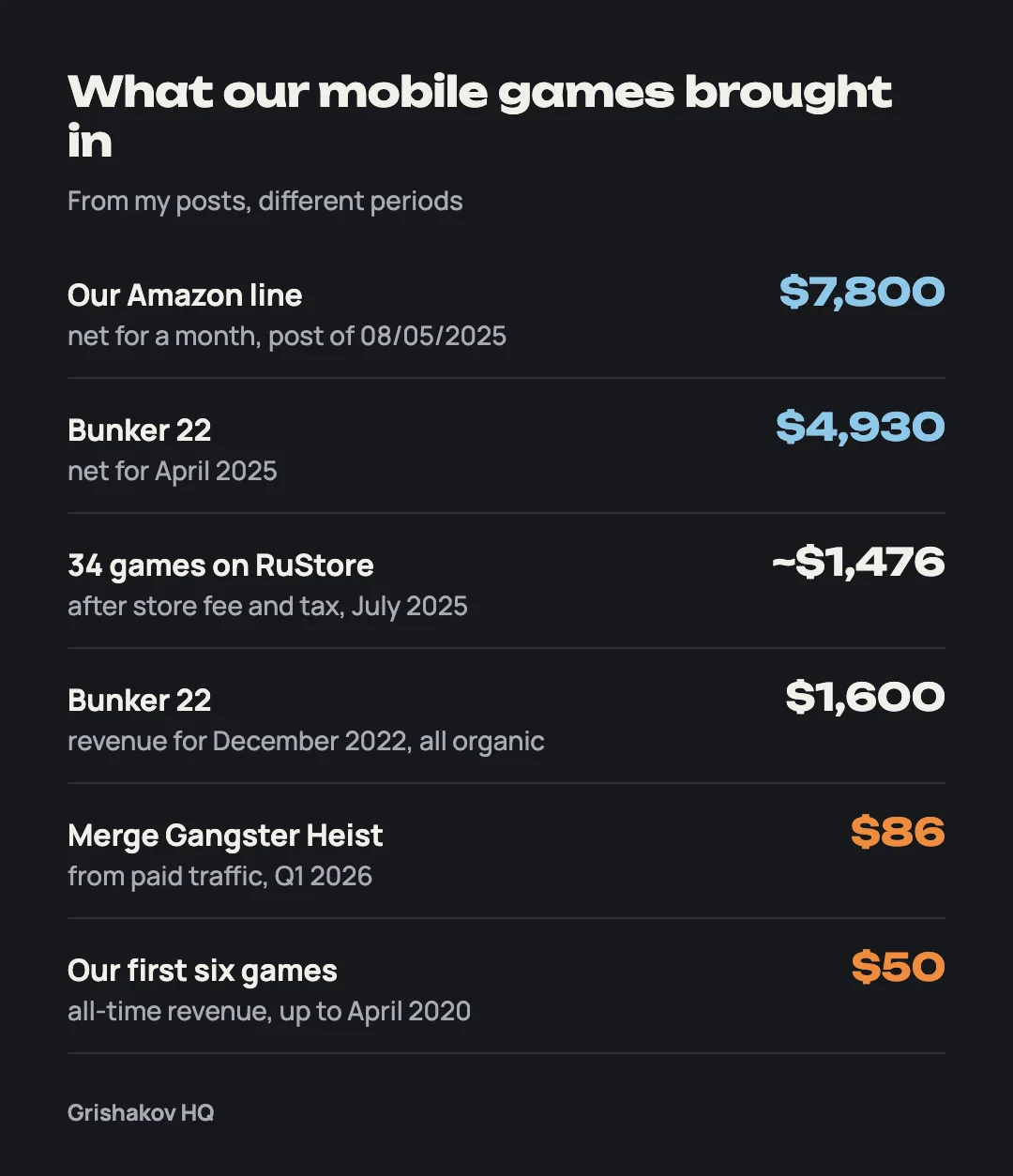
Bunker 22 shows it best. In December 2022 it made $1,600, and I wrote: "It's all organic. We haven't grown up to paid installs here yet." A little over two years later, in April 2025, the game brought in $4,930 net profit, even though apart from releasing it on PlayStation and Switch we had not touched it in a long time: "The main reason for the growth is a spike in organic."
Merge Gangster Heist, which was our flagship, made $86 on paid installs in the first quarter of 2026. In July 2026 I wrote about it: "The organic share there is 7%. Basically zero."
On RuStore, a Russian Android app store, July 2025 was what I called "a little record": two games out of 34 made most of the revenue, and the other 32 "bring in practically nothing." All of it came from organic players and the store's featuring (when the store puts a game into its collections).
How do mobile games make money: ads and in-app purchases
For us the money comes from two sources: ads and purchases inside the game. Subscriptions work for us on Amazon.
In my stream on the results of April 2023, ads brought us about $30,000, purchases on Google Play $8,225, and on the App Store $9,294. Almost all of it came organically, and paid installs then accounted for roughly a tenth of revenue.
How much do mobile games make from ads?
Ad revenue is impressions divided by a thousand and multiplied by eCPM. eCPM is how much an ad network pays per thousand impressions, and it depends heavily on the format, the country and the platform. As an example, here is Russia in Q2 2024, according to Tenjin and CAS.AI:
| Ad format | eCPM on iOS | eCPM on Android |
|---|---|---|
| Banner | $0.73 | $0.47 |
| Interstitial, full screen | $10.55 | $4.52 |
| Rewarded | $11.44 | $4.52 |
I took two conclusions from our experience. Without mediation, where several ad networks compete for every impression at once, there is nothing to do in mobile. In 2023 I wrote that mediation gives "on average a 150-200% increase out of thin air," and in 2026 I put it more bluntly: "if you don't have mediation hooked up in your game, there's no point in doing mobile games at all."
I showed how mediation works and how to set it up in AppLovin MAX step by step, right in the interface, in a separate video. The video is in Russian, and YouTube has an English dub track for it.
Ads also have a ceiling. In December 2023 we greatly increased playtime in two games, impressions went up, and revenue per player went down. "The more often and the more we show ads to the same player, the cheaper each next impression gets." After that we put the emphasis on purchases.
In-app purchases
Purchases worked better for us than I expected myself. In July 2023 we tested the purchase price in Bunker 22: $3, $5 and $7. At $5 and $7 there were twice as many purchases, 14 against 7. The $5 variant gave +86% to revenue, and the $7 variant +89% to purchase income and +70% to ads. I wrote the conclusion like this: "the variant with cheap in-apps loses on every front."
And in March 2026 we took a risk in Merge Gangster Heist and removed interstitial ads from the first 10 levels and for everyone who had paid even once. Over the first week, revenue per player (LTV) grew by 60%, along with retention. The result is preliminary: we broke the test ourselves with a change and are relaunching it. I don't like this kind of ad myself: "I hate interstitials myself and don't want my players to suffer." At the start you will not earn decent money without them, but in a big game with purchases and rewarded ads, in my experience, they only hurt.
If you are tuning your own game's monetization too, I post the results of tests like these as soon as they come in.
Our monetization A/B tests and what came out of them
Evgeny on XHow much do Google Play, the App Store and other stores take?
Stores take a fee only on purchases. Ad revenue comes directly from the network or the mediation platform.
| Platform | Fee on purchases as of October 11, 2026 |
|---|---|
| Google Play | 15% on the first $1M of revenue a year, 30% above that, subscriptions 15%; in the US, EU, UK, Japan and Australia a separate scheme since 2026 |
| App Store | 15% under the Small Business Program, if last year's revenue was up to $1M |
| RuStore (Russian Android store) | 15% on purchases and subscriptions |
| Yandex Games (Russian browser game platform run by Yandex) | the developer gets 50% of Yandex's income from purchases, per the license agreement |
In our own RuStore calculation for July 2025, the fee came out at 17.65%, although the contract says 15%, and we also spent money every month on putting out new games, so the net from purchases was much smaller than the revenue. This is not tax advice: rates and regimes differ for everyone. Who can connect payments on RuStore now and how to publish a game there, I went through in how to publish a game on RuStore.
Do paid installs pay off: CPI, retention and LTV
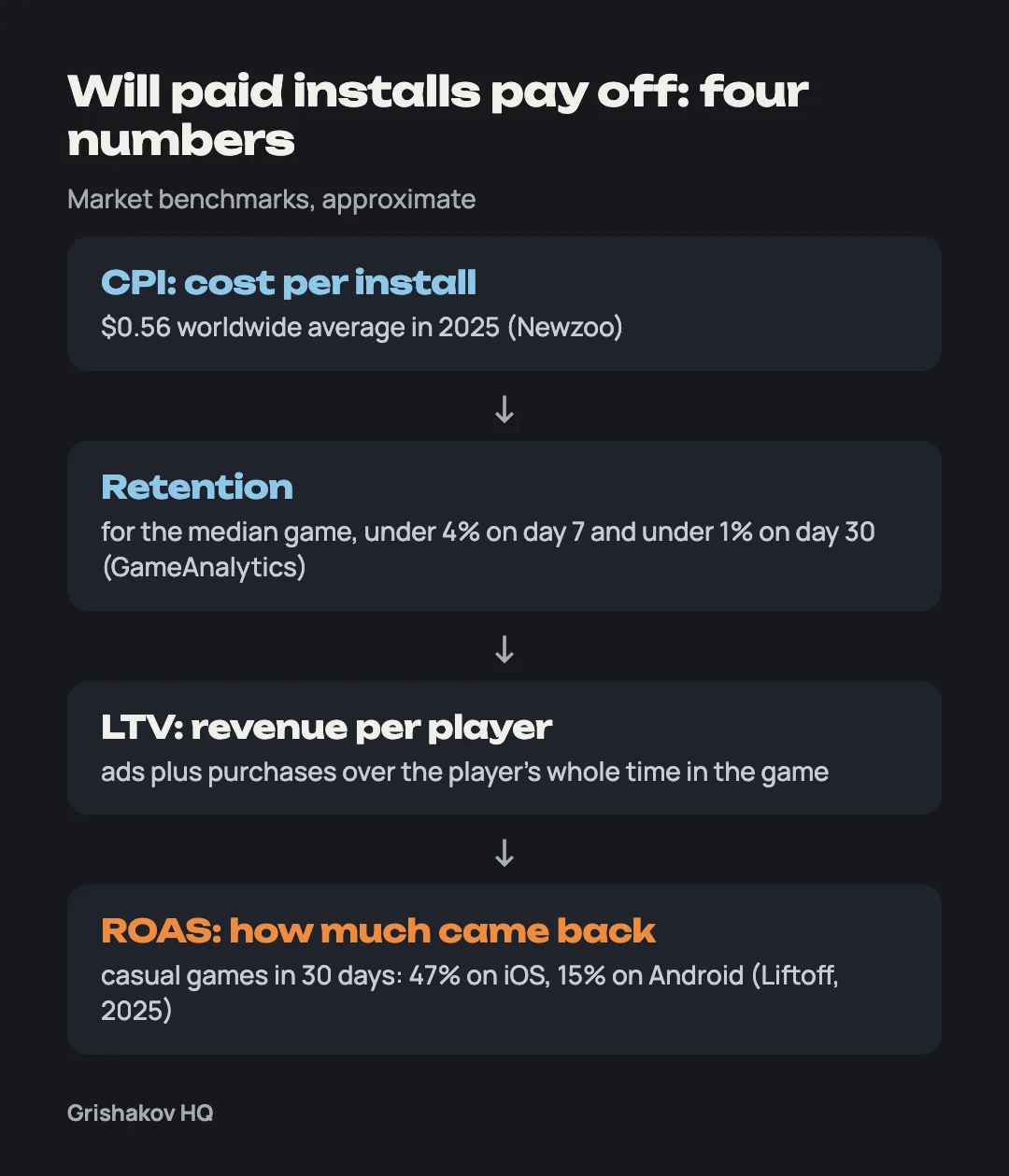
Paid user acquisition means advertising your game inside other apps. It pays off only if a player brings in more than their install cost. I judge it by four numbers:
- CPI, the cost per install. According to Newzoo, the average CPI worldwide grew by 30% in 2025, to $0.56. Our Survival after War got $0.27 per install in the US in a CPI test in July 2024.
- Retention, the share of players who come back on day 1, day 7, day 30. According to GameAnalytics for 2026, the median game keeps fewer than 4% of players on day 7 and fewer than one in a hundred on day 30.
- LTV, how much money a player brings in over their whole time in the game: ads plus purchases.
- ROAS, the share of what you spent on acquisition that has come back by a given day. According to Liftoff's 2025 report, casual games earn back on average 47% of the spend in 30 days on iOS and 15% on Android.
This shows why paid installs sometimes worked for us and sometimes did not. In April 2025 our mobile line spent $96,000 on ads and by early May had made $14,500 net profit. In November of the same year we had to cut spending from $20,000 to $7,000 a week because payback dropped. And for Merge Gangster Heist in 2026, paid installs "went down to zero." When I took that failure apart, I wrote that a game with little organic traffic "needs a really big LTV margin."
More on when to start buying installs and what payback target we hold is in the article on how to market an indie game.
Organic traffic and store packaging: growth for free
Our best months came from players who found the game themselves, through store search and recommendations. That is organic traffic.
Bunker 22 grew to $4,930 net a month on an organic spike. Nuclear Day, according to my July 2026 post, holds up the same way: "when we spend money on the ad budget, we buy at break-even, and we get the profit from organic growth." And as organic grows, so does the payback on paid installs: in May 2025 I wrote that together with Bunker 22's organic spike "the ad payback also jumped sharply."
Of the free tools, we rely most on A/B tests of the store packaging: icons, screenshots, descriptions. Only a minority of them win: in March 2023 we won 2 tests out of 18, in April 2 out of 11. But that same year I wrote that "any new icon that wins an A/B test can multiply organic": conversion to install goes up, and the store itself lifts the game in search.
Is making a mobile game worth it for an indie developer?
If you are making your first game and have no money for long paid acquisition, the mobile market is harsher than Steam. In July 2026 I wrote honestly about our mobile line: "Bad so far! We've been treading water for a year, and sometimes stagnating. Neural nets arrived, paid installs are getting more expensive, there isn't enough organic."
That said, our best months in mobile happened without a hit: mediation, tests of purchase prices and packaging, going to new platforms. What this looks like on browser platforms, I went through in how to publish a game on Yandex Games. For comparison, how much indie games make on PC is in how much indie games make on Steam, and what developers on a salary earn is in how much game developers make.
Frequently asked questions
How much do mobile games make a month?
Most make almost nothing: according to Sensor Tower, in 2025 games outside the top 1% shared 7.5% of in-app purchase revenue. Our games earned very differently: Bunker 22 brought in $4,930 net profit in April 2025, while Merge Gangster Heist made $86 on paid installs over the first quarter of 2026. Out of our 34 games on RuStore, two made almost all the revenue.
How much do mobile games make from ads?
Ad revenue is impressions divided by a thousand and multiplied by eCPM. In Russia in Q2 2024, an interstitial on Android paid about $4.52 per thousand impressions and a banner about $0.47; on iOS rewarded ads paid $11.44. In 2023 mediation gave us on average +150-200% to ad revenue, but ads have a ceiling: the more often one player sees them, the cheaper each next impression.
Which makes more money in a mobile game, ads or purchases?
For us the combination worked best. In the Bunker 22 test, a $7 purchase gave +89% to purchase income and +70% to ads compared with the $3 variant. And when we removed interstitial ads in Merge Gangster Heist for paying players and in the first 10 levels, revenue per player over the first week grew by 60%, although we are still relaunching that test.
How much do Google Play and the App Store take?
They take a fee on purchases only. Google Play takes 15% on the first $1M of revenue a year and 30% above that, with subscriptions at 15%. The App Store takes 15% under the Small Business Program if last year's revenue was up to $1M. RuStore takes 15%. Stores take no fee on ad revenue, which the ad network pays you directly.
How much does it cost to advertise a mobile game?
It is usually counted as the price of one install, CPI. According to Newzoo, the average CPI worldwide rose to $0.56 in 2025. Our Survival after War got $0.27 per install in the US in a CPI test in July 2024. It pays off only if a player brings in more: per Liftoff's 2025 report, casual games earn back 47% of the spend in 30 days on iOS and 15% on Android.
Is making a mobile game profitable for an indie developer?
It is harsher than Steam if you have no money for long paid acquisition. The median game keeps fewer than 4% of players by day 7, and paid installs pay off only when a player brings in more than their install cost. Our best months came without a hit, from organic traffic, mediation and A/B tests of prices and store packaging. In July 2026 I described our own mobile line as treading water for a year.
Sources
- "Global games revenue surpasses $200bn for the first time", PocketGamer.biz (Newzoo), 2026
- "Sensor Tower: The State of Mobile 2026", GameDev Reports
- eCPM in Russia in Q2 2024 (Tenjin, CAS.AI) (in Russian), wnhub, 08/26/2024
- "GameAnalytics: Mobile and PC game benchmarks 2026", GameDev Reports
- Liftoff, Casual Gaming Apps Report 2025
- Google Play, service fees (Play Console Help)
- Apple, App Store Small Business Program
- RuStore, "Monetizing mobile apps and games in Russia in 2026" (in Russian), 09/30/2026
- Yandex Games, license agreement, section 8.1 (in Russian)
- Evgeny Grishakov, "April results! How much we made in a month in game dev" (in Russian), YouTube, 05/09/2023
In summer 2026 we decided to spend 40-50% of our mobile effort on a new flagship project with a target of $10 in revenue per player. Do you think a mobile game can really reach numbers like that? I share how our mobile games are doing on X.
How our new mobile flagship goes
Evgeny on X