
How Much Do Indie Games Make on Steam, and How Many Break Even
When you are making your own game, the first thing you want to know is how much indie games make on Steam for small teams like yours. The news only covers the hits, and judging by them the market looks well fed. This article collects what is known about everyone else: GameDiscoverCo's open spreadsheet of January 2026 releases, Valve's own figures, Gamalytic and VG Insights data, and honest postmortems from developers.
I'm Evgeny Grishakov, I make and publish games, and our own numbers, from $432,000 gross for Meltopia to "$89 in the black" in China, are part of the picture too.
Our games' numbers as we go, including the awkward ones
Evgeny on XHow much does a typical indie game make on Steam?
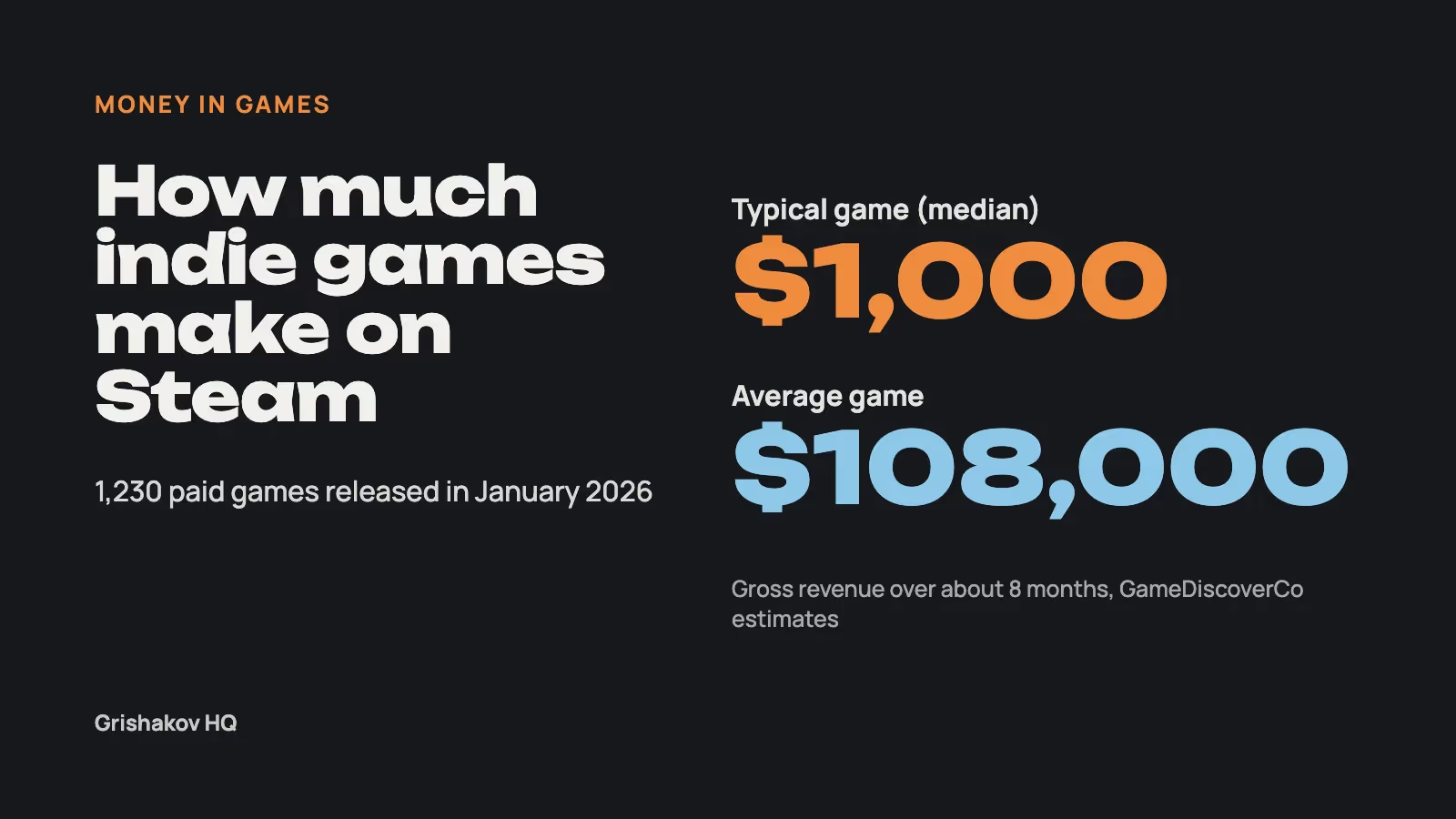
About $1,000 gross in its first eight months, if you look at the median: half the games earn more, half earn less, and for the bottom half the amounts are tiny.
The freshest open snapshot came from Simon Carless of GameDiscoverCo on September 15, 2026. He attached a spreadsheet with all 1,230 paid games released on Steam in January 2026 and an estimate of their lifetime revenue. It covers every paid release of the month, including a few big projects, and 690 of them carry the Indie tag, so this is the market indies launch into. The revenue is GameDiscoverCo's estimate: gross, before Steam's cut, refunds and taxes, and Steam only. Counted by threshold, it looks like this:
| Gross revenue | Games out of 1,230 | Share |
|---|---|---|
| $1,000 or more | 619 | 50.3% |
| $10,000 or more | 248 | 20.2% |
| $100,000 or more | 88 | 7.2% |
| $1M or more | 16 | 1.3% |
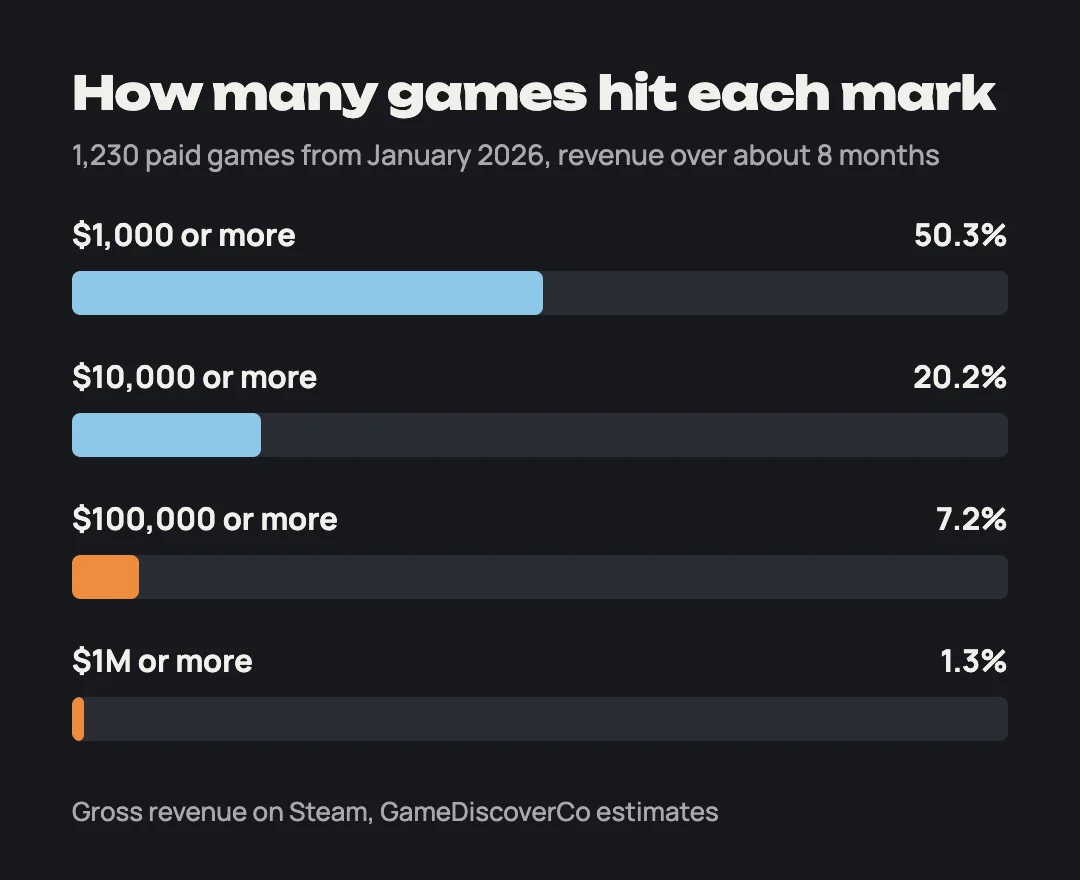
Almost half the games in the spreadsheet have revenue rounded down to zero, meaning less than about $500, and the median game sold around 100 copies.
Other services put the median even lower. Gamalytic looked at games released between January 1 and October 21, 2025: the median was $249, and 66% of games made less than $1,000 (as reported by 80.lv). Part of the gap is timing: Gamalytic's sample includes games with only a few weeks of sales, while GameDiscoverCo's January releases had about eight months. The services also estimate revenue differently, and only Valve knows the exact sales.
Why is the average Steam game revenue misleading?
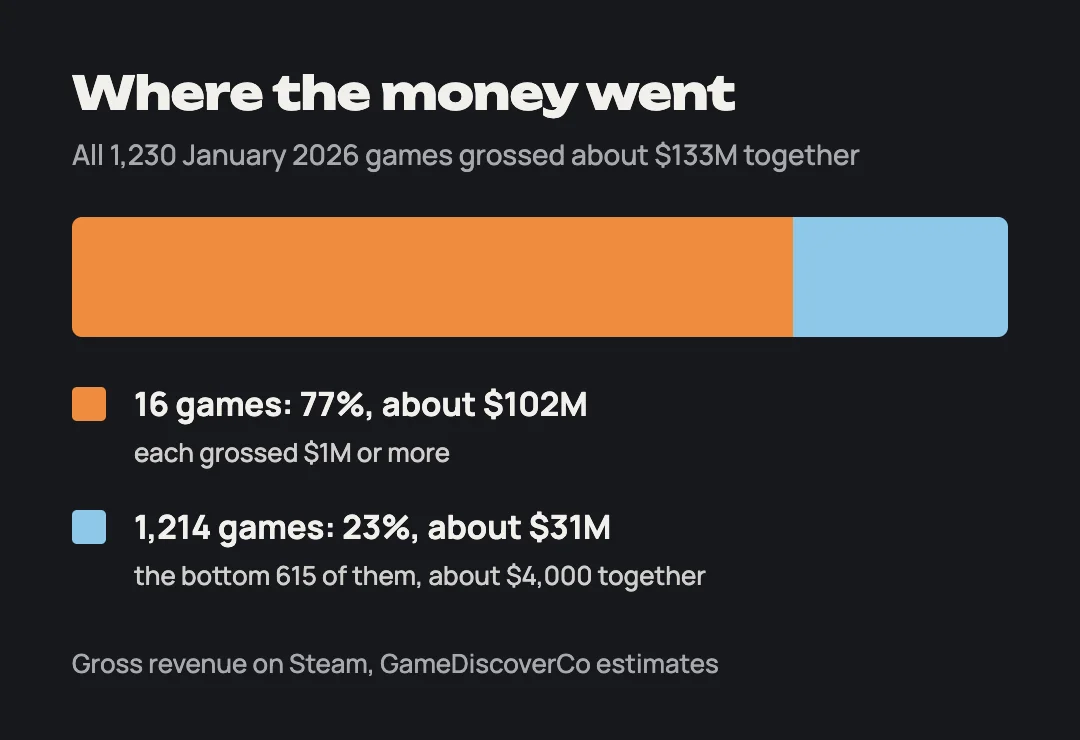
A few hits pull the average up: in the January spreadsheet it is about $108,000. Meanwhile the 16 games that made $1M or more took $102M of the $133M total, 77% of all the money, and the bottom 615 games made about $4,000 between them.
Gamalytic shows the same picture: for 2025 releases the average revenue is $358,900 and the median is $249. If someone tells you "the average indie game makes X", that is almost certainly a number only a small share of games ever reach.
In March 2026 at GDC, Valve said that 5,863 games earned more than $100,000 on Steam in 2025, almost twice as many as in 2020. That count includes games of any release year, old hits too. GameDiscoverCo estimates that about 1,700 of them were 2025 releases, roughly 8.5% of the 20,000 games launched that year, and about 600 new releases, around 3%, grossed more than $500,000 in their launch year.
Mike Rose of the publisher No More Robots worked out what that means for a team: "$100k revenue = roughly $50k to the dev, after Valve's cut + taxes. How many multi-person studios do you know that could survive after making $50k from their game launch? Not many!!" (quoted by Kotaku). I worked out step by step where that half goes in the article how much Steam takes from a game sale.
What percentage of Steam games make money back?
A small share, and the bigger the budget, the smaller it gets. Carless ran the numbers on the same January games:
- a $100,000 budget, self-published: by his estimate 80 games out of 1,230 would have broken even, 6.5%;
- a $500,000 budget of your own money: you need more than $1M gross to get $550,000 back net, and 16 games managed it, 1.3%;
- a $500,000 budget from a publisher: about 7 games, 0.6%, would have fully recouped under typical terms, by his estimate.
Carless notes that January is a quiet month, though even in strong months of 2026 only 20-30 new releases pass $1M, and the split stays similar.
Gamalytic found that 40% of 2025 games did not earn back even the $100 Valve charges to publish one game.
According to Carless, the business works if you are a publisher with a strong catalog, or a compact team that made something notable on a small budget.
I went through how budget and revenue line up for specific games, from one made with almost no money to a project worth several million dollars, in a separate video, and our games are in it too. The video is in Russian, and YouTube has an English dub track for it.
How much did our Meltopia make?
As of August 17, 2026, our Meltopia had grossed $432,000. It came out on May 1, so that is 108 days of sales. We made it inside a company with 125 people on the payroll, and Steam games are only one of our business lines, so our result does not carry over to a small team one to one. How much the developer personally earns, on a salary and on their own games, I covered in how much game developers make.
Around it we started building a set of smaller revenue streams: GOG, China, key stores. The goal is for that stream to work from day one when our next games launch. What has come of it so far is in how much Meltopia made in China and on GOG.
Does the price of a game affect how much it makes?
Strongly, but it is a correlation, and most likely it reflects who makes the game. Cheap games are more often hobby projects, while expensive ones are more often made by experienced teams with a budget.
Median gross and the share of games that reached $100,000 in the January spreadsheet, by base price without discounts:
| Price | Median | $100K or more |
|---|---|---|
| under $3 | $0 | 0% |
| $3 to $4.99 | $0 | 1.0% |
| $5 to $9.99 | $1K | 7.4% |
| $10 to $14.99 | $11.5K | 14.5% |
| $15 to $19.99 | $43K | 35.8% |
There are few games priced above $20 (44 out of 1,230), and they include big projects, so they are left out of the table.
GameDiscoverCo saw the same thing with 2024 games that sold at least 1,000 copies. Of those priced under $5, 1.7% reached about $1.43M in their launch year; of the $20-29.99 games, 19.2%; of games at $40 and up, 62%. Even that money may not be enough for an expensive game, because its development and marketing usually cost more.
What else do indie games that make money have in common?
Genre, publisher, studio experience and the first weeks after launch. On each of these, the data shows a clear difference in results.
Genre. In the January spreadsheet, 5.1% of games tagged Indie reached $100,000, Roguelike 11.1%, Deckbuilding 13.6%, Online Co-Op 23% (out of 61 games with that tag). Developers set tags themselves, so this is a signal of which kinds of games tend to find buyers. According to Chris Zukowski, among 2025 games with 1,000+ reviews, which usually means $150,000 or more in revenue, the most common were narrative games, simulators and horror.
Publisher. Among January games where the developer and the publisher are different companies, 18.7% reached $100,000; among self-published ones, 4%. Publishers pick promising projects in advance, so most of that gap is probably the selection itself. What a publisher does for its share, and whether an indie game needs a publisher at all, I covered separately.
The studio's game number. According to the VG Insights report for 2024, a studio's first indie game makes $120,000 on average, the second $168,000, the third and later ones $209,000. That is an average, also pulled up by hits, but the direction is clear. In the same report, VG Insights points to the makers of Lethal Company and Palworld: before their hits, both had released several games that earned much less.
Launch. Zukowski looked at every 2024 game with a weak launch, under 150 reviews in the first 30 days. Only 28 of them later climbed to 500+ reviews, 0.16% of all the year's releases. If a game did not sell in its first month, Zukowski advises starting the next one.
How much does an indie developer actually keep per month?
About half of gross, sometimes a bit more. GameDiscoverCo puts net revenue at 58% of gross; Carless broke down the deductions (refunds, VAT and Valve's 30%) separately back in 2020. How the road from gross to money in hand works, and how much each deduction eats, I showed in how to estimate how much a Steam game made.
At 58%, the January spreadsheet works out like this:
- the median game: $1,000 gross over eight months, about $580 net, about $70 a month;
- a game at the 90th percentile, better than nine out of ten: $50,000 gross, about $29,000 net, about $3,600 a month.
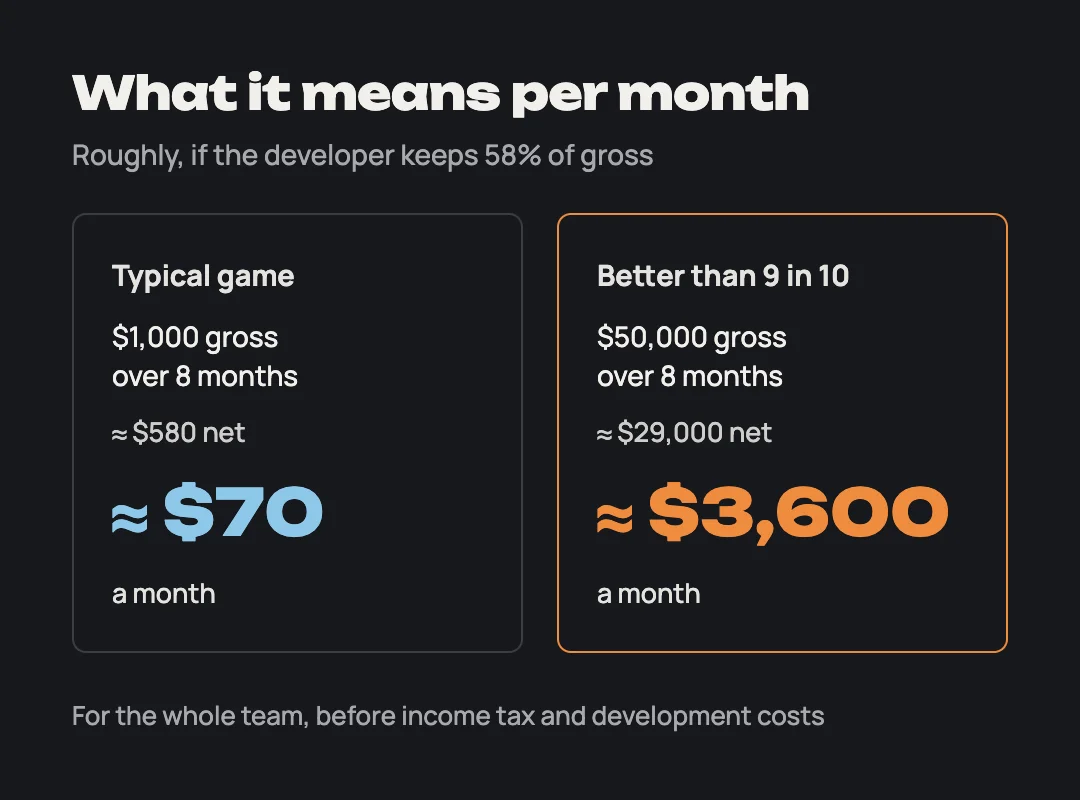
About 120 of the January releases did better than that mark. The money is split across the whole team, and it is before income tax and before development costs.
What do real indie game results look like?
Usually more modest than beginners expect. Developers rarely publish numbers, and more often after a success, but even the four open reports below range from $486 gross to $1.5M, and three of the four ended under $15,000:
- Dream Warrior (2024, $4.99): 167 wishlists at launch, 107 copies, $486 gross and about $120 profit.
- Godless (2024, 5 years of development): 6,668 wishlists, 472 copies and about $1,500 after taxes and Steam's cut.
- Extraneum (2024, 3 years of development): about 10,000 wishlists, about 2,400 copies and about $12,000 after all deductions.
- Thronefall (2023, early access): 315,000 copies, 6.9% refunds and just over $1.5M gross.
For Extraneum, 10,000 wishlists turned into about 2,400 copies sold over a year. The author called it a failure in the sense that he cannot live off games yet, and a success in that it gave him hope. Thronefall was made by Jonas Tyroller and Paul Schnepf, and Tyroller already had a big YouTube channel and released games behind him.
Robert of High Tower Games, the maker of Dream Warrior, explained why he posted his modest numbers: "Everyone loves sharing numbers from successes. Numbers from failures are harder to find."
How to apply these numbers to your own game
Plan your budget from the median and keep the good scenario separate. For a first game, the realistic baseline is revenue near zero plus experience, and $50,000 gross on Steam is already better than 90% of releases. That is why I advise keeping your first game small and testing interest before full production. How money works in mobile games, where income comes from ads and purchases, is in how much mobile games make.
The order is:
- Count what you spend on the game in money and time, and compare it with the thresholds: one game in five grosses $10,000, roughly one in fourteen grosses $100,000.
- Find 10-20 games of your genre and price released over the last year and estimate their revenue. Base your odds on them, not on the hits. How to do that from review counts I showed in the breakdown of the estimation method.
- Plan for several games: according to VG Insights, studios' second and third games earn more than their first on average.
- Prepare the launch early: in 2024, after a weak launch only 28 games reached 500+ reviews, 0.16% of the year's releases. How many wishlists a festival demo brings and how to prepare it is in Steam Next Fest: how to prepare a demo, and how many wishlists you need before launch and where they come from is in Steam wishlists.
Have you worked out how much your game needs to make to break even? And which line of the January table would you put yourself in?
Frequently asked questions
How much does the average indie game make on Steam?
It depends on what you call average. The median paid game among January 2026 releases grossed about $1,000 in eight months, and Gamalytic puts the 2025 median at just $249. The arithmetic mean for the same January games is about $108,000, but 16 hits that took 77% of all the money pull it up. So plan around the median, not the average.
How much money can an indie game make on Steam?
In GameDiscoverCo's January spreadsheet, roughly one game in five grosses $10,000, roughly one in fourteen grosses $100,000, and 1.3% of games reach $1M. A game at the 90th percentile, better than nine out of ten, grossed about $50,000, and about 120 of the 1,230 January releases did better. For a first game, $50,000 is already a very good result.
Do indie games make money back?
A small share do, and the bigger the budget, the smaller the share. By Carless's estimate on the same January games, with a $100,000 budget and self-publishing 80 games out of 1,230 would have broken even, 6.5%, and with $500,000 of your own money only 16 games, 1.3%. According to Gamalytic, 40% of 2025 games did not earn back even the $100 Valve charges to publish one game.
How much does an indie developer keep from Steam sales?
About half of gross, sometimes a bit more: GameDiscoverCo estimates net revenue at 58% of gross after refunds, VAT and Valve's cut. For the median game that is about $580 over eight months, about $70 a month; for a game better than nine out of ten, about $3,600 a month for the whole team, before income tax and development costs.
What decides whether a game makes money on Steam?
The data shows differences by price, genre, publisher, the studio's game number and the first weeks after launch. Games at $15-19.99 reach $100,000 in 35.8% of cases, while in the January spreadsheet none of the games under $3 did. With a publisher, 18.7% of January games reached $100,000; without one, 4%. And after a weak launch in 2024, only 28 games climbed to 500+ reviews, 0.16% of the year's releases.
Sources
- Simon Carless, "Is the game biz sustainable for the average indie dev?", GameDiscoverCo, 09/15/2026
- GameDiscoverCo, spreadsheet of paid Steam releases from January 2026 (attached to the 09/15/2026 post)
- Chris Kerr, "Valve says 5,863 titles earned over $100,000 on Steam in 2025", Game Developer, 03/11/2026
- Simon Carless, "What Steam's 2026 biz update tells us about the ecosystem", GameDiscoverCo, 03/13/2026
- John Walker, "Game Devs React To Valve's Boast Of How Few Profit On Steam", Kotaku, 03/16/2026
- Theodore McKenzie, "Steam's Getting More Games But Earning Less, Analysts Report", 80.lv, 10/22/2025
- Simon Carless, "The 'shape' of the PC new game market in 2024", GameDiscoverCo, 02/18/2025
- Simon Carless, "Most PC games gross <$1,000", GameDiscoverCo, 10/02/2023
- Simon Carless, "Game refunds & the hidden costs of 'getting to net' on Steam", GameDiscoverCo, 08/17/2020
- VG Insights, Global Indie Games Market Report 2024
- Chris Zukowski, "What the hell happened in 2025?", How To Market A Game, 01/27/2026
- Chris Zukowski, "Only 28 games recovered from a bad launch in 2024", How To Market A Game, 02/12/2026
- High Tower Games, "Dream Warrior postmortem", itch.io, 01/01/2025
- Danil Kalyupa, "I developed a game for five years and released it without ads or a publisher" (in Russian), DTF, 08/29/2024
- David Jalbert, "Extraneum post-mortem, one year later", itch.io, 10/21/2025
- Simon Carless, "Deep dive: how Thronefall went minimal", GameDiscoverCo, 10/04/2023
Right now we are getting Clear the Snow and Silicone Heart ready, two very different games, and soon we will see which part of this table each one lands in. I share how that battle goes on X.
Where Clear the Snow and Silicone Heart land, on X
Evgeny on X