
How Much Does Steam Take From Game Sales, and What the Developer Keeps
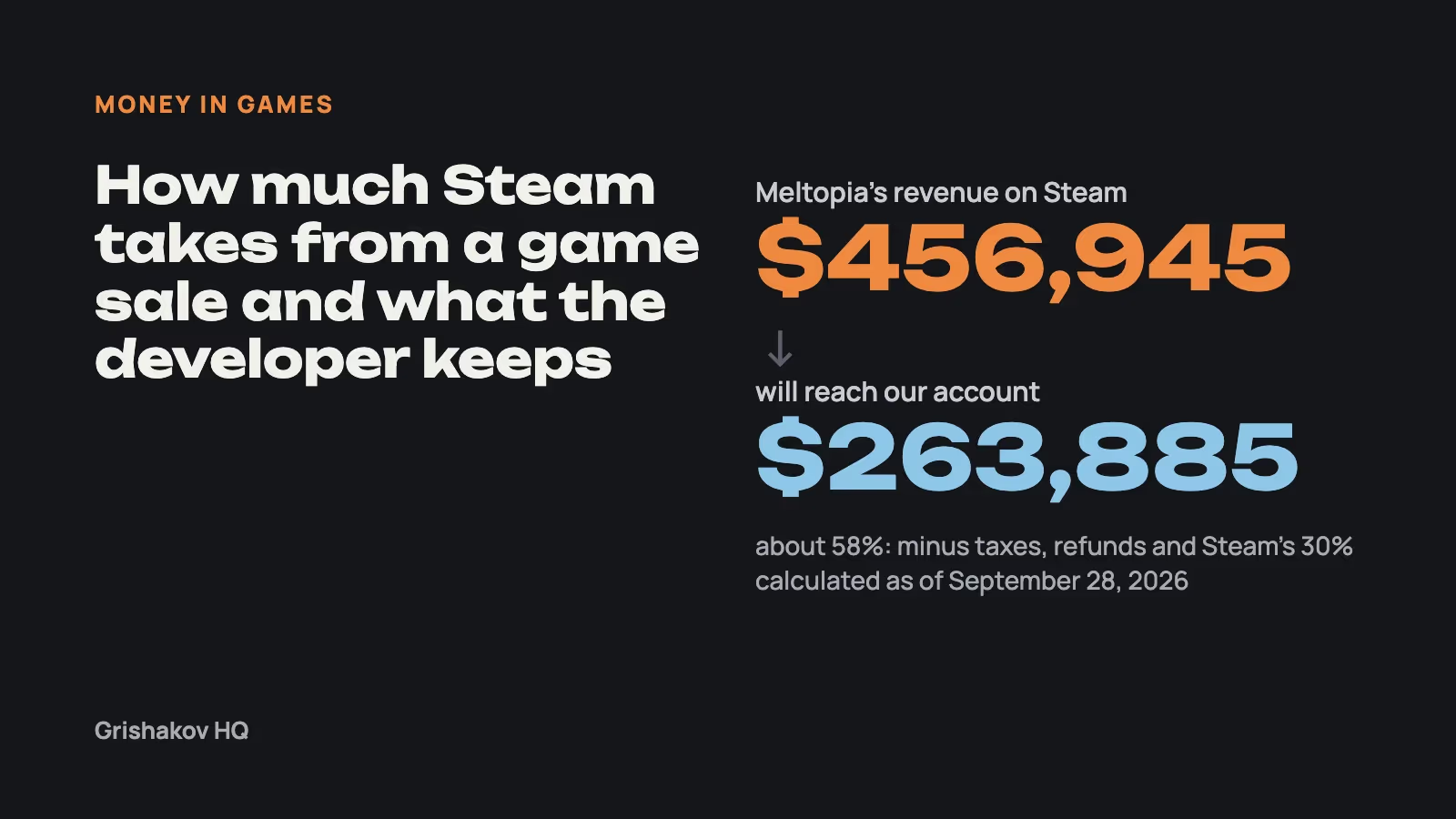
It's nice to show Meltopia revenue in the hundreds of thousands of dollars, but only a bit more than half of that money reaches us. So how much does Steam take from game sales, and what is left? Below is the whole path from the number in the Steam dashboard to money in the bank: by Steamworks rules and on our real numbers, with a step-by-step estimate for your own game at the end.
I'm Evgeny Grishakov, I make and publish games. I post the revenue, sales and refunds of our games on X as they come in, including the launches that didn't work out.
Revenue, refunds and payouts of our games as we go
Evgeny on XHow much does Steam take from game sales?
Valve's base share is 30%, the developer keeps 70%. Since 2018 there are tiers: once a game has made more than $10M on Steam, Valve takes 25% of the money above that amount, and after $50M, 20% of the money above it.
The tiers are counted separately for each game, together with its DLC and in-game purchases, and revenue counts from October 1, 2018.
The lower rate applies only to money above the threshold: every game pays 30% on its first $10M. When Valve announced the tiers, one developer pointed out right in the comments under the announcement that this does little for indies: most of them won't make even $10,000. So for almost every indie game, Steam's cut is simply 30%.
Valve's share itself has been challenged in court for several years: since 2021 there has been a lawsuit in the US led by Wolfire Games. In November 2024 the court allowed it to proceed as a class action: the class includes everyone in the US who, since January 28, 2017, paid Valve a commission on sales to US buyers. Until the case is decided, count with today's 30%.
What amount is the 30% taken from?
From net revenue, which Steamworks calls Net. The documentation puts it this way: Valve pays from Net Revenue, which is gross revenue (Gross) minus taxes, refunds and chargebacks. Gross includes VAT and sales tax. Net is multiplied by the developer's share, and withholding tax, if any, is subtracted from the result.
The chain looks like this:
- Gross: everything buyers paid, with VAT inside the price.
- Net: Gross minus VAT and sales taxes, refunds and chargebacks (payments reversed through the bank).
- Developer share: 70% of Net.
- Payout: the developer share minus US withholding tax, if any.
The number in the Sales & Activations report shows revenue before deductions. Valve itself says it includes no refunds, no chargebacks and no taxes, and the real amount to be paid is only visible in the monthly report. That's why the payout is always noticeably smaller than the number you want to show off.
How much will reach us from Meltopia: $456,945 step by step
About $263,885 of Meltopia's $456,945 Steam revenue should reach our account, almost 58%. This is my calculation from post #3441 as of September 28, 2026: by then we had sold 89,518 copies, and this is Steam revenue only, without other stores.
| Step | $ thousand, rounded |
|---|---|
| Steam revenue | 456.9 |
| Taxes (VAT and sales taxes), 8.5% | -38.8 |
| Refunds, budgeted with a margin at 9% | -41.1 |
| Net, Steam takes 30% of this | 377.0 |
| Steam's share, 30% | -113.1 |
| To our account, 58% of revenue | 263.9 |
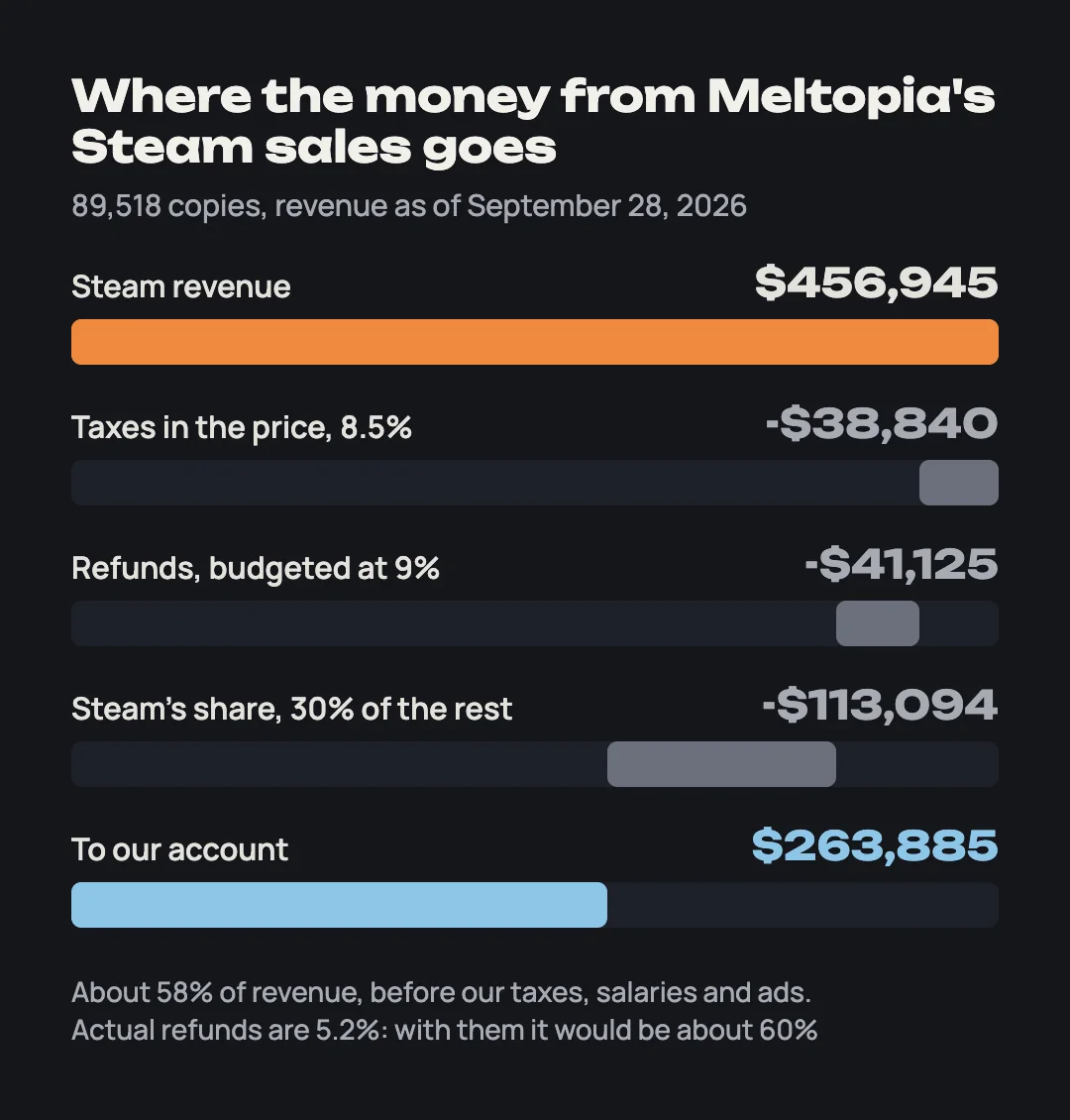
I count taxes at an average of 8.5%. The percentage jumps around all the time because it depends on the countries where the game is bought, but as an average level of loss it works.
For refunds I budget 9%, as in the calculations for our other projects, although Meltopia's refunds are 5.2%, and that is more of an exception. I take both shares in the table from the whole revenue, so if you recalculate step by step from the remainder, the numbers won't match exactly.
In the post I rounded the result to 57.5%, more precisely it comes to 57.75%. If you plug in the real 5.2% refunds, about $276,040 would reach the account, 60.4% of revenue, roughly $12,000 more.
The number is close to what Simon Carless of GameDiscoverCo worked out for the portfolio of the publisher No More Robots in 2020: from 56.5% to 59.5% of revenue in different months. I went through his model, also with 8.5% taxes and 9% refunds, in the article on how to estimate a Steam game's sales.
Out of this $263,885 we then pay our own taxes, staff salaries, ads and development of the next games. Once I already had to explain that we don't make "a million dollars net a month": the text was simply missing the word "revenue".
I showed how Meltopia sold in its first month, how many copies, how much revenue and in which countries, in a video. It is in Russian, and YouTube has an English dub track for it.
I post fresh reports on our games on Steam, consoles and other stores on X, without rounding them in the flattering direction.
Fresh reports on our games, no flattering rounding
Evgeny on XHow much goes to taxes in the price, and why revenue per copy is below the price
Taxes take 8.5% of our revenue on average, and revenue per copy is noticeably lower than the store price. Steam prices already include VAT in every country where Valve collects it, and that tax is subtracted before Steam's share. The more purchases come from high-VAT countries, the smaller the Net. US and Canadian sales tax works differently: it is added on top at checkout.
Rates in Valve's table vary a lot: 19% in Germany, 20% in the UK and France, 22% in Russia, 23% in Poland, 16% in Kazakhstan, 10% in Japan. A €10 purchase in Germany gives a Net of about €8.40, and the developer keeps about €5.88 of it, before refunds.
The second reason revenue per copy is below the price is regional pricing and discounts. Steam prices are set in 37 currencies, and for countries with lower purchasing power Valve recommends prices below the US ones.
Meltopia costs $6.99 and launched with a 40% discount at $4.19. In the first week, the US accounted for 28% of sales, Russia 16%, Germany 11%, Kazakhstan 6%. By my recalculation, in the first day and over the first week one copy brought in $3.99 of revenue on average, and by the end of September $5.10.
What is the average Steam refund rate?
Meltopia's refunds were 5.2% by the end of September, and the median in a GameDiscoverCo survey is 9.5% of copies sold. A game can be refunded within two weeks of purchase if it was played for less than two hours, and sometimes Valve refunds outside that rule too.
Refunds pile up until the two-week window closes, so in the first days the number is deceptively low. For Meltopia it grew like this: 1.4% a few hours after launch, 2.5% over the first day, 3.9% on day four, 4.7% after a week and 5.2% by September 28. For comparison, our early game Bunker 21 had 79 sales and 5 refunds when the first stream about it came out.
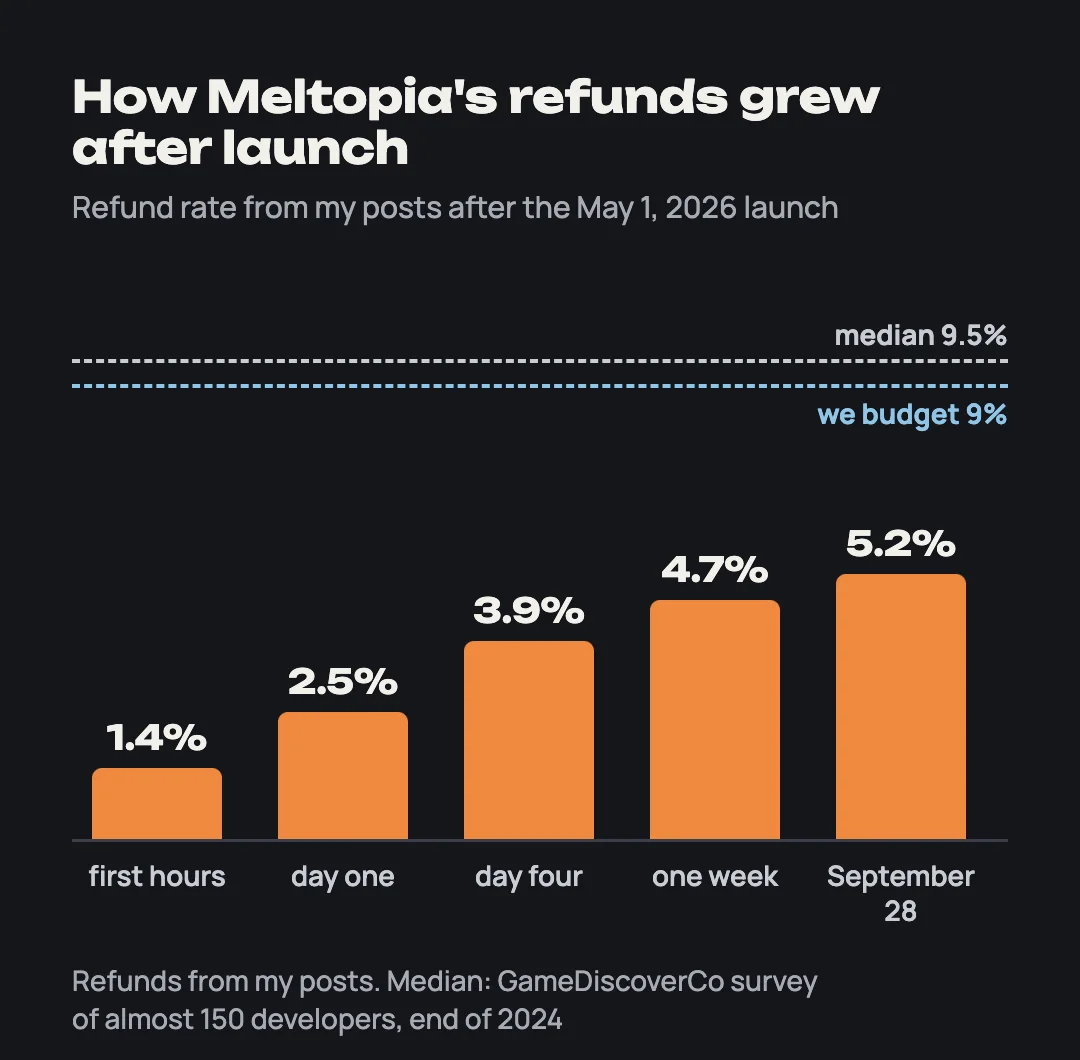
At the end of 2024 GameDiscoverCo surveyed almost 150 developers: the median share of refunded copies over a game's lifetime was 9.5%, the average 10.8%. My 9% is close to that median. Yours will depend on the game's quality and playtime length. Valve separately warns that in weekly stats after a discount the refund rate usually spikes: sales have already dropped, while people who bought during the sale are still refunding.
You can see your refunds in Steamworks: Sales & Activations, the game's package page, the Refund Data section. It shows the share by week and month, reasons by category and the texts players write when they refund. Steam counts the share as the number of refunded copies in a period divided by the number bought in the same period.
Steam tax form and US withholding tax: up to 30% more
US tax withholding is a separate deduction after Steam's share, and it is only calculated on the part of your share that came from US sales. The rate is 0% to 30%. Which one you get depends on how you completed the tax interview in Steamworks and whether your country has a tax treaty with the US. This is my retelling of Valve's and the IRS's rules for general understanding; for your own situation, go to a tax advisor.
You complete the tax interview when you register in Steamworks. US companies and citizens need W-9 information, companies and citizens of countries with a US tax treaty need W-8BEN information, and verification, according to Valve's onboarding page as of October 2026, may take up to 30 days. If there is no treaty with the US, Valve has to withhold 30% and pay it to the US tax service (IRS). If the treaty benefit is confirmed later, Valve does not return what was withheld before.
In post #3441 I put it this way: if your tax form was filed wrong and Steam is taking territorial withholding, write to support, submit the tax form and get rid of all the extra deductions.
What losing a treaty looks like in practice: in August 2023 Russia suspended most of its tax treaty with the US, and in response the US stopped applying its benefits to payments from August 16, 2024. Valve then emailed partners that for tax residents of Russia the withholding rate changes to 30% instead of the treaty's 0%. Habr published a quote from that letter on August 17, 2024. At the time I wrote about "an extra 30% in taxes" too, and that it was very harsh.
By Valve's rules, withholding is calculated on the US part of the developer's share, and App2Top clarified at the time that it applied only to US sales. If the US makes up a quarter of your share, 30% of it is about 7.5% of the whole payout. How much of your game's share comes from the US is in the US Share column of the monthly report.
How often does Steam pay developers, and what else gets lost on the way
Steam pays once a month, by the 30th of the following month: money for February arrives at the end of March. While the developer's share is under $100, the payout may be held until the next month. Payments are only in US dollars, by bank transfer, and Valve does not control intermediary bank fees. If you change banks, do it before the 15th, otherwise the payout may be held until the next cycle.
The Steam Direct fee, $100 per new game, is non-refundable, but Valve pays it back: the amount comes as a separate line in a payout after the game makes $1,000 in adjusted gross revenue. The other payments and deadlines on the way to launch, from registering in Steamworks to the Release button, are in the article on how to publish a game on Steam.
Money also gets lost on currency conversion. Some stores pay us in currencies other than dollars, while almost all our expenses are in dollars, and once I lost €1,000 on two currency exchanges through euros. Every such inefficiency is a small hole in our money glass that lets money slowly leak out every month, so my next goal was to bring conversion losses down to a minimum.
How much do other stores leave: our numbers
By our reports, Steam leaves almost 58% of revenue, consoles 70% after their share, and RuStore, by my recalculation, 76.6% after its commission and our tax. But each store has its own share, its own deductions before it and its own kind of report, so you can't compare the percentages head to head.
| Store | What we see | What it is after |
|---|---|---|
| Steam, Meltopia | 58% of revenue | after taxes, refunds and 30% |
| GOG, Meltopia | "net" almost 58% of revenue, we expect about 70% of that to arrive | what was deducted from revenue, I didn't specify in the post |
| Switch and PS, our Survival After War | 70% | after the platform's 30% |
| RuStore, our mobile games | 76.6% | after 17.65% and 7% tax |
On GOG, by September 29 we had sold 554 copies of Meltopia, and 5 of them were refunded. "Net" there was $2,166.5 of $3,748, and how much would land in the account was still unclear in post #3458; I expected about 70% of that amount. For our Survival After War on consoles it came out to almost exactly minus 30%: on Switch, "revenue before the store's commission" of $3,390 became $2,375 of net income.
RuStore, a Russian Android app store, has a smaller commission, 17.65%, but in my calculation for our games there I also subtracted our 7% tax right away, so that number is closer to money in hand. More on GOG and sales in China is in the article on selling games outside Steam.
How to estimate the payout for your own game
To estimate the payout, subtract taxes, refunds and Steam's share from revenue, and if your withholding rate is not 0%, also the withholding on the US part. Here is how our scheme looks:
- Take the game's revenue for the month from Sales & Activations.
- Subtract taxes: if you don't know your country mix, use an average of 8.5% of revenue.
- Subtract refunds: your own rate from Refund Data, or 9% of the same revenue to be safe.
- Multiply what's left by 0.7. That is the developer's share until the game makes $10M.
- If your withholding rate is not 0%, subtract it from the US part (the US Share column).
- Check yourself against the monthly Steamworks report, where all deductions are already applied, and budget for bank fees and the exchange rate.
On $10,000 of revenue this scheme gives $5,775 before withholding and banks. If more of your buyers are Europeans with their high VAT, or more purchases are discounted, it will be less.
The most common mistakes in these calculations:
- comparing the Sales & Activations number with the payout and panicking: the first is before deductions;
- counting the 30% from the store price or from the amount with VAT;
- taking US withholding tax for a second Steam cut on all revenue;
- doing the tax interview at the last minute, although Valve will not return what was withheld at the old rate;
- calling the money in the account profit, when your own taxes, salaries and ads still come out of it.
If you need to estimate how much someone else's game made, that is a different task: I went through the review-based formula and checked it on Meltopia in the article on how to estimate a Steam game's sales. What share of indie games reach meaningful money at all is in the article on how much indie games make on Steam. And if a publisher releases your game, what amount its share is counted from is decided by the contract: more in the article on whether an indie game needs a publisher.
About 58% of revenue stays with us, the rest goes to taxes, refunds and Steam, which runs the store and payments around the world. Is that a fair split, what do you think?)
Frequently asked questions
What percentage does Steam take from developers?
Valve's base share is 30%, the developer keeps 70%. Once a game has made more than $10M on Steam, Valve takes 25% of the money above that amount, and after $50M, 20%, and the tiers are counted separately for each game together with its DLC. Every game pays 30% on its first $10M, so for almost every indie game Steam's cut is simply 30%.
What amount does Steam take its 30% from?
Not from the store price, but from net revenue, which Steamworks calls Net: gross revenue minus VAT and sales taxes, refunds and chargebacks. Steam prices already include VAT, and it is subtracted before Valve's share. A €10 purchase in Germany, with its 19% VAT, gives a Net of about €8.40, and the developer keeps about €5.88 of it, before refunds.
How much money actually reaches the developer?
For our Meltopia, by my calculation as of September 28, 2026, about $263,885 of $456,945 in Steam revenue will reach our account, almost 58%. The rest goes to taxes in the price, 8.5% on average, refunds, which I budget at 9% to be safe, and Valve's 30%. For No More Robots' portfolio in 2020, Simon Carless calculated a similar 56.5-59.5% of revenue.
How and when does Steam pay developers?
Once a month, by the 30th of the following month: money for February arrives at the end of March. Payments are only in US dollars by bank transfer, and Valve does not control intermediary bank fees. While the developer's share is under $100, the payout may be held until the next month, and if you change banks, do it before the 15th, otherwise the payout also moves to the next cycle.
Does Steam withhold US tax from developer payouts?
It can, from 0% to 30%, and only on the part of your share that came from US sales. The rate depends on your Steamworks tax interview and on whether your country has a tax treaty with the US: without one, Valve has to withhold 30%. If the US makes up a quarter of your share, that is about 7.5% of the whole payout. This is a retelling of the rules; for your own case, see a tax advisor.
How much does it cost to put a game on Steam?
The Steam Direct fee is $100 per new game. It is non-refundable, but Valve pays it back: the amount comes as a separate line in a payout after the game makes $1,000 in adjusted gross revenue. After that come the deductions from sales: taxes, refunds and Valve's 30%, and on $10,000 of revenue my scheme gives $5,775 before US withholding and bank fees.
Sources
- Valve, Steamworks: New Revenue Share Tiers, 11/30/2018
- Comments on Valve's revenue share announcement, 2018
- Steamworks Documentation: Taxes FAQ
- Steamworks Documentation: Reporting and Payments
- Steamworks Documentation: Reporting and Payments FAQ
- Steamworks Documentation: Onboarding (tax interview)
- Steamworks Documentation: Steam Direct Fee
- Steamworks Documentation: Developer Refund Reporting
- Steamworks Documentation: Pricing
- Steam Refunds policy
- IRS, Russia - Tax Treaty Documents
- Habr, Steam starts charging Russian developers a 30% tax (in Russian), 08/17/2024
- App2Top, withholding applies only to US sales, 08/19/2024
- GameDiscoverCo, "Steam refunds: how many should you expect?", 02/04/2025
- Simon Carless, "Game refunds & the hidden costs of getting to net on Steam", Game Developer, 08/17/2020
- TechSpot, antitrust lawsuit against Valve gains class action status, 11/29/2024
- Evgeny Grishakov, "How much MELTOPIA made in ONE MONTH" (in Russian, English auto-dub), YouTube, 06/25/2026
I break down new payouts, refunds and sales of Meltopia, Silicone Heart and Clear the Snow on X as the reports come in.
How Meltopia, Silicone Heart and Clear the Snow keep earning
Evgeny on X