
How to See How Much a Game Made on Steam, and How Wrong the Estimate Is
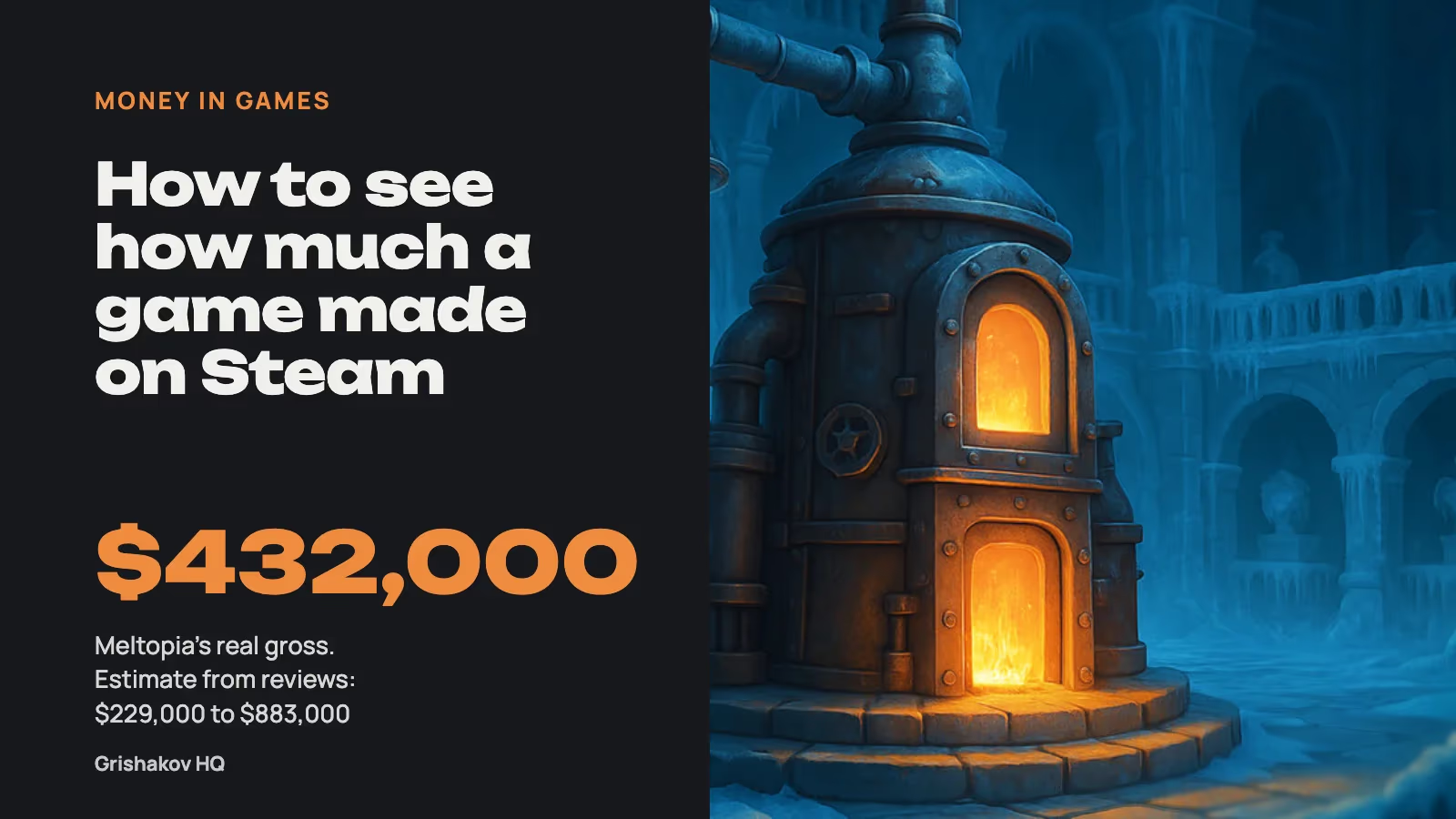
When you pick a genre for your next game, or hear that "this indie made a million on Steam", you want to know how much the game really made. Here is how to see how much a game made on Steam: not exactly, but as an estimate, and the method is easy to test on our own Meltopia, because we know the answer in advance: as of August 17, 2026, the game had grossed $432,000.
I post the numbers of our games on X, including the funny ones, like being "$89 in the black" after a summer in China.
Our games' numbers as we go, including the awkward ones
Evgeny on XHow to see how much a game made on Steam: can you get the exact number?
No. Only the game's owner sees exact sales on Steam, in the Steamworks partner dashboard. Steam has no public revenue counter, and everything analytics sites show is an estimate.
Real numbers appear only when developers publish them themselves. Valve allowed this directly in an announcement on November 30, 2018: a partner can share their game's sales data however they see fit. So the most reliable source is postmortems, reports and interviews from the developers themselves, and for all other games you calculate an estimate.
How to estimate Steam game sales from reviews
You estimate sales from the number of reviews, because roughly every Nth buyer writes one. N is called the multiplier, and the trick itself is known as the Boxleiter method, after developer Mike Boxleiter. I could not find his original text: in 2015 Jake Birkett wrote that developer Ryan Clark had passed the idea on to him, citing Boxleiter.
The steps:
- Find the total number of reviews. The number in the summary on the game's page can be lower than the full count, because not every review is counted there. The full count comes from Steam's open API: the request
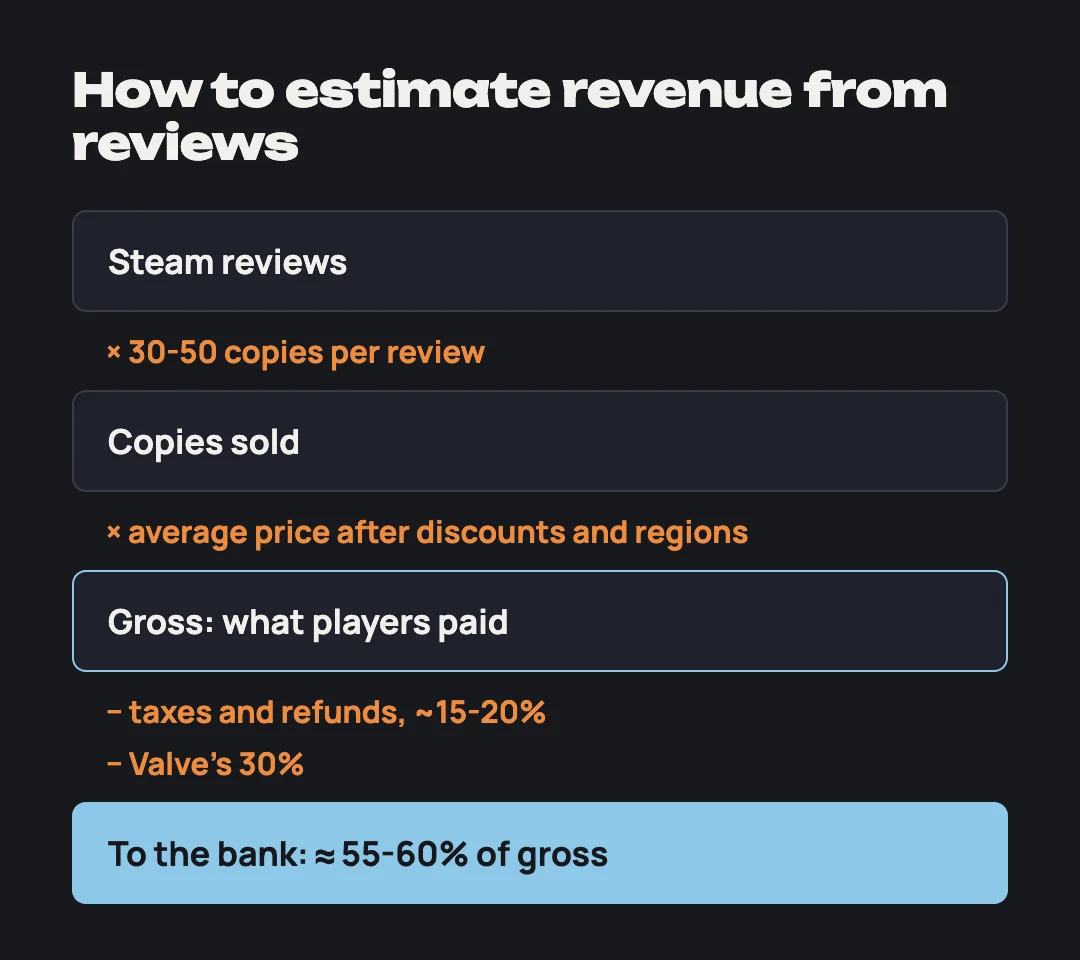
store.steampowered.com/appreviews/<game id>?json=1&language=all&purchase_type=allreturns atotal_reviewsfield, and the game id is in its store page address. - Pick a multiplier. For games released in 2022-2026, use 30-50 copies per review; games selling tens of thousands of copies are closer to the top of that range.
- Multiply reviews by the multiplier. That is your estimate of copies sold.
- Multiply copies by the average price people actually paid. It is almost always lower than the US price, because games sell at a discount, and in Russia, Turkey, Brazil and other regions prices are lower.
For example, a game has 2,000 reviews. With a multiplier of 40 that is about 80,000 copies. If the price is $10, and discounts and regional prices eat a third of it, you get about $530,000 gross, and that is still far from the money in the developer's bank account.
Which review multiplier to use in 2026?
For recent games, use 30-50 and treat the result as a range. The multiplier drops every year: at the end of October 2019, Steam started prompting players to leave a review itself, and there are now more reviews per sale.
| Who counted | When | Sample | Multiplier |
|---|---|---|---|
| Jake Birkett | 2018 | 50+ paid indie games | average 82, median 77, range 30-150 |
| GameDiscoverCo | 2020 | 237 games | average 63, median 58; 2020 games: median 38 |
| GameDiscoverCo | 2022 | ~200 games from 2020-2022 | 2022 median 29 |
| Gamalytic | 2023 | ~120 games with public sales | median about 35 |
The year is not the only factor. For very small games (under 1,000 copies sold), GameDiscoverCo counted about 20 copies per review in 2022; for games selling 50,000-100,000 copies, about 59. Short games and games that are often sold at a deep discount collect fewer reviews per sale, so their multiplier is higher. Story games, on the other hand, get discussed more eagerly and have more reviews per sale.
The spread remains even if you pick the multiplier carefully. About his sample, Birkett wrote: "So if you use the median of 77x, you might have overestimated or underestimated by about 2x."
I post our own sales on Steam, GOG and in China on X, and they are handy for checking any estimate against.
Which tools show a Steam game's revenue estimate?
Gamalytic and VG Insights show revenue in dollars. SteamDB and SteamSpy give you data for the calculation, but they have no revenue estimate of their own.
| Tool | What it shows | Revenue | Access | Caveats |
|---|---|---|---|---|
| SteamDB | prices by region, discount history, reviews, player counts, wishlist rankings | no, takes owner estimates from third-party services | free, part of the history after login | the site itself warns that the data is provided as is |
| SteamSpy | owners as a range, player counts, playtime | no | free | almost useless for small games since profiles were made private in 2018 |
| Gamalytic | copies, owners, gross revenue, countries | yes, before Steam's cut, with discounts and regional prices, base game only | partly free, API on paid plans | by their own tests, 77% of estimates fall within ±30% |
| VG Insights | copies, revenue, audience | yes | now opens inside Sensor Tower, login required | no data without login |
| PlayTracker | owners and active players across platforms | no | free trial | method not disclosed |
The "owners" these tools show include giveaways, bundles and keys, so there are more of them than copies sold. Gamalytic's revenue is before Steam's share, so it is gross.
How many copies did Meltopia sell, and how wrong is the estimate?
On Meltopia the method misses by tens of percent. The game came out on May 1, 2026, and by August 17 it had grossed $432,000. Steam's open API lets you count how many reviews it had by the same date: about 1,640. Now, at the end of September, it has 1,743.
If you put those 1,640 reviews and the US price of $6.99 into the formula (copies = reviews × multiplier), you get this:
| Multiplier | Revenue at $6.99 | Error vs real gross |
|---|---|---|
| 20 | $229,272 | -47% |
| 30 | $343,908 | -20% |
| 35 | $401,226 | -7% |
| 50 | $573,180 | +33% |
| 77 | $882,697 | +104% |
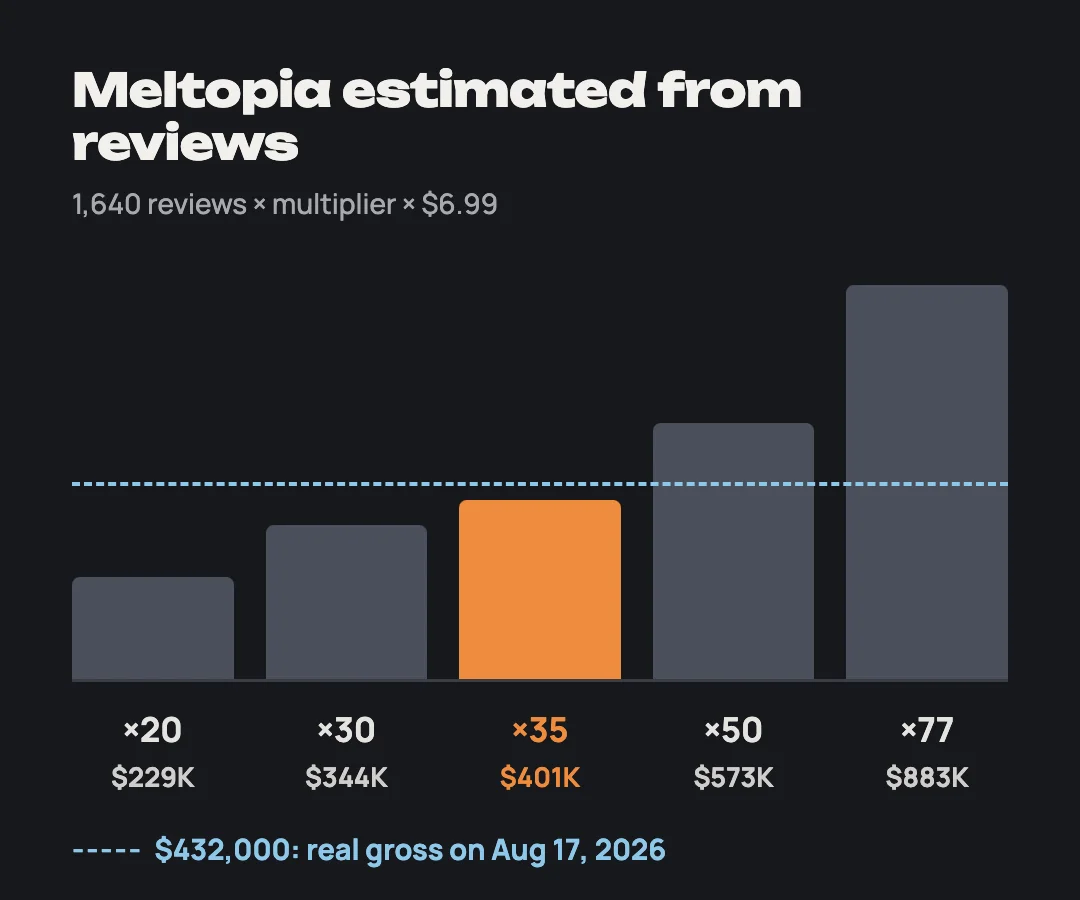
The multiplier of 35 came closest to $432,000, and it got there by accident. In our post about China we wrote that 330 sales there were 0.4% of all the game's sales, and by Steam's country table that share is in units (details in the breakdown of how much Meltopia made in China and on GOG). Going by that share, there were somewhere around 73,000-94,000 copies by September 11. The game had 1,718 reviews on that date, so by this rough count Meltopia's multiplier is about 43-55.
So the formula "35 × full price" landed almost exactly, even though it was wrong twice. It counted fewer copies than there were, and it took a higher average price than the real one: the game launched at a 40% discount for $4.19, in Russia it costs about $3.60, and right now every fourth review is written in Russian. By the same rough count, a copy brought in about $5-6 on average at a $6.99 price. Here the two errors cancelled each other out, but on another game they can push in the same direction.
Ruble amounts in this article are converted to dollars at the Bank of Russia rate for October 22, 2026, about 82 rubles per dollar.
How many copies Meltopia sold in its first days and how many reviews it had at that point, I said in a video in mid-May, a couple of weeks after launch. The video is in Russian, and YouTube has an English dub track for it.
For Meltopia, SteamSpy shows 0 to 20,000 owners, so for small 2026 games it simply has no data.
How much of the gross reaches the developer?
Roughly 55-60% of gross, if you count Steam only. The rest goes to taxes, refunds and Valve's share, and the publisher's share and the developer's own taxes come off after that. There is a separate article on how much an indie game publisher takes and what amount their share is counted from.
Valve takes its share from what is left: VAT and sales taxes, refunds and chargebacks come off the gross first. I went through these deductions step by step on Meltopia's revenue, along with the tax form and payout timing, in the article on how much Steam takes from a game sale.
The "gross" figure a developer sees in the Steamworks sales report does not include these deductions yet. The detailed breakdown is only in the monthly report. So when a developer names their gross, they are naming the amount players paid, and their own income is noticeably smaller.
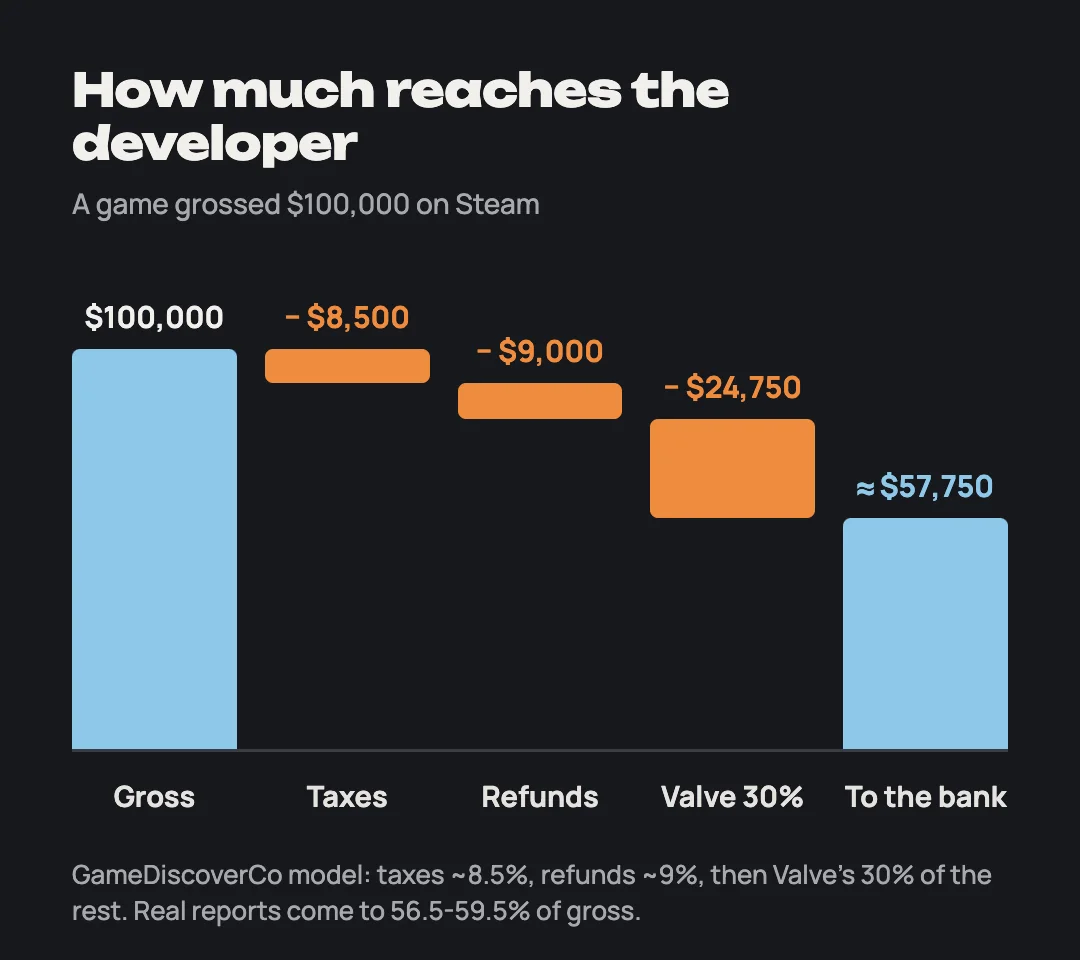
Simon Carless of GameDiscoverCo worked out how much is left in practice, using the catalog of the publisher No More Robots: refunds took 6.5-11% of dollar revenue, VAT and sales taxes about another 8-9%, and after Valve's 30% that came to 56.5-59.5% of gross. From a game that grossed $100,000, the developer gets roughly $56,500-59,500 before their own taxes and partner payouts.
The path from gross to net shows up in the GOG report for Meltopia's first four days in that store:
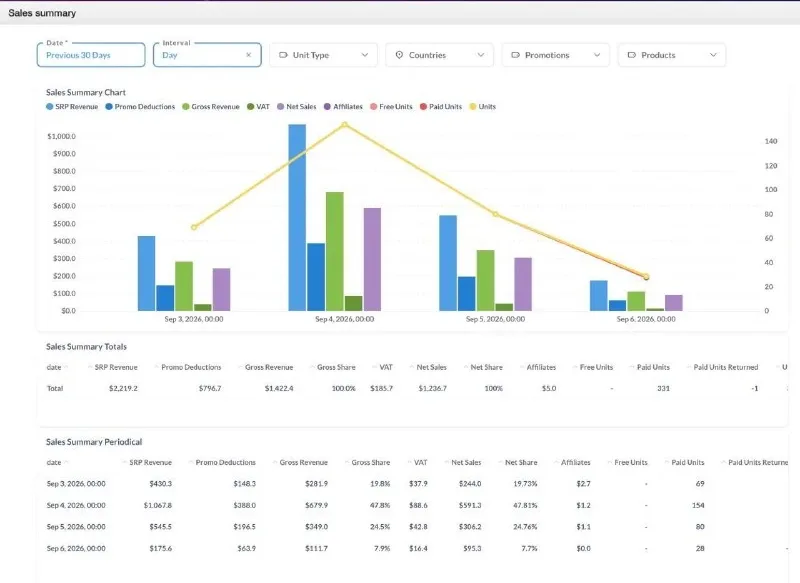
- sales at the suggested retail price: $2,219;
- discounts: $797;
- gross: $1,422;
- VAT: $186;
- net sales: $1,237.
From the "shelf" amount to net sales, 56% made it through, and the store's share has not been taken out of that yet. Over those four days we made roughly $800-900 net. Not a lot, but not nothing either. Steam China looks similar: out of $1,087 in revenue, $575 should reach our account after tax.
In our bet with fellow developers Alexey Gorbatov and Alexey Efremenkov over who makes more on Steam, the rule about net money is written down separately. Efremenkov put it this way: only the part of the money a participant can put in their own pocket after paying all partner shares counts.
What mistakes break a Steam sales estimate most often?
Price and the confusion between gross and income shift the estimate the most. Six mistakes keep coming up in breakdowns and discussions:
- Multiplying copies by the full US price and forgetting discounts and regional prices. On Meltopia, by the rough count above, the full price overstates the average price by about 15-45%.
- Using one multiplier for every game, although it depends on release year, size and genre.
- Trusting SteamSpy for small games, for which it has almost no data after 2018.
- Confusing owners with copies sold, although owners include giveaways, bundles and keys.
- Comparing today's review count with revenue at an older date. Meltopia's reviews grew by about 6% between August 17 and September 25.
- Taking the gross from a tool or a news story as money in the developer's account, and calculating Valve's 30% from the amount including VAT.
How to use an estimate without fooling yourself
Calculate a range and check it at least two ways: a single number without a range tells you nothing. For one game it looks like this: reviews × 30 and × 50, multiplied by a price 30-40% below the US price. If Gamalytic has an estimate, compare it with your range, and if the game's author published numbers, use those and keep the formula for everything else.
Reviews appear only after launch; before that, you see demand in wishlists. I covered how many wishlists Steam Next Fest brings and how to prepare a demo for it in a separate article.
And look at the market as a whole. By GameDiscoverCo's estimate, of the 1,230 paid games released on Steam in January 2026, 16 grossed more than $1M, that is 1.3%. With a $100,000 budget and self-publishing, only 80 games, or 6.5%, would have broken even. The full breakdown of that data, by thresholds and break-even, is in the article on how much indie games make on Steam.
Have you estimated other games like this before choosing a genre? And if you know your own game's real sales, how many times more copies do you have than reviews?
Frequently asked questions
How can I see how many copies a game sold on Steam?
Only the game's owner sees the exact number, in the Steamworks dashboard; from the outside you can only estimate it. Take the full review count from Steam's open API (the total_reviews field) and multiply it by 30-50: that is roughly how many copies there are per review for games released in 2022-2026. The "owners" figures from tools do not work for this, because they include giveaways, bundles and keys.
Does SteamDB show a game's sales and revenue?
SteamDB has no revenue estimate of its own: it shows prices by region, discount history, reviews, player counts and wishlist rankings, and takes owner estimates from third-party services. Gamalytic and VG Insights show revenue in dollars, and Gamalytic's figure is gross, before Steam's share. SteamSpy is almost useless for small games after 2018: for Meltopia it shows 0 to 20,000 owners.
What review multiplier should I use to estimate Steam sales?
For games released in 2022-2026, use 30-50 copies per review and treat the result as a range, not one number. The multiplier drops every year: Birkett's median in 2018 was 77, GameDiscoverCo's for 2022 was 29, and Gamalytic's in 2023 was about 35. For very small games it is closer to 20, and for games selling tens of thousands of copies it is closer to the top of the range.
How accurate is a revenue estimate based on reviews?
The error can be up to 2x either way, as Birkett already wrote about his sample. On Meltopia, a multiplier of 30 gave -20% against the real gross, 50 gave +33%, and 35 landed almost exactly, but by accident: the formula undercounted copies and overstated the average price, and the two errors cancelled out. By Gamalytic's own tests, 77% of its estimates fall within ±30%.
How much of Steam sales reaches the developer?
Roughly 55-60% of gross. VAT and sales taxes, refunds and chargebacks come off the gross first, and only then does Valve take 30% of what is left. Under GameDiscoverCo's model, from $100,000 gross the developer gets roughly $56,500-59,500 before their own taxes and partner payouts. I went through the deductions step by step in the article on how much Steam takes from a game sale.
Sources
- Steamworks Documentation: Payments and Sales Reporting
- Steamworks Documentation: Tax FAQ
- Jake Birkett, "How to estimate how many sales a Steam game has made", Grey Alien Games, 03/12/2015
- Jake Birkett, "Using Steam reviews to estimate sales", Game Developer, 05/04/2018
- Simon Carless, "How that game sold on Steam, using the 'NB number'", GameDiscoverCo, 08/03/2020
- Simon Carless, "Game refunds & the hidden costs of 'getting to net' on Steam", GameDiscoverCo, 08/17/2020
- Simon Carless, "Steam sales estimates: why game popularity matters", GameDiscoverCo, 11/14/2022
- Simon Carless, "What 'Steam review count' tells us about your game", GameDiscoverCo, 08/28/2023
- Simon Carless, "Is the game biz sustainable for the average indie dev?", GameDiscoverCo, 09/15/2026
- Gamalytic, "How to accurately estimate Steam game sales", 05/13/2023
- Gamalytic, About
- SteamDB, FAQ
- Steam API, Meltopia reviews (data taken 09/25/2026)
Right now we are getting Clear the Snow and Silicone Heart ready for release and guessing which of the two will make more. I share how that battle goes on X.
The Clear the Snow vs Silicone Heart battle, on X
Evgeny on X