
How to Market an Indie Game on Steam: What Worked for Us and What Went Nowhere
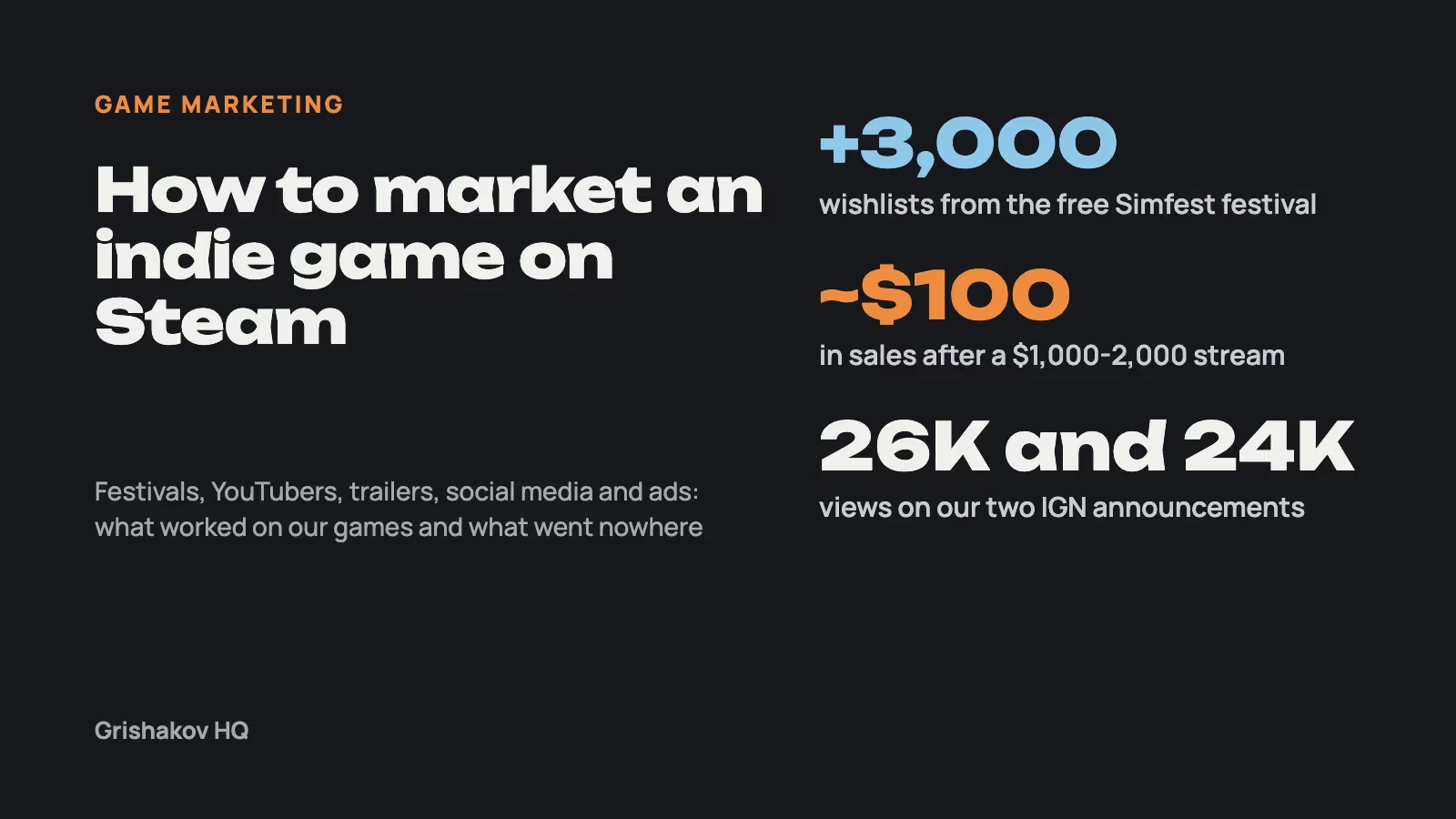
How to market an indie game when there is almost no ad money is a question I had to answer again on every game we made, from Up or Lava in 2023 to Meltopia, which launched on May 1, 2026 with 32,000 wishlists and sold 27,135 copies in its first week. There were a lot of attempts in between, and honestly, we burned some of the money.
Below are the marketing channels in the order I would launch them today: what to do, what it cost us and what it brought. We market our games ourselves and mostly with our own money, so the spending and results here come from our own reports.
I post the costs and results of every new experiment on X as we go, failures included.
Our marketing as it happens, with numbers
Evgeny on XHow to market an indie game on Steam: what actually drives visibility
Steam shows a game more often the better it sells and the longer people play it. Our job as developers is to bring enough people to the store page for Steam to notice.
Valve says it plainly in the Steamworks visibility docs: "With a few exceptions like the Popular Upcoming tab, wishlists are not a factor in your game's algorithmic visibility on Steam." On traffic it is even stricter: "The traffic landing on your store page is not a factor in your Steam store visibility." What counts is the sales that traffic brings.
Wishlists work through an email. On launch day Steam itself notifies everyone who has the game on their wishlist, and the first sales come from them. According to GameDiscoverCo's 2025 data, games with more than 25,000 wishlists sell a median of about 0.15 copies per wishlist in the first week. If the first week is strong, Steam starts showing the game in new releases and top sellers, and organic traffic kicks in. That is what happened with Meltopia: after launch it got into three sections of the store and was gaining 7,000-8,000 wishlists a day.
How many wishlists you need at launch, what they turn into and what one wishlist cost us in different channels, I covered in detail in the article about Steam wishlists.
When to start marketing your game, and in what order
Start as soon as you have a Steam page and a minute of gameplay you are not ashamed to show. But the big bursts, meaning a festival, the demo and YouTubers, are better placed closer to launch.
Valve's rules say a Coming Soon page has to be live for at least two weeks, but you will not collect wishlists in two weeks. Too early is bad too: in GameDiscoverCo's 2025 data, games that undersold had been on Steam before launch for 411 days on average, and the ones that beat their plan for 214. Old wishlists convert worse than fresh ones.
Back in 2024 we started testing game ideas through marketing. The plan was: make a page, a trailer and seed it on Reddit and DTF, then see what a wishlist costs. I wrote at the time: "As soon as we find a game where a wishlist costs $0.5-1, we will work on it and put all our effort into it." After that, collect wishlists through festivals, the community and ads.
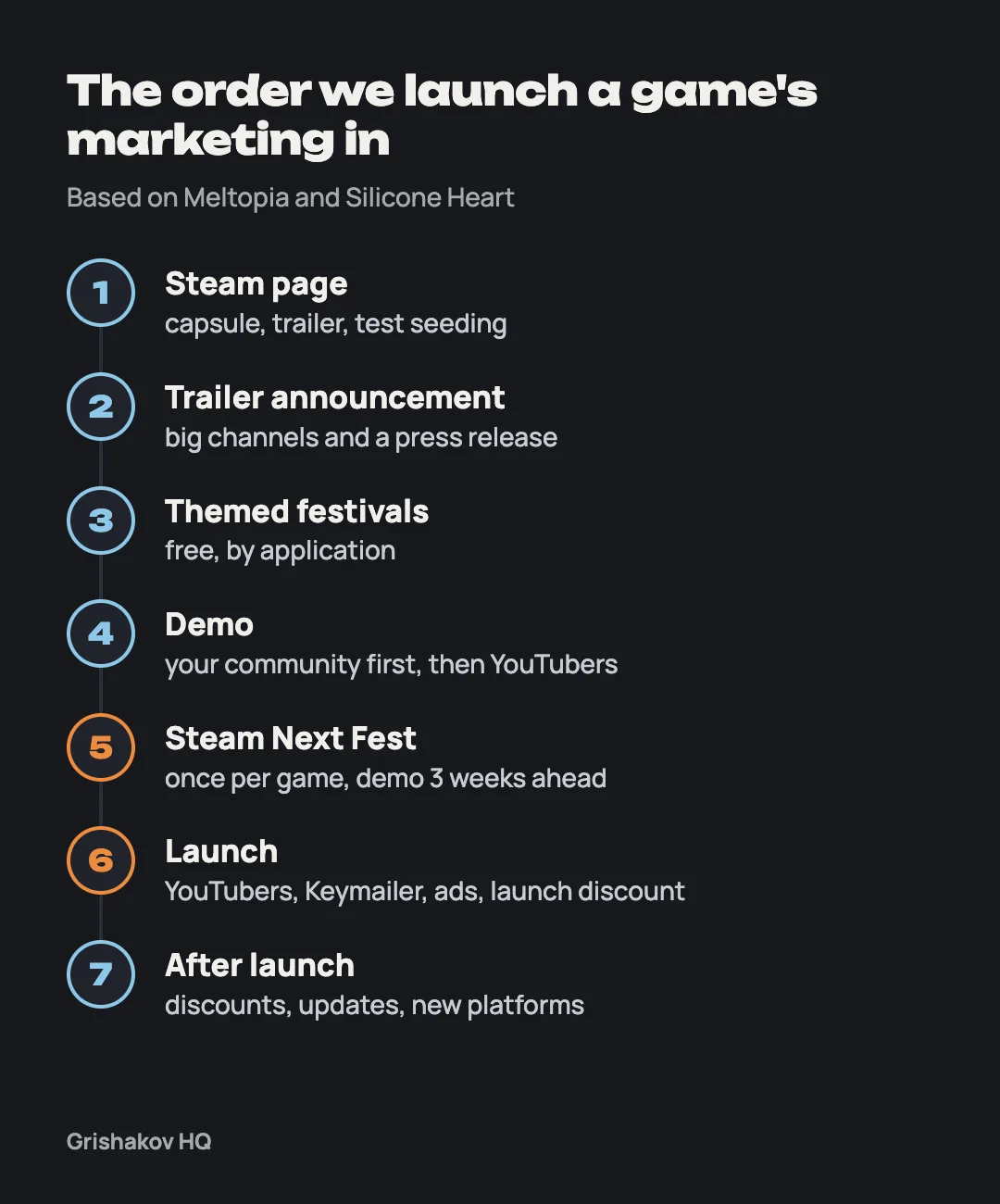
The order we arrived at by Meltopia and Silicone Heart:
- A Steam page with a capsule and a trailer, a test seeding to find the cost of a wishlist.
- A trailer announcement on big channels and a press release to the media.
- Every free themed Steam festival that accepts Coming Soon games.
- A demo, first for your own community, then for YouTubers.
- Steam Next Fest with the demo and YouTubers on the same days.
- Launch: YouTubers, Keymailer, ads, a launch discount.
- After launch: updates, discounts, ports to other platforms as new reasons to talk about the game.
In early October 2026 Silicone Heart was between steps four and five. The demo came out on October 5, 2026, and I wrote that for the first 10 days we would "marinate" it in our Russian-speaking community, then start active marketing around October 15 to enter Next Fest on October 19 on a wave of hype.
Steam festivals and Next Fest: the cheapest channel
Steam festivals are free to enter, and for us they were the most cost-effective channel. Themed festivals accept Coming Soon games and games with a demo. Next Fest takes only games with a demo, and only once in a game's life.
In summer 2026 Silicone Heart took part in the free Simfest: "We just applied, it got approved, and that's it." At its peak the festival brought 842 wishlists a day, +3,000 in total. My takeaway was short: "Take part in every festival!"
Next Fest has stricter rules. It runs three times a year, in February, June and October, a game can take part once, and the demo has to be submitted for review at least three weeks ahead. According to Valve's 2021 data, published by GameDiscoverCo, the median game's daily wishlists grow by 421% during the fest. But a lot depends on who brings the people. At the February 2026 Next Fest, Meltopia got about 600 wishlists from the festival itself and about 12,000 from YouTubers who were playing the demo on the same days.
How to prepare a demo and what went wrong for us at Next Fest, I went through in the article Steam Next Fest: how to prepare your demo.
YouTubers and streamers: when they pay off and when they don't
For us YouTubers never paid off directly, but they created spikes, after which Steam started showing the game on its own. Paying a streamer for one broadcast turned out to be the most expensive option. Sending keys and a free demo worked better.
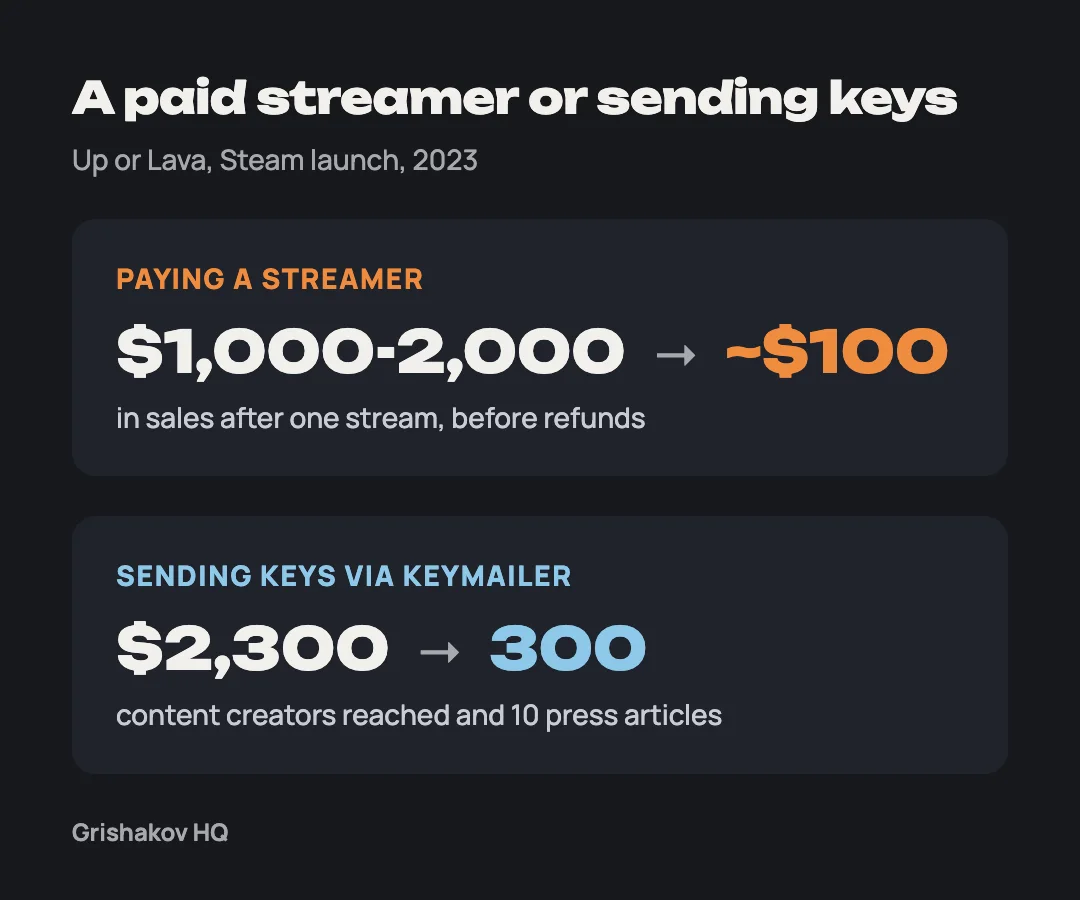
I have the money breakdown from the Up or Lava launch in 2023. We spent $4,800 on marketing: $2,500 on Russian streamers and YouTubers and $2,300 on the key distribution service Keymailer. This is how I described the streamer economics then: "you spend $1,000-2,000 on a streamer. And after the stream you get about $100 in sales. And there will still be refunds on that." Keymailer for $2,300 reached 300 content creators and got us 10 articles in the press.
My conclusion from that launch still holds: "You need YouTubers so that other YouTubers notice you and start making their own videos." And the second one: "if you want more organic traffic on Steam, YouTubers at launch are a must-have." I estimated a launch budget at $5,000-10,000 back then.
Russian streamers paid off even worse for us than foreign ones, because players in Russia found it harder to top up their Steam wallets. When a Korean streamer we found through Keymailer played the game, he had 1,000 viewers online, and 30 Koreans came into the game right away. On Russian streams I did not see that kind of link, at least by my own observations.
On Meltopia we did it differently: we wrote to YouTubers who covered similar games and gave them the demo, and paid $2.29 per 1,000 views for short videos through the Jestr service. Some videos got hundreds of thousands of views, and we paid one more creator for a long video. That is where the 12,000 Next Fest wishlists came from.
If you also write to YouTubers and track who brought how much, I post these calculations for each of our games on X.
How we count YouTubers and festivals
Evgeny on XTrailer, IGN and press: what an announcement gets you
A trailer premiere on IGN sounds impressive, but for us it went nowhere twice. We got more out of the news stories that follow it and out of the sites where our audience actually is.
When we were preparing the Silicone Heart announcement in 2025, I first went to PR people. The cheapest offer was about 2,000 euros for a slot on IGN or a similar site. Another PR person quoted $3,000 for IGN and $6,000 together with outreach to English-language media. None of the options came with a guaranteed result. For us, with no publisher and our own money, that was expensive. In the end, through developer friends, I got an editor's contact and got onto IGN for free. The announcement got 88,000 views across all platforms and 70+ publications, and the only costs were a paid post in a Telegram channel (about $19) and a voice-over (about $317).
Ruble amounts in this article are converted to dollars at the Bank of Russia rate for October 22, 2026, about 82 rubles per dollar.
In the video I tell how a chain of developer friends led me to the IGN editor, why I did not want to pay a PR person $3,000, and how many wishlists the announcement brought in the end. The video is in Russian, and YouTube has an English dub track for it.
But the views on IGN itself were always modest for us. In November 2025 I wrote honestly: "We've already done 2 announcements on IGN and both went nowhere. The result: 26 and 24 thousand views. Not much." The Silicone Heart trailer on PlayStation's YouTube channel did better: 33,000 views against 25,000 on IGN. Day by day we got 240, 260, 140 and 160 wishlists together with other sources, and the PlayStation trailer itself brought about 600 wishlists. That channel only takes companies with a PlayStation devkit that are releasing the game on the console: you apply, prepare a 2K-4K trailer and set a date at least four weeks out.
IGN turned out to be useful to us in a different way. In February 2026 I wrote: "IGN isn't much use. But! Along with the trailer, you get posts from news sites, and that's a different story." In Russia the site where it starts, for me, is DTF, the biggest Russian gaming community: "There are sites where everything starts. In Russia's case, that's DTF." If they write about you there, other outlets usually follow.
For Clear the Snow, after two modest announcements, we changed the trailer itself: one minute instead of two, pace and co-op from the first seconds, 95% of the scenes recorded live with other players, and mechanics borrowed from viral YouTube videos.
Social media and short videos: YouTube, TikTok, Reddit, X
For us short videos brought a steady but small flow of wishlists, and the game's own social accounts worked worse than other people's big audiences on YouTube.
In March 2025 the Silicone Heart short videos got 100,000-120,000 views a month across all platforms, and a wishlist cost us about $4.90. After optimization we planned to get it down to about $1.10-1.20. "Yes, no miracle happened. But it's a perfectly workable tool that keeps bringing in new people," I wrote then. April was a record, 270,000 views, 80% of them on YouTube, and by my count they brought about 270 wishlists. In other developers' cases I looked at then, TikTok views affected wishlists much more than YouTube Shorts did. I estimated that TikTok would have given us 3-4 times more wishlists, but we did not test it ourselves.
Chris Zukowski of How To Market A Game puts it bluntly: "95% of successful Steam games are not social media friendly."
With Reddit, everything comes down to subreddit rules. Andrei Popov, an indie developer, described on DTF that big subreddits have a rule: no more than 10% of your posts can be about your own game. One of his posts, with 800+ upvotes and 82,000 views, brought +34 wishlists. I don't treat X (Twitter) as a main platform for Steam: Zukowski has seen almost no cases where it was the main source of wishlists. But for me it is still "a decent way to reach YouTubers and influencers."
Paid ads for indie games: should you pay for wishlists?
Paid ads bring real people, but by our numbers a paid wishlist does not pay off through first-week sales. I would turn ads on when the free channels are already working.
Our X ads brought 18,000 wishlists for $15,000. With GameDiscoverCo's median of 0.15 sales per wishlist in the first week, that is about 2,700 copies, and to earn back $15,000 from them alone, each copy would need to bring the developer more than $5.5 after Steam's cut and taxes. We treated the ads as an investment in the launch base and in the chance to get into the sections where the game is shown for free. For Meltopia, in my Next Fest video I called the X ad results "so-so", and before launch we also ran Reddit Ads.
In February 2026 the Silicone Heart publisher ran ads for the trailer on the GameTrailers channel through Google Ads. I was afraid paid views would kill the organic ones, but it went the other way: the video got 146,000 views, comments came in by themselves, and we got 2,000+ wishlists. A video with a lot of views, as I wrote then, catches the attention of YouTubers, regular players and the media alike.
How to market a game for free
If you need to get a game noticed from zero with no budget, you have festivals, a demo, keys sent to YouTubers, and posts where your genre's players hang out. It costs nothing but takes time.
What worked for us with no money or almost none:
- free Steam festivals: Simfest gave Silicone Heart +3,000 wishlists;
- a DTF roundup and a short by a YouTuber who covered Meltopia on his own brought +2,000 wishlists in three days;
- co-op in the demo: every player can invite friends, so the demo spreads by itself;
- emails with a key to hundreds of YouTubers instead of paying them, which is how we marketed Meltopia in China;
- audience spillover: after Meltopia took off, wishlists started coming to Clear the Snow too. "Yes, not 7-8 thousand a day. But still not bad."
With no money at all, I would start with festivals and a demo: for Simfest, one application was enough.
How to tell which channel worked: Steam UTM links
Put UTM tags on every link to Steam and count wishlists above the normal baseline. Without that you will not know what you paid for.
Steam itself counts visits from links tagged with utm_source or utm_campaign and shows in Steamworks how many of them wishlisted or bought the game within 72 hours of the click. But Steam does not see every visit: for example, if a person switched browsers or opened the Steam client and found the game through search. So the second check is the baseline. Take wishlists by day after the event, subtract the usual daily growth and divide the cost by the difference. That is how we measured an interview on iXBT, a Russian tech site: 639 wishlists above baseline at about $0.44 each. I wrote then: "Weeell! That came out a bit pricey))"
After launch: discounts, updates and community
Marketing does not end at launch: every discount, update and new platform is a reason to show the game again to people who have not bought it.
Steam's rules do not allow a regular discount in the first 30 days after launch, but before launch you can set a launch discount of 10 to 40%. For Meltopia's first sale in June 2026, we made a new mod, updated the capsules with a note about new content, and agreed with an English-speaking streamer to run a 24-hour broadcast right on the game's store page. That way a buyer sees gameplay without leaving for YouTube.
We worked with the community separately. A Supporter Pack with the soundtrack and skins brought $2,785 in a few days. For those who don't want to pay, we gave out a free skin and invited them to a private Discord channel where we show development and let them play new modes first. The goal, as I wrote then, is "to stretch out the decline in sales and players for as long as possible." Even the Steam Deck Verified badge, which we fought for for five months, I see as "another news hook." Will it raise sales? "No idea! We'll see."
How we looked for Meltopia buyers outside Steam, in China and on GOG, I covered in the article where to sell a game besides Steam.
How to market a mobile game
On mobile, marketing means buying traffic with strict payback math. It is worth starting once the game already earns on organic traffic.
The numbers there are on a completely different scale. In April 2025 we spent $96,000 on ads for our mobile games, by early May we had $14.5K of net profit from those ads, and by day 120 we expected $25K. The benchmark we use to cut or raise spending is 120% payback by day 60. But the market changes fast: in November 2025 our spending dropped from $20,000 to $7,000 a week, because our main ad network and iOS sagged. And Merge Gangster Heist, our former flagship, earned $86 from paid traffic in the whole first quarter of 2026. What a mobile game's revenue is made of and how to calculate ad payback, I covered in the article how much mobile games make.
Organic traffic helps paid traffic: when Bunker 22 had an organic spike, organic accounted for 90% of the growth, installs were 16,000-20,000 a day, and the game's ad payback jumped. That is why in a 2023 stream I advised not to start active user acquisition until the game makes at least $2-5K on organic traffic across Yandex Games, Google Play and other platforms.
Google Play has a free tool for this, pre-registration: for up to 90 days people can sign up for the game, and on launch day it installs for them automatically. If you are targeting Russia's own platforms, I covered how promotion works there in the guides on Yandex Games and RuStore.
Marketing agency, publisher, or doing it yourself
An agency makes sense if you have money and no time, but compare every offer with what you could do yourself. Twice we skipped an agency and did it cheaper on our own: with IGN and with China.
PR people quoted from 2,000 euros to $6,000 for getting onto IGN, and we got there for free with an email to an editor. In China an agency offered to buy 3-4 influencers for Meltopia for 5,000 euros, and I said no: "The odds of it paying off are about zero." Instead we hired someone who knows Chinese, translated the page and capsule, and started writing to hundreds of creators with keys. The budget was $400 plus 15% of sales in China.
Paid services for one specific task work better than a full-service agency. Keymailer got Up or Lava 300 creators for $2,300, and for the Meltopia launch we took its $1,000 plan to stretch out the hype.
The third path is a publisher: it takes over marketing and can run ads itself, as with the Silicone Heart trailer. What a publisher takes in return and when it is worth it, I covered in the article does an indie game need a publisher. And where the release itself starts, from registering in Steamworks to the Release button, is in the guide how to publish a game on Steam.
Frequently asked questions
How do you market an indie game on Steam for free?
Enter every themed Steam festival that accepts Coming Soon games, release a demo and take it to Next Fest, send keys to YouTubers who cover similar games, and post where your genre's players are, such as niche subreddits. The free Simfest gave Silicone Heart +3,000 wishlists, and a DTF roundup plus one YouTuber's short gave Meltopia +2,000 in three days.
How much does it cost to market an indie game?
It depends on the channels. For the Up or Lava launch we spent $4,800: $2,500 on streamers and YouTubers and $2,300 on Keymailer, and after that I estimated a launch budget at $5,000-10,000. The Silicone Heart announcement cost almost nothing: one paid Telegram post and a voice-over. PR people quoted prices from 2,000 euros to $6,000 for getting a trailer onto IGN.
When should you start marketing your indie game?
Open the Steam page early. Valve requires at least two weeks before launch, but wishlists build up over months. A page that sits too long hurts, though: in GameDiscoverCo's data, games that undersold had been up before launch for 411 days on average, and games that beat their plan for 214. Place the big bursts, the demo, Next Fest and YouTubers, closer to launch.
Should you pay streamers to play your game?
Not if you expect them to pay off directly. On Up or Lava a $1,000-2,000 streamer brought about $100 in sales, before refunds. YouTubers matter because other creators and Steam then notice the game: at Next Fest, Meltopia got about 12,000 wishlists from creators' videos against about 600 from the festival itself. Sending keys and a demo works better than buying broadcasts.
How do you market a game from scratch?
Start with a Steam page with a capsule and trailer, then a test seeding on Reddit and similar sites to learn what a wishlist costs. After that come free festivals, a demo for your own community, outreach to YouTubers and Next Fest. Measure success in wishlists, through UTM links and above the normal baseline, not in likes: for one developer, 82,000 views on Reddit brought 34 wishlists.
How do you market a mobile game?
By buying traffic, but only once the game already earns on organic traffic: I advised starting when it makes at least $2-5K that way. We keep a benchmark of 120% payback by day 60 and cut spending when payback falls. Google Play also offers free pre-registration for up to 90 days, and on launch day the game installs for everyone who signed up.
Sources
- Valve, Visibility on Steam (Steamworks documentation)
- Valve, Coming Soon (Steamworks documentation)
- Valve, Steam Next Fest (Steamworks documentation)
- Valve, Upcoming Steam Events (Steamworks documentation)
- Valve, Discounting (Steamworks documentation)
- Valve, UTM Analytics (Steamworks documentation)
- Google Play Console Help, Pre-registration
- Simon Carless, "Steam demo showcases: officially good", GameDiscoverCo, 08/09/2021
- Simon Carless, "The state of Steam wishlist conversions", GameDiscoverCo, 10/17/2025
- Chris Zukowski, "Why am I not getting wishlists?", How To Market A Game, 12/05/2023
- Andrei Popov, "Promoting a game on Steam and wishlists: Reddit" (in Russian), DTF, 06/08/2023
- Evgeny Grishakov, "How our game got on IGN for FREE, and how many wishlists it got" (in Russian), YouTube, 05/22/2025
- Evgeny Grishakov, "How to get the MOST wishlists from Steam Next Fest..." (in Russian), YouTube, 03/19/2026
Silicone Heart was planned for the October 2026 Next Fest, which started on October 19. Will the February story repeat, when YouTubers gave Meltopia 12,000 wishlists against 600 from the festival itself? I will show the numbers day by day on X.
Silicone Heart at Next Fest, day by day
Evgeny on X