
How to Make a Game with AI: What It Already Does and Where It Breaks
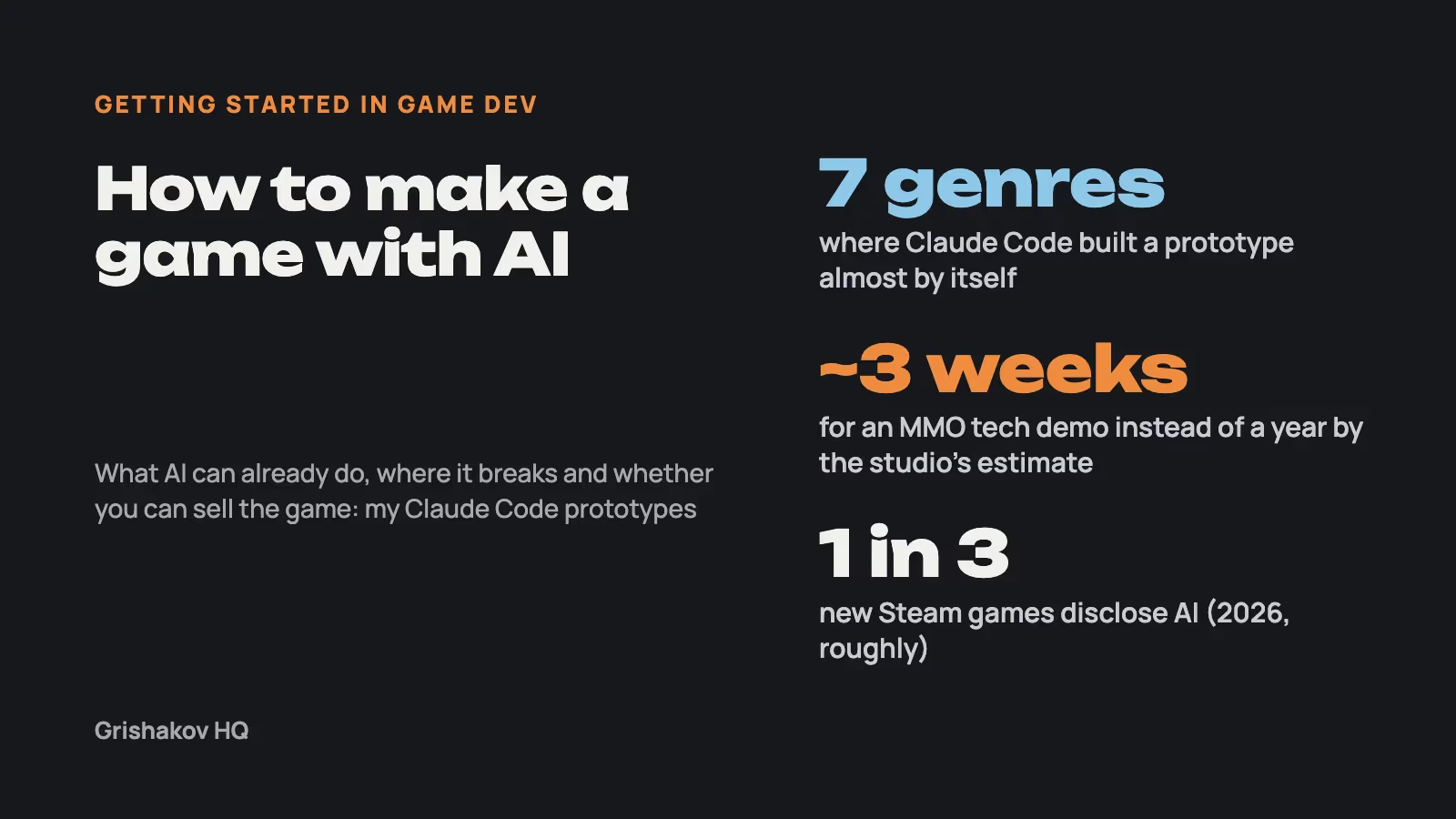
How to make a game with AI is something I have been testing on myself since spring 2026. I run several prototypes at once, from a strategy game with tens of thousands of units to a Pokémon MMO, and Claude Code writes the code for me. This is vibe coding: you describe in words what you want, and the AI writes the code. At the same time, Meltopia, our game that took off on Steam, was made by the team by hand, with no AI in the code.
In one video I said it honestly: "no illusions, don't count on Claude Code making the whole game for you." So below is what worked for me and what didn't, which genres AI handles almost alone, what to use, what it costs, and what Steam says about it.
I show new prototypes and how they turn out on X as I go.
My Claude Code prototypes as they happen
Evgeny on XCan you make a game with AI without coding?
I am not a programmer, and I managed to build a small game. A big one with many systems is still out of reach for a beginner who doesn't understand code.
I am making my GTA-style Pokémon MMO without the studio team. In June 2026 I wrote about it like this: "I do everything myself, with no outside help, and I'm not a programmer. CLAUDE does everything in the GODOT engine." In the video about the project I listed it out: "I don't write code, I don't move models around, I don't set up textures, it does everything itself." The only things I did by hand were downloading ready-made animations from the free Mixamo service and checking how they fit into the game.
I picked the engine for myself. In Godot all project files are text, so the AI edits them itself, without me moving things around in the editor. For someone who doesn't write code, that is the deciding difference from Unity and Unreal Engine.
Other people's attempts show the limit well. In 2025 Wharton professor Ethan Mollick built a 3D game with Claude Code in four prompts: the first version cost him about $5, and another $8 went on fixing a bug that stopped the game from working. His conclusion: "vibecoding is most useful when you actually have some knowledge and don't have to rely on the AI alone." On the Godot forum in April 2026, a developer posted a breakdown of a failure: he spent about 40 hours trying to vibe code a metroidvania with different AI tools, and the project fell apart on enemies and the combat system once the logic spread across many files.
Chat or agent: the best AI for game development
For a game I needed an agent that opens the project files itself, edits them and runs them. Copying chunks of code back and forth from a chat works for one scene, not for a game.
ChatGPT in a browser window writes a piece of code, and it is on you to paste it in, find the error and explain it to the model. Claude Code, Cursor or OpenAI's Codex work right inside the project folder: they read the code, change the files they need, run commands and see the errors themselves. The Claude Code docs describe it exactly that way, as a tool that "reads your codebase, edits files, runs commands."
This is how I have it set up. I work in the free Visual Studio Code editor with several Claude Code chats open inside, each on its own task: three work on the MMO, one more on a service. I dictate tasks by voice and have almost stopped typing. If the AI gets stuck, I simplify the task and strip everything extra, and I solve one problem in the same chat where the context already is.
Games have one quirk: the AI does not see what is happening on screen. In the MMO video I showed how I struggled with a wall-jump animation. According to the logs, everything played, but nothing changed on screen. The way out is screenshots and a debug label right in the game saying "animation played", so the model at least knows what is true. By the way, I ended up postponing the wall jump.
What games can AI make almost by itself: 7 genres from my prototypes
Claude Code did best for me where everything is built on math: physics, simulations, calculations, interfaces, with simple stylized graphics. In June 2026 I put it like this: "Claude Code is good at math. And really bad at 3D animation and 3D modeling."
In July I collected in a video seven directions where I got a prototype with no outside help or almost none:
| Genre | What AI did by itself | Where a human is needed |
|---|---|---|
| Real-time strategy | all the logic, thousands of units with physics | an artist for the low-poly models |
| Racing, with a Formula 1 team simulator idea from it | a race with stylized cars in one or two iterations | the AI could not reproduce real cars, the simulator is only an idea so far |
| Ship builder | models and mechanics | the prototype is raw, 3-4 iterations |
| A game like Islanders | both the graphics and the logic, entirely | no artist needed |
| A game like Dorfromantik | graphics, logic and even sounds | the idea itself needs work |
| Water simulation like Timberborn | realistic water: it flows, shines, darkens with depth | hundreds of iterations, then an artist |
| World simulation like Mount & Blade | town economies, traders, bandits, captures | ready-made assets and an artist for the most important models |
About Islanders I wrote separately: ask Claude Code to make it with logic and graphics, and "it will make it almost 1 to 1." Dorfromantik is a similar story, but these games already exist, and a copy without an idea of your own is unlikely to sell.
Real cars came out worst. For the racing game I asked for low-poly models of a Tesla, a Ferrari and a Lamborghini, and I got anything but those. With the Lamborghini, as I said in the video, we "fought for a really long time." That is why I see the race itself as a commercially weak idea, and the team simulator, where the interface and calculations matter more, interests me more.
How I test such ideas step by step, from a prototype in a couple of hours to an announcement with an artist, and why AI still handles 3D for mobile poorly, I covered in the article how to make your own game from scratch.
If you are also trying to vibe code games, I post every new prototype on X: what worked, how many iterations it took and where I got stuck.
Claude Code prototypes: what worked and where I got stuck
Evgeny on XWhere AI breaks: 3D, animation and big projects
Animation, 3D models and projects with many connected systems were the hardest for me. The AI built web services much more easily than games.
In the MMO video I said it straight: "Claude Code works much better and more easily with web services than with games, especially 3D games." And separately: "The biggest problem is animations, tuning the precision of animations." Stairs, a hard landing, a wall jump: every small thing like that takes a lot of iterations, and sometimes a task has to be put aside.
You can see what it looks like live in the video itself. From this point I hook up a downloaded wall-jump animation by voice, Claude Code's logs say it plays while the screen shows nothing, and we go through screenshots and a debug label until the hard landing finally works. The video is in Russian, and YouTube has an English dub track for it.
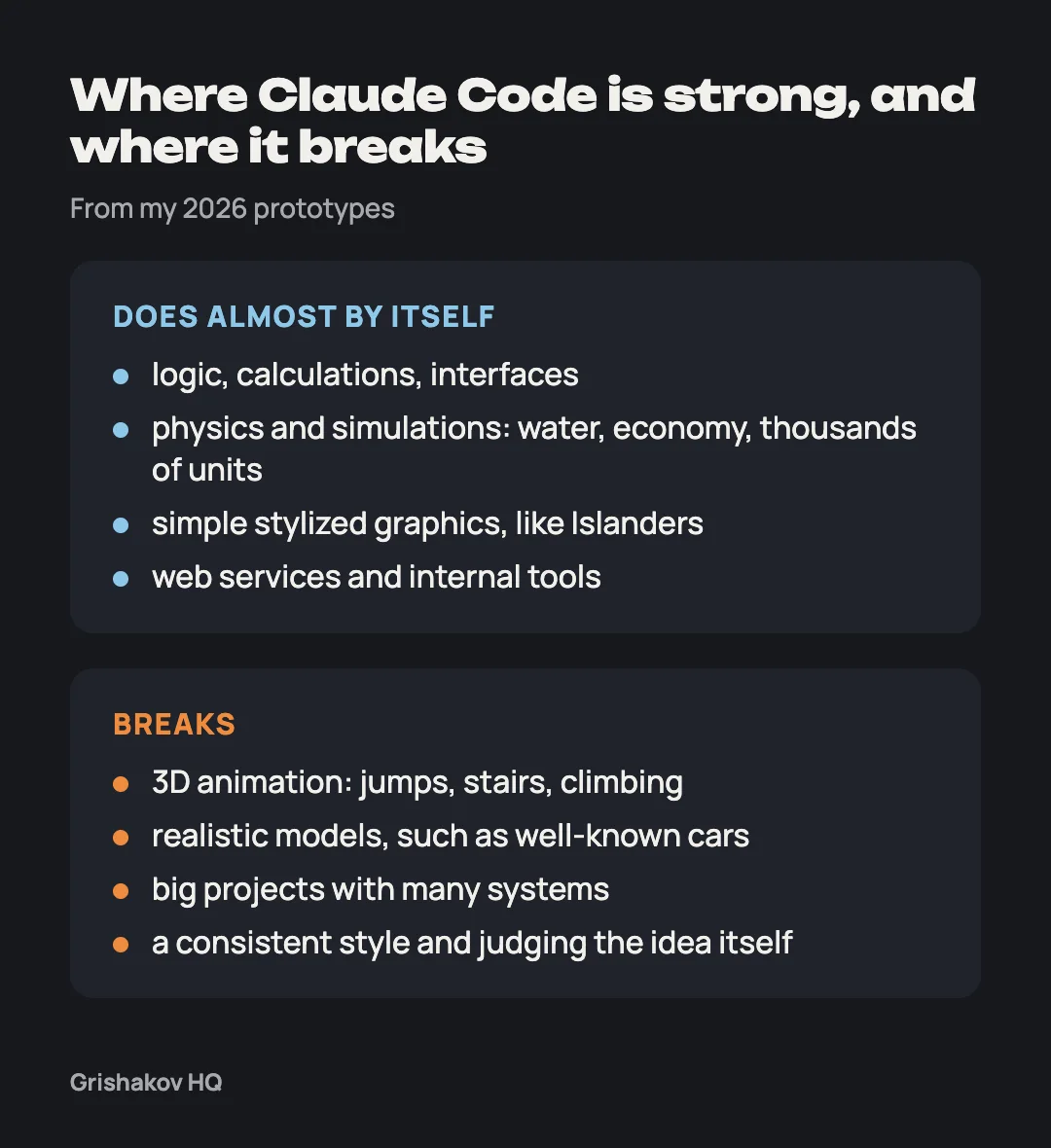
The second problem is that the AI doesn't argue. About vibe coding services I wrote in April: "Claude Code will back you up on everything. Any idea of yours is super cool to it." Whether the game idea is good is your call.
The third is style. If images, models and music come from different AI tools, the game easily looks stitched together from different pieces. The makers of Codex Mortis, a game whose code was written entirely with Claude Code, also named a consistent art style as one of the main problems. That is why I hire an artist for the key models.
AI tools for making games: code, art, sound and video
An AI that makes a whole game exists only for very simple browser games. At the studio and in my own projects we took a separate tool for each task:
- Code. Claude Code in my prototypes. Cursor and OpenAI's Codex work in a similar way.
- Art. In 2023 we started making store icons and pictures for the in-game shop in Stable Diffusion. About one of the games I wrote that what would have taken several days to draw by hand, the AI did in 5 minutes. The icons got better at the same cost.
- Game design. ChatGPT helped come up with mechanics and balance. For Pocket Survivor 2 it suggested shots to different body parts with probabilities, and it also generated item sets by level into a table and random text events.
- Voice. For Silicone Heart short videos we switched to ChatGPT voice-over: "It's the only one that does it with intonation and as human-like as possible. All the other AIs give themselves away right away." A live voice-over for the same game's trailer cost us about $317.
- Video for ads. Google VEO 3 can make animations for ad creatives, but it does poorly if you give it real gameplay and ask it to rework it.
Ruble amounts in this article are converted to dollars at the Bank of Russia rate for October 22, 2026, about 82 rubles per dollar.
For 2D art many people use Midjourney, for 3D models and music there are separate generators, for example Meshy and Suno, and for assets in one consistent style there is Scenario. I have not used them in my prototypes, so I won't rate them. But their free tiers have limits on selling, more on that in the next section.
How much does it cost, and how long does it take?
My money goes mostly on the agent subscription. Building a game to sell completely for free is hard: Claude Code has no free tier, and free tiers of generators often don't give commercial rights.
From my experience in spring 2026, Claude's $20 a month plan "burns out instantly" for this kind of work, and only the plan at about $100 and up is enough for me. I am on the $200 plan myself: it covers the MMO, the service and my main work. The analytics service for our YouTube channels took, as I wrote in May, "3 days! And about 60 bucks of budget." The AI never managed the logo for it though, I kept getting "total nonsense", and a partner helped. Before, a similar service would have cost, by my April estimate, "[tens of thousands of dollars] and months of work."
Cursor and Codex do have free tiers, but with limits. And this is what the generators said on their pages as of October 11, 2026:
- Suno gives 50 credits a day on the free tier, but no commercial rights: you can't put music from there into a game you sell.
- Rosebud on the free tier does not let you download the code, export the game for Windows or sell it.
- Meshy on the free tier gives models under a CC BY 4.0 license: you can use them in a commercial game, but you have to credit Meshy.
Terms change, so check them on the official pages on the day you generate assets, and keep proof of your plan.
As for time, here is how it went for me. The MMO took about three weeks of work, not counting a month-long break. My team had estimated the project before that: the whole studio "would maybe have made some kind of demo in a year, God willing." But so far it is a tech demo: an open world, cars, climbing and auto-battles with Pokémon, with no trading between players, multiplayer or monetization yet. For the first iteration of a small game from the genre table, I plan a couple of hours.
Can you sell an AI-made game on Steam?
Yes, if you follow the platform's rules. On Steam you have to fill in the content survey honestly. But players are wary of AI they can see.
Steam. In January 2024 Valve announced that it accepts games made with AI, and the developer marks two kinds of content in a survey. Pre-generated: anything made with AI during development that ended up in the game. Live-generated, created while the game runs: then you have to describe the guardrails that stop the AI from producing illegal content. Valve shows the answers to buyers on the game's page. The docs say separately that AI tools built into development environments are not the main subject of this section. In January 2026, according to Gigazine, Valve clarified that coding assistants don't need to be disclosed. What needs disclosing is what the player sees and hears: images, sound, text, store page materials. How the release itself works, I covered in the guide how to publish a game on Steam.
Yandex Games. If you also target Russia: Yandex Games is a Russian browser game platform run by Yandex, and its requirements, item 1.23, say: "Interactive artificial intelligence (AI) is prohibited in games. At the same time, it is allowed to use materials that were generated with AI in advance." A chatbot inside the game won't pass there. AI-drawn art will. How release and moderation work on that platform, I covered in the article how to publish a game on Yandex Games.
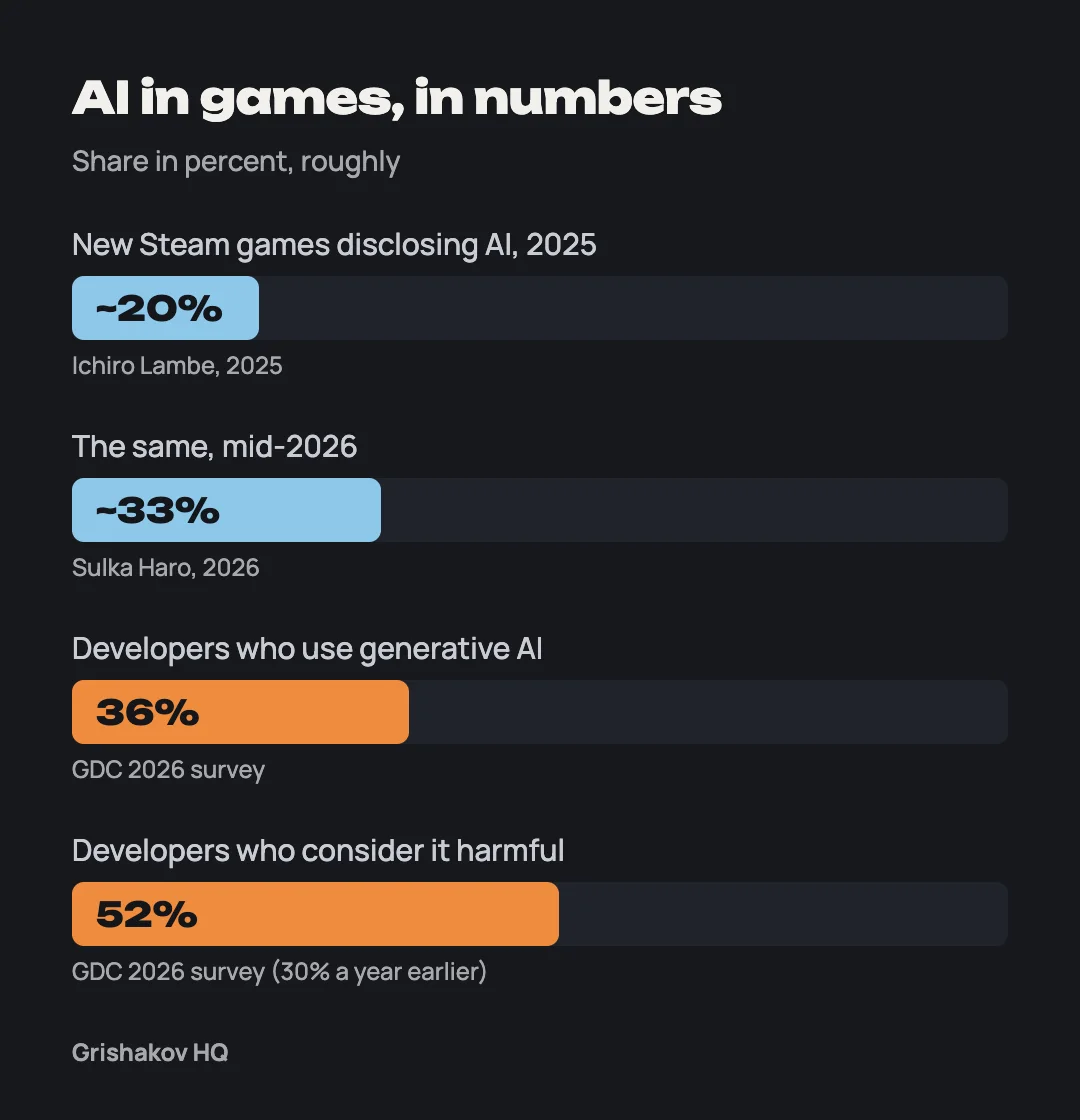
Players and the market. By Ichiro Lambe's count, in the first half of 2025 roughly one in five new Steam games disclosed generative AI, and by Sulka Haro's data, by mid-2026 it was roughly one in three. By the same Haro data, games with the AI disclosure reach at least modest success noticeably less often: at about 55% of the rate of games without it. In the GDC 2026 survey, 36% of developers used generative AI, and 52% considered it harmful to the industry, up from 30% a year earlier. I look at it calmly: back in 2023 I wrote that there is no point whining that AI has arrived, you have to figure out how to use it. But AI the player can see is worth keeping under control.
Vapor World swapped its cutscenes for generated ones before launch, the hero's model changed from frame to frame, and at launch 36% of 64 reviews were positive. The cutscenes were later removed. And Clair Obscur: Expedition 33 lost its Indie Game Awards in December 2025 over AI placeholder textures in the release version.
Rights. What follows is the general picture for the US, and it is not legal advice. The US Copyright Office explained in 2025 that prompts alone do not give rights to the result. What is protected is what a human added: selection, arrangement, modification.
How to make a game with AI: the order I would follow
I would start with a small genre where the game rests on logic, work through an agent, and plan for an artist on the key models from the start. Step by step:
- Pick a genre built on calculations and simulation, with simple stylized graphics: strategy, simulation, a game like Islanders.
- Take an agent: Claude Code, Cursor or Codex. For people who don't write code, Godot is convenient, because the AI edits its files itself.
- Build the first iteration in a couple of hours and look honestly at whether it is fun to play.
- Give the AI one task at a time. If you get stuck, simplify the task and cut the extras, and to check results ask it to print debug labels on screen and send it screenshots.
- If the prototype is alive, make a list of models and scenes for the Steam page and hire an artist at least for the main models.
- For assets you will sell, choose plans with commercial rights and keep the proof, and mark AI content honestly in the Steam survey.
- From there it is like any game: a page, wishlists, festivals. How we marketed our games, I collected in the article how to market an indie game.
Frequently asked questions
Can you make a game with AI for free?
You can build a simple prototype for free: Cursor and Codex have free tiers with limits. But Claude Code has no free tier, and Claude's $20 plan ran out fast for me when working on a game, only the plan at about $100 was enough. Free tiers of generators often don't let you sell the result: Suno Free has no commercial rights, free Rosebud doesn't let you sell the game, Meshy Free requires crediting the service.
What is the best AI for game development?
For code you need an agent that edits the project files itself: Claude Code, Cursor or Codex. All my prototypes are made in Claude Code. For icons and pictures we used Stable Diffusion, for mechanics and balance ChatGPT, for voice-over in short videos also ChatGPT, and for ad videos Google VEO 3. An AI that makes a whole game exists only for very simple browser games.
Can AI make a game without any coding?
A small one, yes. I am not a programmer, and I am making a Pokémon MMO in Godot where Claude Code writes all the code and moves the models itself. But a big game with many systems is still out of reach without understanding code: on the Godot forum a developer described how in 40 hours his metroidvania fell apart on enemies and the combat system. 3D animation is the hardest part for AI.
Can you sell AI games on Steam?
Yes. Since January 2024 Valve accepts games made with AI if you fill in the content survey honestly, separately for pre-generated content and content generated during play. Valve shows the answers to buyers on the store page. According to Gigazine, coding assistants don't need to be disclosed, but images, sound and text made by AI do. Keep in mind that games with the AI disclosure reach even modest success less often.
How long does it take to make a game with AI?
For the first iteration of a small game in a suitable genre, I plan a couple of hours. The tech demo of an MMO with an open world, cars and auto-battles took about three weeks of work, although my team had estimated such a project at about a year to a demo. To get to a finished game, you then need gameplay, multiplayer, an artist for the key models and testing.
Will AI replace game developers?
Not yet. AI is strong at code, logic and calculations, but it doesn't argue with your idea, struggles to keep one consistent style and breaks on 3D animation and big projects. Even in my prototypes the main models need an artist. In the GDC 2026 survey, 36% of developers used generative AI, and 52% considered it harmful to the industry.
Sources
- Valve, Content Survey (Steamworks documentation)
- "Valve announces guidelines for games that use AI on Steam", MobileSyrup, 01/10/2024
- "Steam updates AI disclosure guidelines", Gigazine, 01/20/2026
- Yandex Games, game requirements (documentation, in Russian)
- Anthropic, Claude Code overview (documentation)
- Suno, pricing
- Rosebud AI, pricing
- Meshy, pricing
- GDC 2026 State of the Game Industry, 01/29/2026
- "Nearly 20% of new Steam games in 2025 use generative AI", Insider Gaming, 07/15/2025
- Sulka Haro, "Three years of AI on Steam", 07/13/2026
- Ethan Mollick, "Speaking things into existence", One Useful Thing, 2025
- "Post-mortem of my failed attempt to vibe code a metroidvania game", Godot Forum, 04/23/2026
- "Vibe coding in action: a game made entirely by neural networks announced" (Codex Mortis, in Russian), VGTimes
- "Vapor World Pulls AI Cutscenes After Steam Backlash", Everything Edinburgh
- "The Indie Game Awards snatches back two trophies from Clair Obscur over its use of generative AI", Engadget, 12/2025
- US Copyright Office, AI report part 2 (summary by Crowell), 2025
- Evgeny Grishakov, "TOP 7 games where Claude Code does everything for you" (in Russian), YouTube, 07/02/2026
- Evgeny Grishakov, "I vibe coded a GTA-style Pokémon MMO with Claude Code" (in Russian), YouTube, 06/11/2026
- Evgeny Grishakov, "I vibe coded a service. Giving it away for free" (in Russian), YouTube, 05/07/2026
In June 2026 I was running four prototypes at once, including the water one and the Mount & Blade-style world simulation. What genre would you pick for a game built with AI? I show new prototypes on X.
New AI game prototypes
Evgeny on X