
How to Make Your Own Game from Scratch: Stages, Engine, Team and Timeline
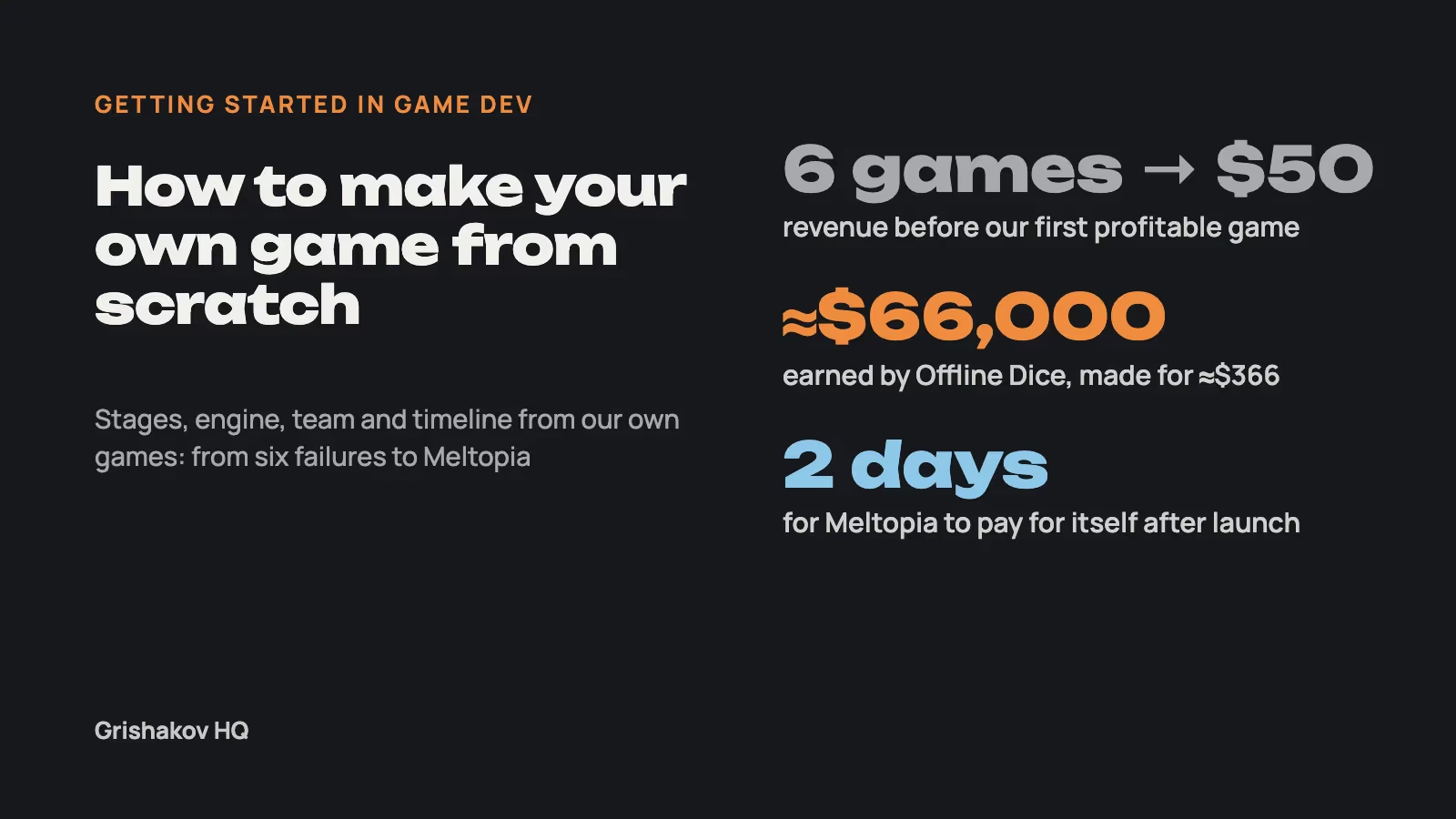
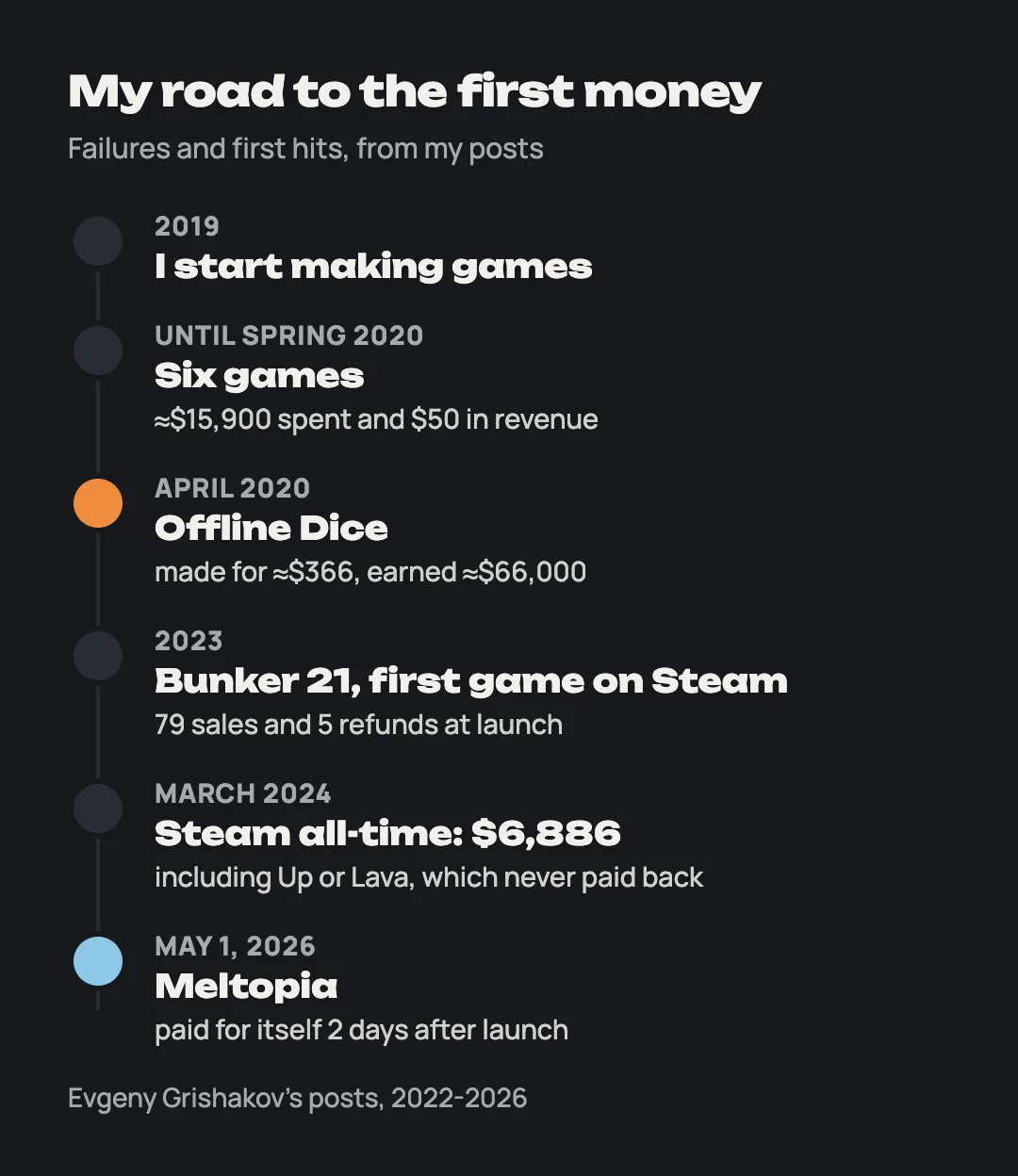
If you want to know how to make your own game, get ready for the first one to most likely earn nothing. I have been making games since 2019, and before our first profitable one, Offline Dice, I spent about $15,900 on six games. They brought in $50, "not thousands! Just 50 bucks," as I later wrote. We made Offline Dice for about $366, and it earned about $66,000. On Steam the story repeated itself: three tries, and only Meltopia paid for itself, two days after its launch on May 1, 2026.
Ruble amounts in this article are converted to dollars at the Bank of Russia rate for October 22, 2026, about 82 rubles per dollar.
This is about an indie game for PC that ends up on Steam. I do not cover Roblox levels or game builders on phones here. Numbers and quotes come from my posts from 2022-2026 and my videos; engine and Steam terms come from the official sites.
I post how we are making Silicone Heart and testing new ideas on X.
How we make games: prototypes, failures and numbers
Evgeny on XHow to make your own game: where to start
Start with a small game and with a check of whether anyone besides you finds it interesting. About the popular advice "make your dream game" I wrote this:
"Just do what you love. Make your dream game!" No offense, guys. But this is the worst advice for a beginner developer. The best advice goes like this: pick a direction that interests you and make games, testing them for virality.
- Evgeny Grishakov, post from September 2025
You can test an idea on Steam before the game is ready. I described the order like this: make the game, put together a store page and a trailer, put it on Steam and do a seeding push, meaning posts and ads wherever players hang out. Then we look at how many wishlists came from posts on Reddit and DTF and how much one wishlist from ads cost. A wishlist is a player pressing "Add to your wishlist" on the game's page, and their number and cost show whether people are waiting for the game. We planned to work seriously on the game where a wishlist would cost $0.5-1. Where wishlists come from and how many you need, I covered in Steam wishlists.
If you have no experience at all, I have three tips I gave back in my mobile games days (there, "release" means putting the game in an app store):
- Make prototypes. Set a deadline, say two weeks, make a small game in that time and release it. Each prototype like that tests a niche: if players and reviews come, improve it; if not, make the next one.
- Play games. The ones trending right now, and work out why they took off.
- Study other people's cases. Follow developers who share numbers, read their write-ups and analyse them. In my experience, people often neglect this tool.
And one limit on genre. I am constantly asked whether a first game should be an online project. I am always against it. When we took on an online open-world project ourselves, I wrote: "Making an online GTA is really hard. It is a huge project that needs thousands of man-hours just to prepare the technical foundation. Even without gameplay."
Game development stages: from idea to Steam launch
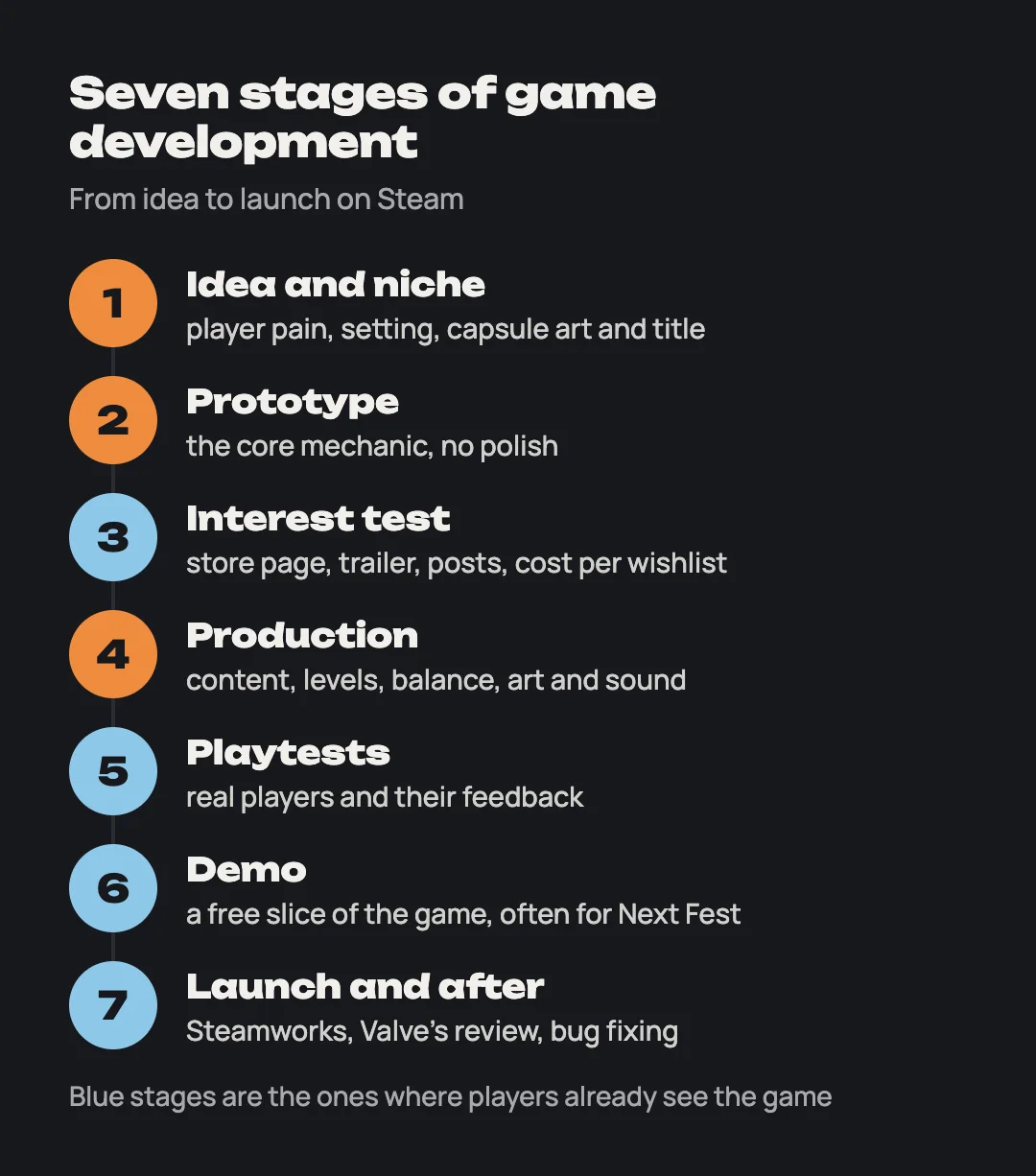
If you put my posts about making our own games into one scheme, you get about seven stages, and in four of them players already see the game:
- Idea and niche. Look for where the game hits a player's pain. The idea for Silicone Heart, for example, came while I was watching the birchpunk YouTube channel: shabby Soviet cyberpunk plus Stardew Valley mechanics, with robots, drones and automation on top. I think about the setting together with the capsule art and the title, and the gameplay features should follow from them.
- Prototype. The smallest playable version, where you test the core mechanic. The art can stay rough: a prototype answers one question, whether it is fun to play.
- Interest test. A Coming Soon page on Steam, a trailer and posts, and then you count wishlists and their cost. If there is no interest, you have lost only a prototype and can move on to the next one.
- Production. Content, levels, balance, game design, art, sound and assets, meaning ready-made models, textures and effects. Many people write a big design document before this. We did not even write out a scene plan for the first Silicone Heart trailer: "We pictured it all in our heads and just listed it."
- Playtests. Tests with real players before the demo. After the Silicone Heart playtests we got more than 1,000 feedback responses.
- Demo. A free part of the game for everyone, usually for the Steam Next Fest festival. A demo and a playtest are different things: in Meltopia's playtests 90% of players wanted to keep playing, while the demo collected negative reviews right away, and we fixed about seven critical points. I covered demo prep in Steam Next Fest: how to prepare a demo.
- Launch and after. Registering in Steamworks, the $100 fee, Valve's review and the release button, then fixing bugs in the first days. The steps from registration to the release button are in how to publish a game on Steam.
How I test ideas now: a prototype in a couple of hours
With AI, my idea testing got faster. In summer 2026 I described this plan:
- I find a niche and try to make a prototype in a couple of hours;
- if it turns out well, I write a list of assets and footage for a Steam announcement;
- I bring in an artist, and the two of us make the prototype, scenes for screenshots and video capture;
- we do a full announcement.
If the announcement takes off, I bring in the team. If not, we have lost almost nothing: a prototype costs my time and a thousand to fifteen hundred dollars for 3D models plus the announcement. An honest caveat, same as in that post: all of this is still theory, and we are testing it on our next projects.
Which prototypes survive this plan and which go in the bin, you can see on my X.
Prototypes we are testing right now
Evgeny on XSmall Meltopia and dream game Silicone Heart: how long they took
We had two ways of developing running at the same time, and the difference in timelines is huge. Meltopia is a small game that at first we even shelved. Silicone Heart is my dream game, and it is still in development.
| Meltopia | Silicone Heart | |
|---|---|---|
| Engine | Unreal Engine 5 | Unity |
| Idea | a small game | a dream game |
| Timeline | under 8 months from assembling the team to launch | in May 2025, 4 months of active development; not out as of October 2026 |
| Result | paid for itself in 2 days | preparing the demo |
We revealed Meltopia with a trailer, were disappointed with the result and switched to another project. Without any marketing, the game started gathering wishlists on its own, and in September 2025 I wrote: "We assembled a team, finished the concept and started development of the final version of the game." In January the plan was: "Meltopia is a small game. There is no goal of collecting a million wishlists and grinding out content for years." Then came playtests, the demo, content creators, the demo festival, bug fixing and the launch on May 1, 2026. To break even it needed about 10,000 sales, and that happened in two days.
In May 2025, Silicone Heart had been in active development for four months, and by August 2025 we had grown the team to eight full-time people. The game is big, with a farm, production and neighbouring locations, and that much content simply takes time. If this is your first game, compare the columns: a small game gets to launch and its first market test in months, a big one takes years, and you need money to live on for all those years.
Best game engine for beginners: Unity, Unreal Engine or Godot
All three popular engines can be had for free, so people choose them by platform, genre and the people who already work with them. Terms as of October 6, 2026:
| Engine | Cost | Where we use it |
|---|---|---|
| Unity | free (Personal) while revenue and funding stay under $200,000 | Silicone Heart |
| Unreal Engine | free up to $1,000,000 in revenue per game, then 5% | Meltopia, Clear the Snow |
| Godot | free, MIT license, no royalties | my experiment with AI |
In Unity you write C#, and our Unity developer job posts say exactly that: "Excellent command of Unity and C#." Meltopia was made in Unreal Engine 5, and the same team is now making Clear the Snow. I picked Godot for my experiment where AI writes the code.
We got the engine wrong on mobile. One of our first mobile games, Scrap Factory Automation, was made in Unreal Engine, and we "couldn't hook up any SDKs (except the most basic ones), or even simply keep developing the game because of the very nominal mobile support in Unreal." In the end a partner moved it to Unity. So pick the engine for the platform where the game will live.
Can one person make a video game, or do you need a team?
You can make a game by yourself, but you do not need to quit your job for it. I am against sudden, stressful changes: I once deliberately drove myself into that kind of stress to get results faster, and it wears you out quickly. Until games bring in enough to live on, a job gives you money to put into development bit by bit. A partner, freelancers or a full-time hire can fill the lack of time. How much developers earn in a job and how much their own games actually bring in, I compared in how much game developers make.
I started all my game companies with partners who covered my weak spots: it is very important to have people next to you who know some things better than you do. In my idea-testing scheme, the minimum team is me and an artist, and everyone else joins only when the announcement has worked.
Freelancers have a catch with speed. For me it looked like this: I described the task, the contractor went away for two weeks, came back with the result, I gave feedback, and they went away for a few more days. Iterations drag on, and it is hard to stay focused on the game. For a specific project you can also hire people for part of the work: for Meltopia we looked this way for a game designer to balance the mechanics and test builds, and a level designer for secrets and funny situations on the levels, paid by the hour or monthly.
How to make a game without coding, with AI
You can try, but the result is not guaranteed yet. In June 2026 I wrote that I was building my dream game on my own: "I do everything myself, without outside help, not being a programmer. CLAUDE does everything in the GODOT engine." Claude Code is an AI that writes code itself from a task description. For web services it changed everything for me: the first version appears in five minutes while I think about the next change, and between iterations "WEEKS disappeared."
With games it works worse. In April I listed what gets in the way: AI handles 3D models badly, at least for mobile, you have to jump between different models, and with online projects it is a problem altogether. A couple of weeks later I wrote it plainly: "making web services is an easy walk compared to games. At least, you don't get a result right away."
In June I went through the strong and weak sides: Claude Code is good at math and bad at 3D animation and modelling. So, as I wrote then, ideally you make a game built on physics and simulations, with schematic graphics. As an example I gave Islanders: ask the AI to make it with logic and graphics, and it will make it almost one to one. Which other genres AI pulled off for me almost on its own, where it breaks and what it costs, I covered in how to make a game with AI.
How long and how much it takes to make a first game
The spread in time is huge: from the two-week prototype I advise beginners to make, to big games that take years. Small Meltopia took under eight months from assembling the team to launch, while Silicone Heart has been in active development since early 2025 and is not out yet. We started Offline Dice in April 2020, and before it, as I later wrote, there "was one screw-up after another."
In money, my path looks like this:
- six games before Offline Dice: about $15,900 spent and $50 in revenue;
- Offline Dice: about $366 for development, earned about $66,000;
- our first game on Steam, Bunker 21: 79 sales and 5 refunds at launch;
- by March 2024 Steam had brought us "$6,886 for all time";
- Meltopia: paid for itself in two days, and after "4 years of empty investment" Steam started bringing in money regularly.
There is one required payment for releasing on Steam: $100 per game, and Valve returns it after the first $1,000 in revenue. Everything else, from the trailer to content creators, is your call: a cost breakdown is in how to publish a game on Steam, and typical revenue in how much indie games make on Steam.
If there is no money for a team but the game already shows player interest, there is still a publisher, more on that in how to find a publisher for an indie game.
Mistakes that stop a first game from shipping
Common beginner mistakes, most of which we went through ourselves:
- A dream game with no testing. A year of work on something only you like.
- Hiding the game until launch. Beginners are afraid to show the game early, and after the first negative review you want to "hide our little craft, delete the studio account." I suffered from this too. Show it as early as possible and listen to uncomfortable criticism.
- An online game as the first game. Too big a task for a first time.
- Rushing the demo. With Meltopia we threw a demo out in a hurry and flew into negative reviews.
- An engine that does not fit the platform. Our case with Unreal on mobile.
- Spending before testing the niche. About our raccoon game I later wrote: "From thoughtlessly spending [about $48,800] on raccoons, we moved to careful attempts to feel out that very niche."
I told the raccoon story in detail in a video: four years and about $48,800 on a factory game about a raccoon that ended with about 1,300 wishlists, how differently our next launches went, and the five checks I now run to see whether people need a game before development starts. The video is in Russian, and YouTube has an English dub track for it.
How not to quit after failures
I came close to quitting myself. About Offline Dice I wrote: "If it hadn't happened in my life, I might have given up." On Steam we had three failed tries, the raccoon game, Bunker 21 and Up or Lava, before Meltopia paid for itself twice over a week after launch.
When too much piles up and burnout starts, cutting the extra helps me: "What didn't work goes into the furnace. What I don't like, I delegate. What grows gets the freed-up energy." For a first game I translate it like this: a prototype that did not land gets shelved, and you make the next one.
So which game are you starting with: a small one, or straight away the one you dream about?
Frequently asked questions
Can one person make a video game?
Yes, especially a small game or a prototype. I am building a game myself with AI in Godot, without help from programmers. But I do not advise quitting your job for a first game: until games pay the bills, a job gives you money for development. A partner, freelancers or an artist, whom I bring in once a prototype works, can cover the lack of time.
How do you start making a game from scratch?
With a small prototype of the core mechanic. Set a deadline, say two weeks, finish the game and show it to people. On Steam, interest is tested with a Coming Soon page, a trailer and posts: you count how many wishlists came in and how much one wishlist from ads cost. A dream game or an online project is not a good choice for a first game.
Which game engine is best for beginners?
All three popular engines are free to start. Godot has no royalties at all, Unity Personal is free while revenue and funding stay under $200,000, and Unreal Engine is free up to $1,000,000 in revenue per game, then 5%. Choose by platform: our mobile game on Unreal could not be developed further and was moved to Unity. We make Silicone Heart in Unity and made Meltopia in Unreal Engine 5.
Do you need to know how to code to make a game?
If you write the code yourself, yes: in Unity, for example, you write C#. You can do without that skill if there is a programmer on the team. Today AI can write part of the code, and that is how I am building a game in Godot without being a programmer. But with games it works worse than with web services: you do not get a result right away, especially with 3D models and online projects.
Can you make a game with AI?
Partly. Claude Code is good at math and bad at 3D animation and modelling, so ideally pick a game built on physics and simulations with schematic graphics, like Islanders. That is how I am building a game in Godot without being a programmer. But with games AI works worse than with web services: you do not get a result right away, and it handles 3D models badly.
How long does it take to make a first game?
A small prototype can be made in two weeks. Small Meltopia took us under eight months from assembling the team to launch and paid for itself in two days. Silicone Heart, my dream game, has been in active development since early 2025: in August 2025 eight people worked on it full time, and as of October 2026 it is still in development. The smaller your first game, the sooner you get a result.
How much does it cost to make a game on Steam?
There is one required payment: $100 per game through Steam Direct, and Valve returns it after the first $1,000 in revenue. The engine can be free. Everything else (trailer, artist, ads and content creators) is your call, and those amounts depend on the game. By my plan, our prototype costs a thousand to fifteen hundred dollars for 3D models plus the announcement.
Sources
- Evgeny Grishakov, Telegram post #2948 "How ONE GAME changed everything", 12/25/2025 (in Russian)
- Evgeny Grishakov, Telegram post #497 "A game for 50 grand", 11/25/2022 (in Russian)
- Evgeny Grishakov, Telegram post #2720 "Picking a viral game", 09/07/2025 (in Russian)
- Evgeny Grishakov, Telegram post #2013 "Hit industry VS cumulative effect", 09/25/2024 (in Russian)
- Evgeny Grishakov, Telegram post #1536 "I have no experience, but I want to make games", 01/28/2024 (in Russian)
- Evgeny Grishakov, Telegram post #3284 "Strengths and weaknesses of AI", 06/22/2026 (in Russian)
- Evgeny Grishakov, Telegram post #3121 "Vibe coding", 04/12/2026 (in Russian)
- Evgeny Grishakov, Telegram post #1415 on quitting your job, 12/17/2023 (in Russian)
- Evgeny Grishakov, Telegram post #1633 on Scrap Factory Automation, 03/25/2024 (in Russian)
- Evgeny Grishakov, Telegram post #2728 "Meltopia is suddenly gathering wishlists", 09/10/2025 (in Russian)
- Evgeny Grishakov, Telegram post #3226 "Our first hit on Steam", 05/14/2026 (in Russian)
- Evgeny Grishakov, Telegram post #1671 on Offline Dice, 04/22/2024 (in Russian)
- Evgeny Grishakov, Telegram post #1097 "First Bunker 21 stream", 08/04/2023 (in Russian)
- Evgeny Grishakov, Telegram post #1611 "Steam sales", 03/14/2024 (in Russian)
- Evgeny Grishakov, Telegram post #2653 "Investing in Silicone Heart", 08/11/2025 (in Russian)
- Evgeny Grishakov, Telegram post #2923 on niches and raccoons, 12/04/2025 (in Russian)
- Evgeny Grishakov, Telegram post #3001 "3 tracks", 01/27/2026 (in Russian)
- Evgeny Grishakov, Telegram post #3002 "Pokemon VS a kind GTA", 01/28/2026 (in Russian)
- Evgeny Grishakov, Telegram post #3066 "Impostor syndrome", 03/05/2026 (in Russian)
- Evgeny Grishakov, Telegram post #3154 "Vibe coding in games", 04/25/2026 (in Russian)
- Evgeny Grishakov, Telegram post #3173 "Woke up and a new record", 05/02/2026 (in Russian)
- Evgeny Grishakov, Telegram post #3214 "The flywheel", 05/09/2026 (in Russian)
- Evgeny Grishakov, Telegram post #3217 on Silicone Heart playtests, 05/12/2026 (in Russian)
- Evgeny Grishakov, Telegram post #3262 "Back to my MMO GTA", 06/06/2026 (in Russian)
- Evgeny Grishakov, Telegram post #3305 "$$$ OF STEAM", 07/09/2026 (in Russian)
- Evgeny Grishakov, video on the Silicone Heart trailer reveal on IGN (in Russian), YouTube, 05/22/2025
- Evgeny Grishakov, "How to get the MAXIMUM wishlists from Steam Next Fest..." (in Russian), YouTube, 03/19/2026
- Unity, Pricing (Unity Personal terms)
- Unity, Pricing updates (Runtime Fee cancelled)
- Godot Engine, License
- Unreal Engine, Licensing options
- Valve, Steam Direct
I post fresh numbers on Silicone Heart and our new prototypes on X.
Our games' path, with numbers
Evgeny on X