
How to Publish a Game on Steam: From Sign-Up to Release, and What It Costs
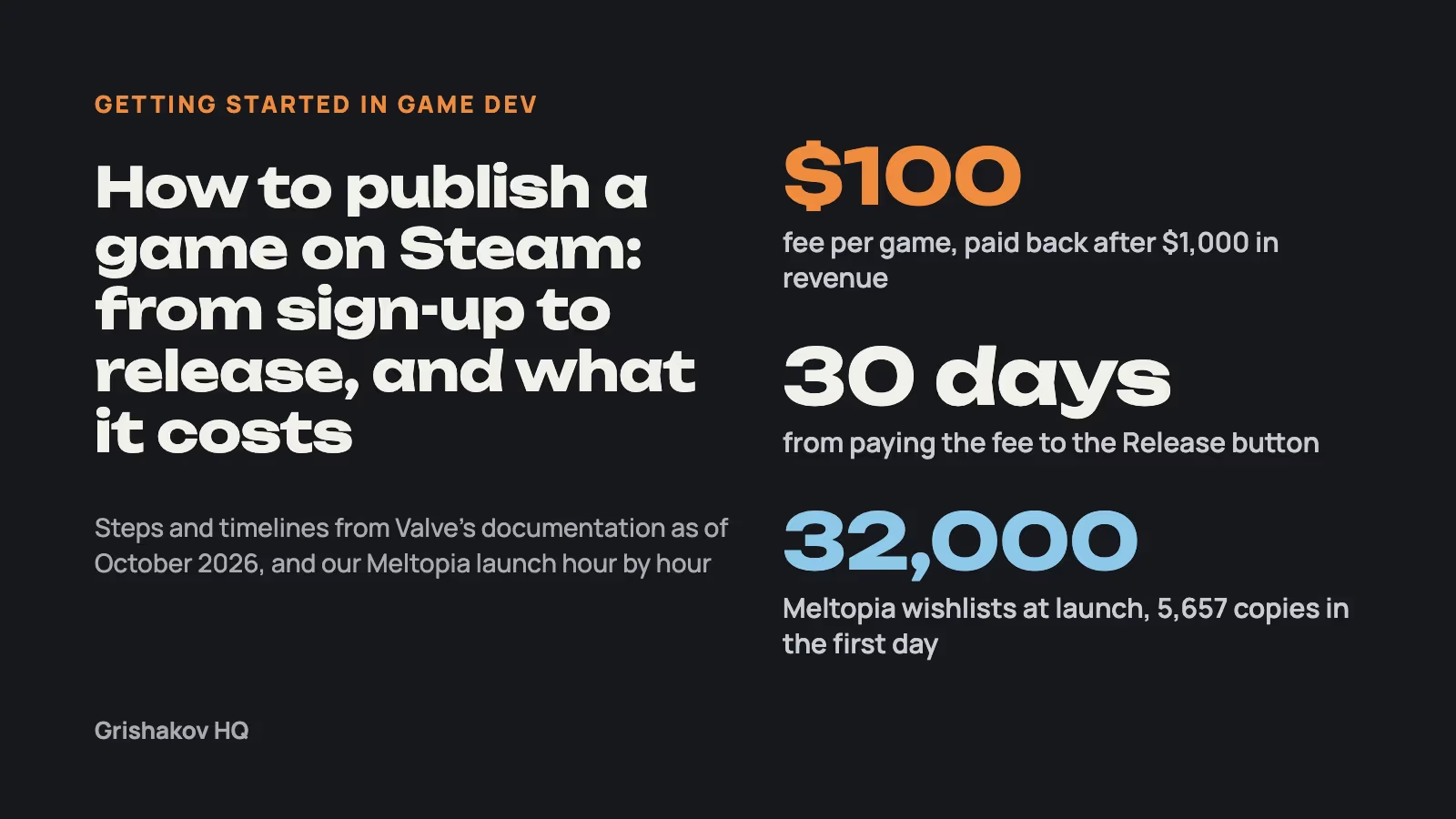
Before Meltopia we had three tries on Steam, and in March 2024 I wrote: "So far Steam has brought us $6,886 in total. Not much." Then Meltopia came out and paid for itself in two days. Below is how to publish a game on Steam step by step, following Valve's documentation with prices and timelines as of October 3, 2026, and next to it how it went for us: what was ready the day before launch, what happened in the first hours and what the packaging cost.
I show how Silicone Heart and Clear the Snow are moving toward release, with wishlists, demos and mistakes, as it happens.
Our games on the way to release, with numbers and mistakes
Evgeny on XHow to publish a game on Steam: six steps from Valve's docs
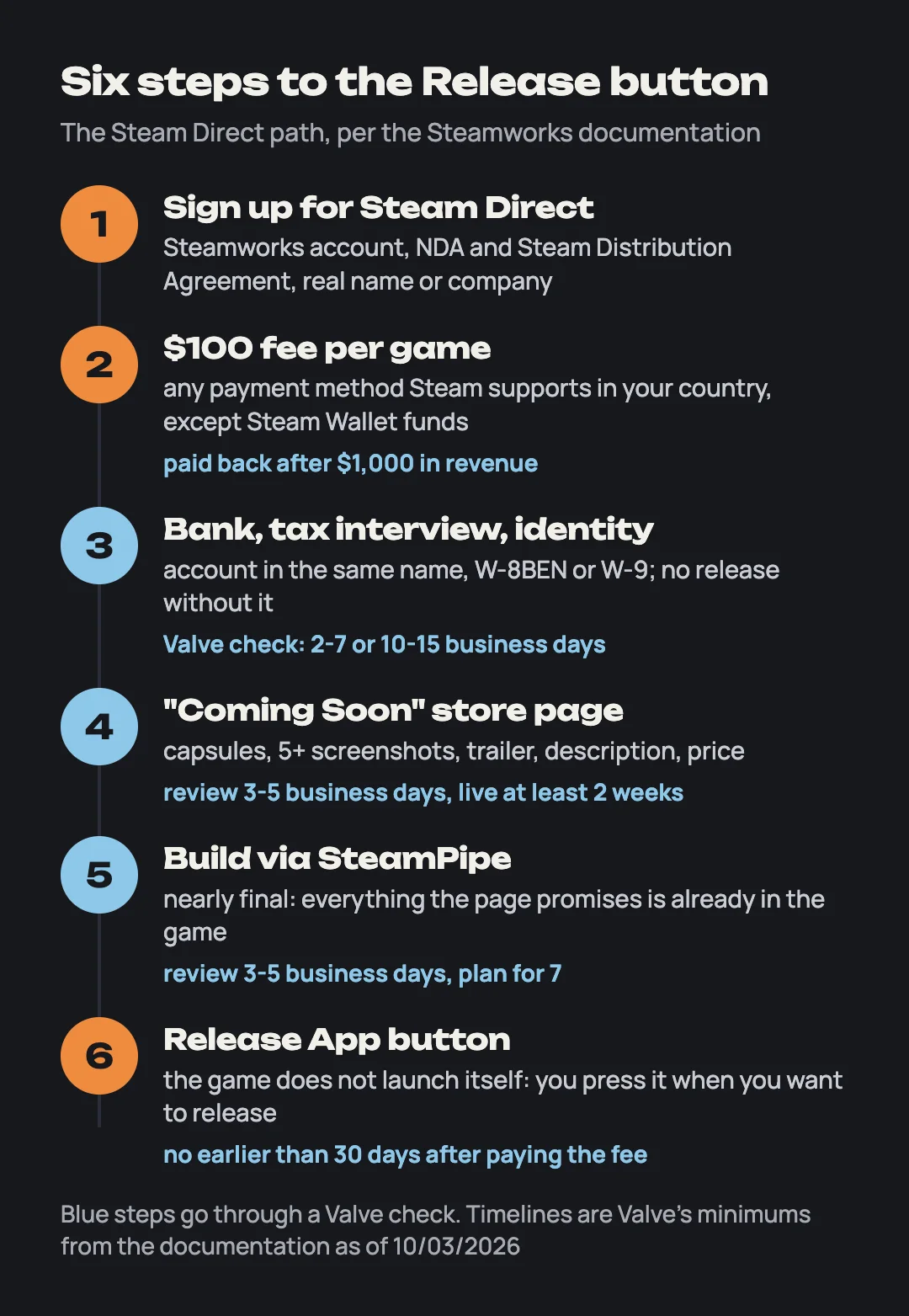
There is one path for everyone. It is called Steam Direct, and Valve describes it as a route "for new game developers from anywhere in the world to bring games to Steam." You need your real name or a company, a bank account, $100 and a finished game with a store page. If you do not have a game yet, I went through where to start and which stages come before this point in how to make your own game. After that there are six steps, and three of them go through a Valve check.
- Sign up for Steam Direct. You create a Steamworks account and e-sign a non-disclosure agreement and the Steam Distribution Agreement. Real name only, no pseudonyms. Valve says it directly: "Do not enter an alias or nickname."
- Pay the $100 fee. It is paid for every app you want to release, with any payment method Steam supports in your country, except Steam Wallet funds.
- Bank, tax interview and identity check. You cannot release a game without valid bank and tax information. Valve has a separate FAQ item about it.
- Store page. Capsules, at least five screenshots, a trailer, a description, a price. The page goes to review, and once approved it is published as "Coming Soon" at least two weeks before release.
- Build. You upload it through SteamPipe, Steam's content delivery system, and it also goes to review. The build has to be "nearly final": every feature on the store page is already in it. You can update it during review and after.
- The "Release App" button. When the page is approved, two weeks have passed and the build is checked, a green button appears at the top of your game's page in Steamworks. Valve warns: "Approved titles will not release themselves." You press it at the moment you want to launch.
How much does it cost to publish a game on Steam?
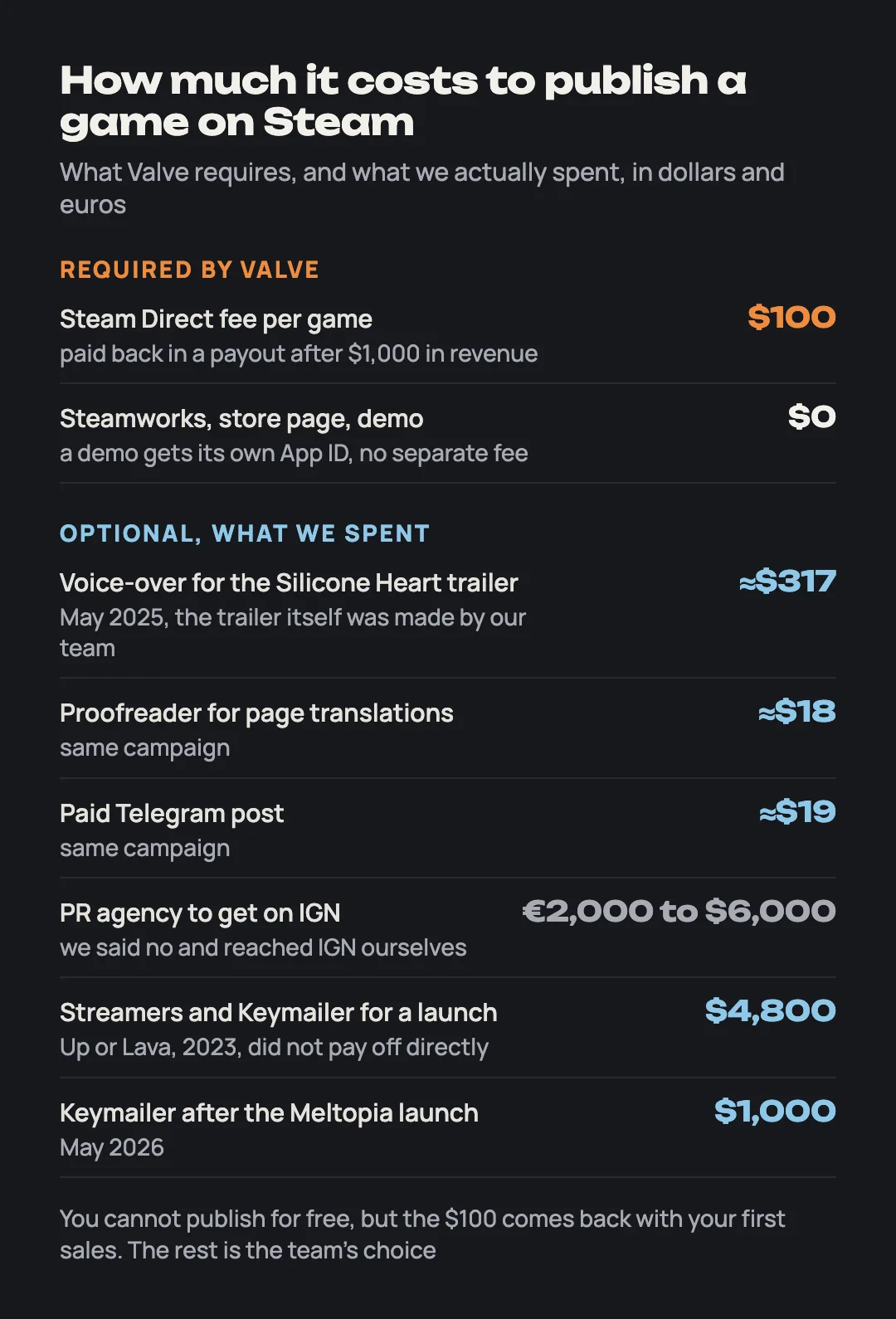
There is one required payment: $100 per game, and Valve pays it back once the game earns $1,000. Everything else, from the trailer to streamers, is up to you, and there the bill can run into thousands of dollars. The table shows what is required and what we actually spent.
| Expense | How much | Conditions |
|---|---|---|
| Steam Direct fee | $100 per game | paid back in a payout after $1,000 in revenue, plus VAT in your country |
| Steamworks, store page, demo | $0 | a demo gets its own App ID, the docs list no separate fee |
| Voice-over for the Silicone Heart trailer | about $317 | May 2025, the trailer itself was made by our team |
| Proofreader for the page translations | about $18 | same campaign |
| Paid Telegram post for the announcement | about $19 | same campaign |
| PR agency to get the trailer on IGN | €2,000 to $6,000 | we said no and reached IGN ourselves |
| Streamers and Keymailer for the Up or Lava launch | $4,800 | 2023, did not pay off directly |
| Keymailer after the Meltopia launch | $1,000 | May 2026, to stretch the wave |
Ruble amounts in this article are converted to dollars at the Bank of Russia rate for October 22, 2026, about 82 rubles per dollar.
The $100 comes back as a separate line in a payout once the game reaches $1,000 in adjusted gross revenue. So you cannot publish a game on Steam for free, but the fee is paid back as soon as the game earns that much. If you dispute the fee payment or reverse it through your bank, Valve may hold both your payouts and the reimbursement.
Everything else is your choice: in our table it ranges from about $18 for a proofreader to $4,800 for streamers. The Silicone Heart announcement in May 2025 cost us a voice-over, a proofreader and one paid post. The trailer was made by people on our team, and we turned down PR agencies that asked €2,000 to $6,000 for an IGN placement and got onto IGN through a chain of industry contacts instead. Chris Zukowski of How To Market A Game advises that with a small budget you invest in the capsule before the trailer, ads or a PR agency. We went roughly the same way with Meltopia. Back in October 2025 I wrote: "a small game, a minimal ad budget, the most attractive graphics we can get."
We figured out streamers for a launch back in 2023 on Up or Lava: $2,500 on Russian streamers, $2,300 on Keymailer. The conclusion then was "Don't expect streamers to pay off directly," but "Streamers are needed so that other streamers notice you and start making their own videos." At the same time I wrote that you should budget $5,000 to $10,000 for a launch. I have not published what Meltopia itself cost. My estimate the morning after launch was that it needed about 10,000 sales to break even, and it broke even in two days.
Registering in Steamworks: who you are, which bank, which taxes
Valve wants to know who it is doing business with, so before release you pass three checks: identity, bank and tax status. Until all three are done, you cannot release. We registered long ago, so everything here comes from Valve's documentation. In March 2024 I wrote that I'm "not a Steam guru yet, but step by step I'm learning what the platform can do."
Who signs the agreement. The Company Legal Name field is for the legal entity that owns the rights to the game and signs the Steam Distribution Agreement. If you own the game as an individual, Valve asks you to choose "Sole Proprietorship" and enter your own name. To "do I need to form a company", Valve's FAQ answers that it is entirely your decision, although many developers have found a company useful.
Bank. You need an account number, a routing number and the bank's address, and the account holder's name must match the name you registered with. For an individual, that means the account must be in your own name, the same as in Company Legal Name. Valve pays only in US dollars: by ACH transfer in the US and by SWIFT in USD everywhere else, so your account has to accept such transfers.
Tax interview. A short questionnaire, 5-10 minutes, that sets your tax status and withholding rate. US citizens and companies give W-9 information, residents of countries with a US tax treaty give W-8BEN information. You cannot save the interview halfway, and after moving to another country you take it again. Withholding on US sales ranges from 0% to 30%: without a tax treaty or without a taxpayer ID (TIN), Valve has to withhold 30%. How that rate works in practice, I went through in how much Steam takes from a game sale.
Valve gives these timelines for the check as of October 2026: on the onboarding page tax verification "may take up to 30 days", the Steam Direct page says identity verification "takes between 15-30 days to complete", the FAQ still says "2-7 business days", and in any case they may ask for more documents. Plan for up to a month: on the Steam Community forum in 2024, a developer from Germany spent eight days unable to pass the interview because of a "your TIN does not match IRS records" error.
Can you publish a game on Steam from any country?
Almost. By Valve's documents, the only countries and territories it does not work with are Crimea, Cuba, Iran and North Korea, plus people on the OFAC sanctions list. In practice the hard part is money in and money out: paying the fee with a method Steam supports in your country, and having an account in your name that accepts USD by SWIFT. If that does not work for you, the options are a company abroad or a publisher who releases the game under their own Steamworks account. Which fits you and how to set it up is a question for a lawyer and an accountant.
Revenue, payouts and mistakes from our launches as they happen
Evgeny on XSteam store page requirements: what goes on "Coming Soon" and how many wishlists it brings
You need a Steam page long before release, because it collects wishlists, and on launch day Steam itself sends every wishlister an email and a notification. Valve requires the "Coming Soon" page to be published at least two weeks before release, but you will not gather wishlists in two weeks.
What to prepare, per the Steamworks documentation:
- Capsules: Header 920×430, Small 462×174, Main 1232×706 and Vertical 748×896, all four required, plus a set for the player's library (600×900 capsule, 3840×1240 Hero, a PNG logo).
- Screenshots: at least five, 1920×1080 or larger, 16:9, gameplay only. Concept art, frames from videos and images with awards do not pass review.
- Trailer: required, up to 1920×1080, 30 or 60 frames per second, a bitrate of 5,000 Kbps or more, in .mp4, .mov or .wmv. You cannot release while the trailer is still converting.
- Description: detailed and clear, with no links to other sites.
Since September 1, 2022, capsules may only carry art, the game's name and its official subtitle. No review scores, awards, "90% off", calls to wishlist or ads for other games. A game that breaks this can lose store visibility and its place in sales. A developer from UhiyamaLab failed review several times in 2025 for exactly this: they put UI screenshots with small text into the capsules.
Zukowski counted how many wishlists to expect from a page: the median for the first two weeks after it goes live is 149, the average is 1,025, and every spike above the median in his sample belonged to a developer who had released games before. His benchmark of "at least 7,000 by launch" to get into Popular Upcoming has been out of date since the June 2026 update: according to Zukowski, Valve raised the bar for that section and at the same time launched a personal calendar of upcoming games. How many wishlists games in Popular Upcoming have now and where to get them, I went through in Steam wishlists: how many you need before launch. Valve also says separately that wishlists do not affect a game's algorithmic visibility. What they give you is the launch-day email to wishlisters. And they do give conversion in the first days, that part is from our own experience. In my Next Fest video I put it like this: "our job is to show Steam as many signals as possible that the game is selling."
Here is how it went for us. The Meltopia page was already up by summer 2025, the trailer on IGN in June got about 25,000 views, and by September the game had a little over 4,000 wishlists. In October there were 7,000, and I wrote: "and we haven't really done anything yet." Then came a playtest for 390 people, the demo and Next Fest, and by the end of March we had 25,000, and 32,000 at launch. How we prepared the demo for the festival and why it went live on the second day is in the article about Steam Next Fest and preparing a demo.
With Silicone Heart, the trailer came out in May 2025 on IGN, GameTrailers and with streamers: 88,000 views, more than 70 posts and 6,000 wishlists, and the page grew from 16,000 to 22,500. My grade at the time: "as a studio without a publisher and without Steam launch experience, we did a solid A. Not an A-plus." For Clear the Snow we built the page first, on announcement day updated the screenshots, the GIF and the capsule, sent the page to 60 media outlets and gave IGN the trailer as a one-day exclusive. At the end of December, on one day, 84 wishlists came in with no effort at all. What else we did to bring people to the page, I collected in the article on how to market an indie game.
How long does Steam review take, what Valve checks and why games get rejected
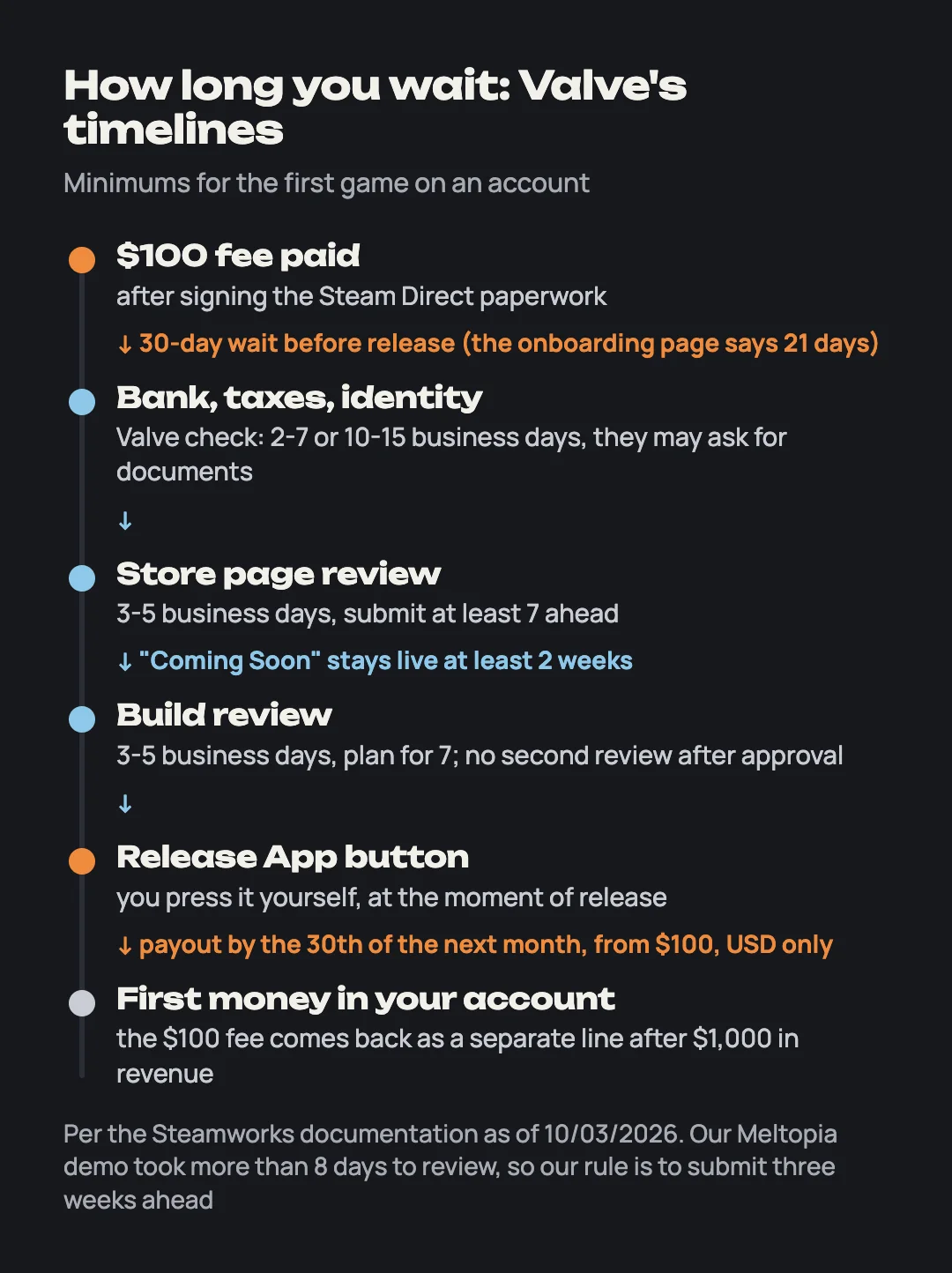
There are two reviews, one after the other: first the store page, then the build. Each usually takes 3-5 business days, but Valve asks you to count on seven, because after any notes everything is resubmitted. Valve asks you to submit the page at least 7 business days before the date you want it public, and the build 7 business days before release.
What Valve checks, per its Review Process page:
- the capsules show the game's name or logo;
- the screenshots show only gameplay;
- the description is detailed, has no outside links, and the page lists no features that will not be in the release;
- the build runs on every operating system listed on the page;
- every feature from the page is in the build;
- in-game purchases go through the Steam Wallet.
If the game has AI-generated content, you disclose it in the content survey in Steamworks. What exactly to disclose, I went through in how to make a game with AI.
After approval there is no second review, and you can update the game as much as you like. The review only confirms that the game runs and has what you promised. Bugs are still on you. On the Steam Community forum in 2025, developers described build reviews that dragged on for weeks with the status "automated tests failed, waiting for a detailed report", and they could not move the release date in the meantime.
There is one more wait that is not a review: time has to pass between paying the fee and release so Valve can verify your information. On the public Steam Direct page it is 30 days. The onboarding page says 21 days for the first games on an account. Steamworks will show which number applies to you, but I would not plan for less than three weeks. In December 2025 I wrote about our whole road to Steam: "Everything takes a very long time))".
I already told the story of our own review in the Next Fest article: we submitted the Meltopia demo 8 days before the festival and expected 2-3 days. Valve first asked us to add what the demo was about and approved it only on the festival's second day. We lost a day and a half of the fest, and now our rule is to submit for review three weeks ahead.
How we launched Meltopia: from store page to the Release button
Meltopia came out on May 1, 2026 with 32,000 wishlists and sold 5,657 copies in the first day. It was our first Steam launch with wishlists and real marketing behind it. Here it is step by step, with numbers from my posts.
Before that there was Bunker 21 in 2023: we had to move its Steam release "because of my inexperience", and after the first stream it had 79 sales and 5 refunds. And there was Up or Lava, which will never pay off. We put the Meltopia team together in September 2025, and the launch came almost eight months later.
The day before launch (post from April 30) we had ready:
- 30,000 wishlists, which grew to 32,000 by launch;
- streamers booked, with the first videos due the next day;
- the trailer sent to IGN, Reddit ads running;
- a spot in the Games from Russia festival, which started on launch day;
- two bundles with other games;
- outreach to Russian media and international streamers;
- new screenshots and GIFs on the page;
- the "Playable" badge on Steam Deck (the game got Verified five months later).
I summed up the list back then: "Total madness!)" The price on the page was $6.99 with a 40% launch discount. We made the launch trailer from April 5 to 15.
Launch day. We pressed the button on the evening of May 1. Within two hours there were already 335 people in the game, and the same day the trailer went up on IGN and the festival started. We shipped a day-one patch at 1 a.m.: players found a pile of bugs, some of which broke progression. That night I wrote down a rule: bugs in the first hours split into two groups. Critical ones and visual ones at the start of the game get fixed right away, everything else goes into a week of polish. By 1 a.m. we had 2,277 sales, 1.4% refunds and 408 players online.
The first day. By morning there were 3,949 sales, 12.3% of wishlists had already converted, and I wrote: "To break even, the game needs about 10,000 sales. It's already clear everything will be fine." The full first day came to 5,657 copies, $22,565 gross revenue, a 17.5% conversion from wishlists and 3,500 new wishlists on top. That was not enough to get into the top 15 popular releases of the week: that takes 2,150 concurrent players or more. But, as I wrote at the time, "the game worked out, that's what matters."
The first week. By May 4, Meltopia was in three store sections at once: top sellers among new releases, popular new releases and popular games under about $3.70 in the Russian store view. Every day brought 7,000-8,000 wishlists, and we kept a rhythm: an update every day, and after each update we answered everyone we could. That is also when we added every localization except Chinese: without a translation, conversion in those countries could sag. Over seven days: 27,135 copies, $107,984 in revenue, a peak of 1,078 concurrent players, 534 reviews and 89.9% positive. Back then I wrote that the project paid off in two days, and after 25 days there were 50,000 sales, after which sales dropped 5-6 times.
Why we held on to May 1 even though the team asked me twice to move the launch, and how we then shipped patches every single day, I told in a video recorded in mid-May while it was all still fresh. The video is in Russian, and YouTube has an English dub track for it.
How much of that revenue actually reaches your account and how to calculate it is in the article on how much Steam takes from a game sale. And to see how unusual a start like this is, look at how much indie games make on Steam: the median game released in January 2026 grossed about $1,000 in eight months.
How you get paid after release
Steam pays once a month, by the 30th of the following month: February sales arrive by March 30. It pays only in US dollars, by SWIFT outside the US, and only once the payout reaches $100. While the amount is smaller, it is held until the next month, and you can raise this threshold yourself in the settings. Change your bank by the 15th, or the payout moves to the next cycle.
Two places where many people trip up with their first game. The figure in the Sales & Activations report does not account for refunds, taxes and chargebacks. The real amount shows up only in the monthly report, so the forum question "I made $200, where is my payout" usually means that after deductions it came to less than $100. And the $100 fee arrives in that same monthly payout after $1,000 in revenue.
If the tax form was filed incorrectly, Steam may also take territorial withholding, and here, as I have advised before, you write to support and file the form again. For us, after four years of putting money into Steam with nothing to show for it, the direction started bringing money in: "Regularly. Like clockwork. Into our account." And we could finally plan a budget.
If you can't publish the game yourself: a publisher
If you have nothing to pay the fee with, nowhere to open an account, or not enough people for the store page and marketing, a publisher can release the game under its own Steamworks account. What a publisher does and how much it takes, I went through in do you need a publisher for an indie game, along with the terms we offer.
In short: if we give an advance for development, up to $50,000, revenue is split 50/50; if there is no advance, the developer gets 70% and we get 30%. We plan development for up to six months, and right now five games by other developers are in the works with us as publisher. We publish through our studio Garden of Dreams, and the site has our games and a contact email.
Which step are you on right now: the store page, the demo, or already the Release button?) And what held you up the longest?
Frequently asked questions
How much does it cost to publish a game on Steam?
There is one required payment: $100 per game, the Steam Direct fee, plus VAT in your country. Steamworks, the store page and a demo are free. Everything else, like the trailer, capsules and streamers, is optional: our voice-over for the Silicone Heart trailer cost about $317, PR agencies asked €2,000 to $6,000 for an IGN placement, and streamers plus Keymailer for Up or Lava cost $4,800 and did not pay off directly.
Can you publish a game on Steam for free?
No, the $100 per game is paid before release and is not refunded as such. But Valve reimburses the fee: once the game reaches $1,000 in adjusted gross revenue, the $100 arrives as a separate line in the monthly payout. If you dispute the fee payment through your bank, Valve may hold both your payouts and the reimbursement.
How long does Steam review take?
The store page review takes 3-5 business days and the build review another 3-5, one after the other, and Valve asks you to plan for at least seven each. The "Coming Soon" page must be live for at least two weeks, and between paying the fee and release Valve requires 30 days per the Steam Direct page or 21 days per the onboarding page. Our Meltopia demo took over 8 days, so we submit three weeks ahead.
Do I need a company to publish a game on Steam?
No. Valve's FAQ says that forming a company is entirely your decision. An individual chooses "Sole Proprietorship" and enters their real name, and the bank account must be in that same name. If a company owns the game, it goes in the Company Legal Name field, and the company signs the Steam Distribution Agreement.
How many wishlists do you need before releasing on Steam?
According to Zukowski, the median for the first two weeks after a page goes live is 149 wishlists, and his old benchmark of "at least 7,000 by launch" went out of date after the June 2026 update, when Valve raised the bar for Popular Upcoming. Valve says wishlists do not affect algorithmic visibility, but they bring a launch-day email to every wishlister. Meltopia had 32,000, and 17.5% of them converted in the first day.
When does Steam pay developers?
Once a month, by the 30th of the following month, so February sales arrive by March 30. Valve pays only in US dollars, by SWIFT outside the US, and only when the payout reaches $100; smaller amounts roll over to the next month. The Sales & Activations figure does not include refunds, taxes and chargebacks, so the real amount is only in the monthly report.
What changed about publishing on Steam by 2026?
The Steam Direct path itself is the same: $100, two reviews, the Release button. The rules around it changed. Since September 2022, capsules may carry nothing but the game's name and subtitle. And in June 2026 Valve raised the bar for Popular Upcoming and launched a personal calendar of upcoming games, so the old wishlist benchmarks for that section are out of date.
Sources
- Valve, Steam Direct
- Steamworks Documentation: Onboarding
- Steamworks Documentation: Steam Direct Fee
- Steamworks Documentation: Steam Direct FAQ
- Steamworks Documentation: Review Process
- Steamworks Documentation: Release Process
- Steamworks Documentation: Coming Soon
- Steamworks Documentation: Store Graphical Assets
- Steamworks Documentation: Graphical Asset Rules
- Steamworks Documentation: Trailers
- Steamworks Documentation: Uploading to Steam (SteamPipe)
- Steamworks Documentation: Taxes FAQ
- Steamworks Documentation: Reporting and Payments FAQ
- Steamworks Documentation: Visibility on Steam
- Steamworks Documentation: Wishlists
- Chris Zukowski, "How many Steam wishlists will you get in your first two weeks", How To Market A Game, 2021-2022
- Chris Zukowski, "(Archive) How many wishlists should I have when I launch my game", How To Market A Game, 2022, marked as archived in June 2026
- Chris Zukowski, "How do you get streamers to cover your game? Get a better capsule", How To Market A Game, 2022
- Steam Community, "Build review has taken weeks", 04/29/2025
- Steam Community, "Tax Identification Number", 04/28/2024
- Steam Community, "Why won't steam send my payment?", 05/29/2019
- UhiyamaLab, "I Failed Steam Review Multiple Times, So I Made a Checklist of All 14 Required Images", 2025
- Evgeny Grishakov, "How to get the MAXIMUM wishlists from Steam Next Fest..." (in Russian), YouTube, 03/19/2026
Our next two Release buttons are still ahead: Silicone Heart and Clear the Snow. How they get to launch and what their first days show, I share on X.
How Silicone Heart and Clear the Snow get to the Release button
Evgeny on X