
Do Indie Games Need a Publisher? What an Indie Game Publisher Does and How Much It Takes
I look at the indie game publisher question from both sides. We released Meltopia ourselves and sold 50,000 copies by the end of May 2026 without a publisher. Silicone Heart had a publisher, and in the summer of 2026 we parted ways with it. And we run our own publishing labels, the console one, Upscale Studio, and the mobile one, Apollo Publishing, where we are the ones splitting revenue with developers.
I post the numbers of our games and publishing labels as we go, the bad ones included.
Our games' and publishing numbers as we go
Evgeny on XWhat does an indie game publisher do, and what does it buy?
A publisher makes sure the finished game gets seen and bought: it brings money, runs marketing, does ports, localization and testing, and deals with the platforms. The developer makes the game itself. In return, the publisher gets the rights to publish it and a share of revenue for years ahead.
What a publisher's work usually includes (based on Simon Carless's breakdown at GameDiscoverCo and Raw Fury's public contract):
- money for development: an advance, most often paid in parts as milestones are reached;
- marketing and PR: trailers, press, content creators, festivals and shows;
- localization and testing;
- console ports and platform relations;
- people at launch and community work.
Rami Ismail, a developer and consultant, suggests looking at the deal soberly: "they're not funding development: they're purchasing publishing rights." The publisher later takes the advance back out of the game's revenue, so in effect it works as an investor with a support team.
Indie developer Tavrox reminds that a publisher will not support your game forever: its time is limited, and it needs to release new games. A publisher does not guarantee sales either.
How much do indie game publishers take? Revenue share and advances in numbers
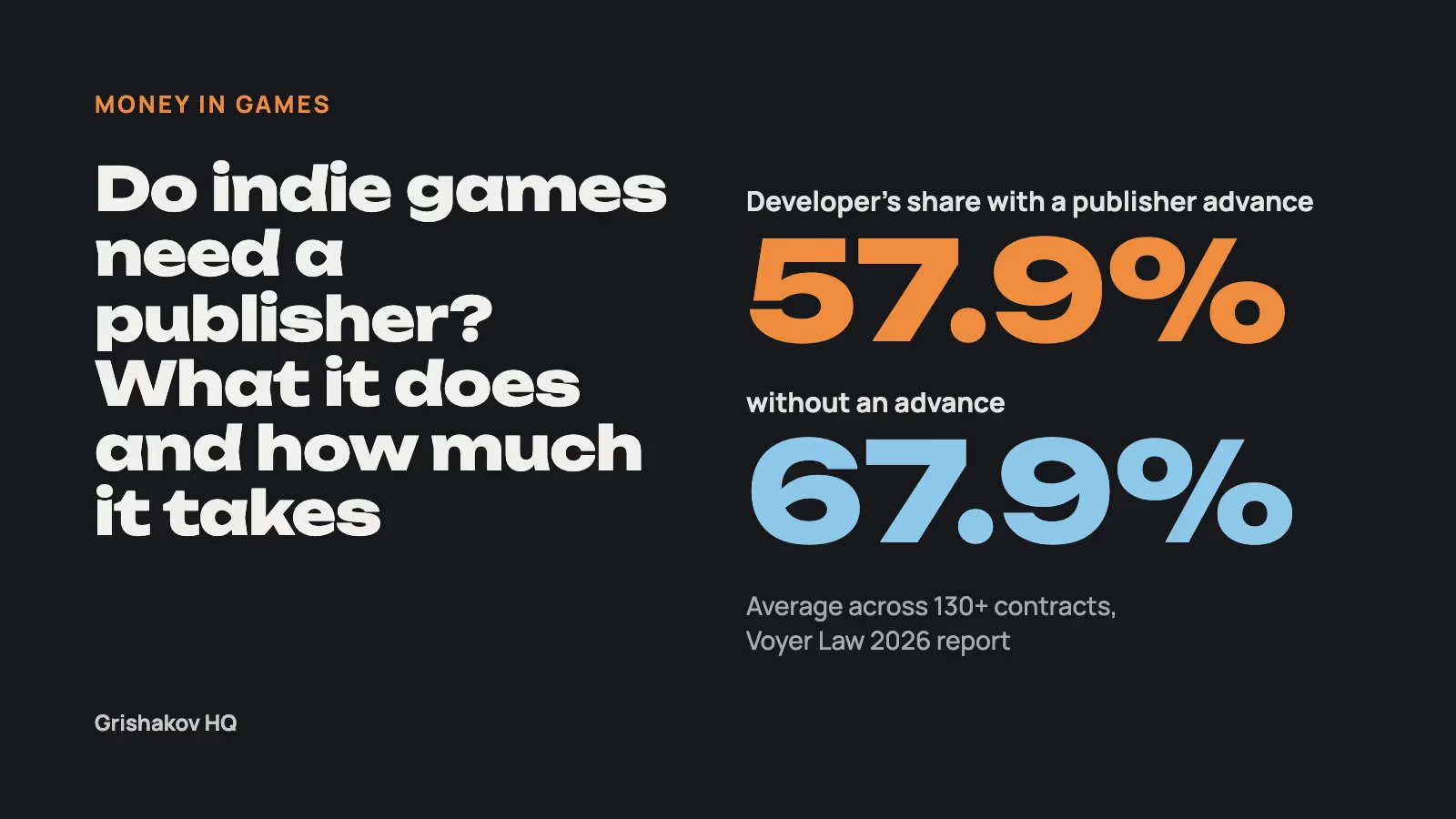
Usually from a third to 42% of net revenue, and much more until it earns back its investment. In its 2026 report, Voyer Law went through 130+ contracts from 2017-2026: on average the developer gets 57.9% of net revenue with an advance and 67.9% without one.
| Source | Developer gets | Condition |
|---|---|---|
| Voyer Law 2026, contracts with an advance | 57.9% on average | advance: median $270K |
| Voyer Law 2026, no advance | 67.9% on average | the publisher does not fund development |
| Voyer Law 2026, consoles only | 66% on average | console port and release |
| Typical deal per Carless (2023) | about 20%, then 50% to 70% | before and after recoup |
| Hooded Horse | 65% | no recoup |
| Russian publishers, App2Top (2025) | 50% or 70% | 50% with investment after recoup, 70% on PC or for marketing only |
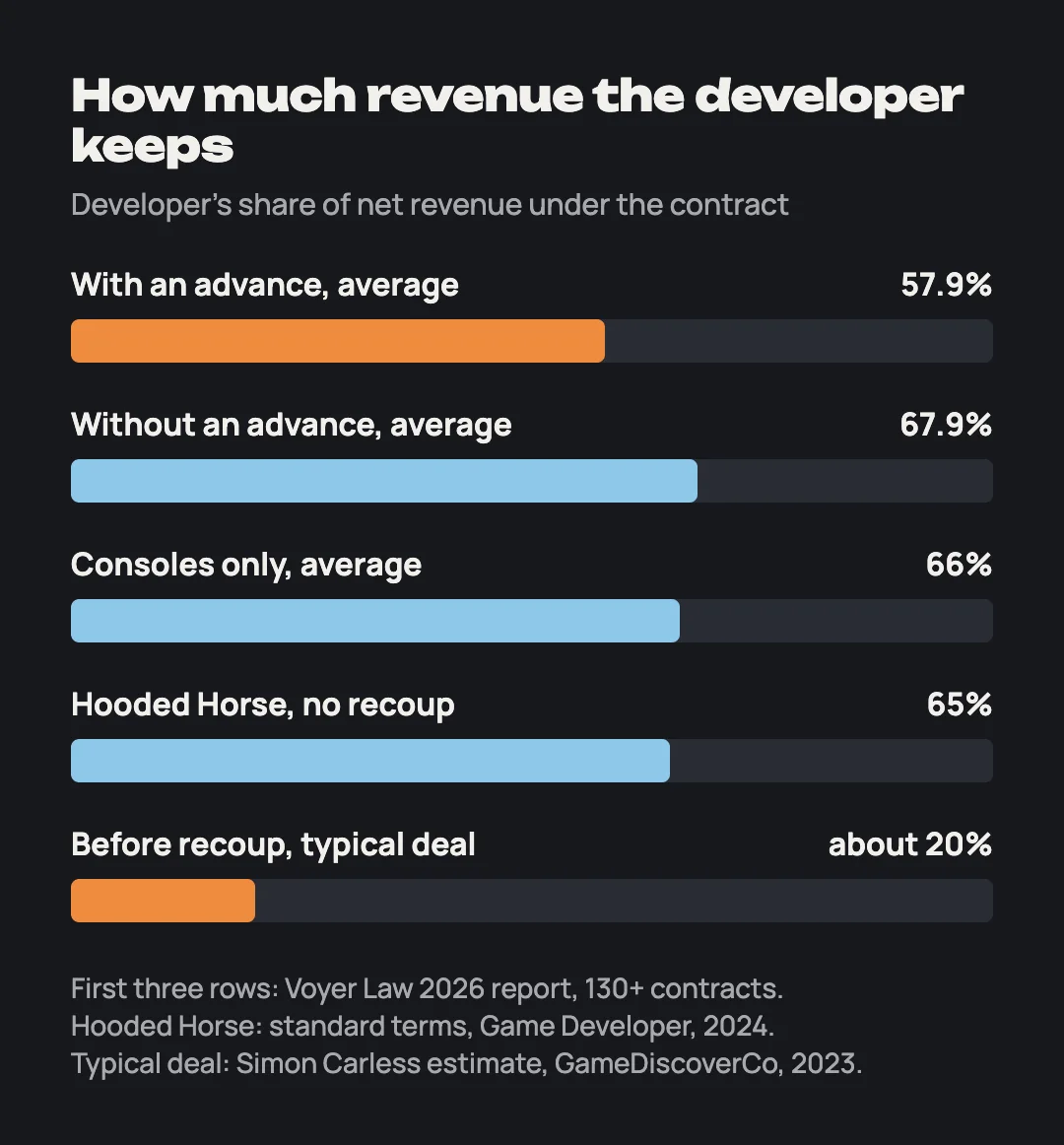
A few caveats about the table. Voyer Law analyzes its own clients' contracts, so it is not a random sample of the market. Their average advance is $602,818, but large deals pull it up, and the median is noticeably lower, $270,000.
The rights to the game (IP) stay with the developer in 93.2% of contracts with an advance. A contract with an advance lasts 6.98 years on average, without one 4.6 years.
What the share is calculated from is also set by the contract: money after the store's cut, taxes, refunds, or something else. The difference is big. Out of Meltopia's $456,945 Steam revenue, by my calculation with a margin for refunds, about $263,885 will reach our account, around 57.5%, and that is without any publisher. I went through how that chain adds up in the article on how to estimate how much a game made on Steam.
What is recoup, and why does it matter more than the percentage in the contract?
Recoup is the publisher getting its investment back out of the game's revenue: the advance, marketing, localization, ports. While recoup is going on, the developer gets a small share or nothing. That is why the amount the publisher has to earn back affects your income more than the percentage in the contract.
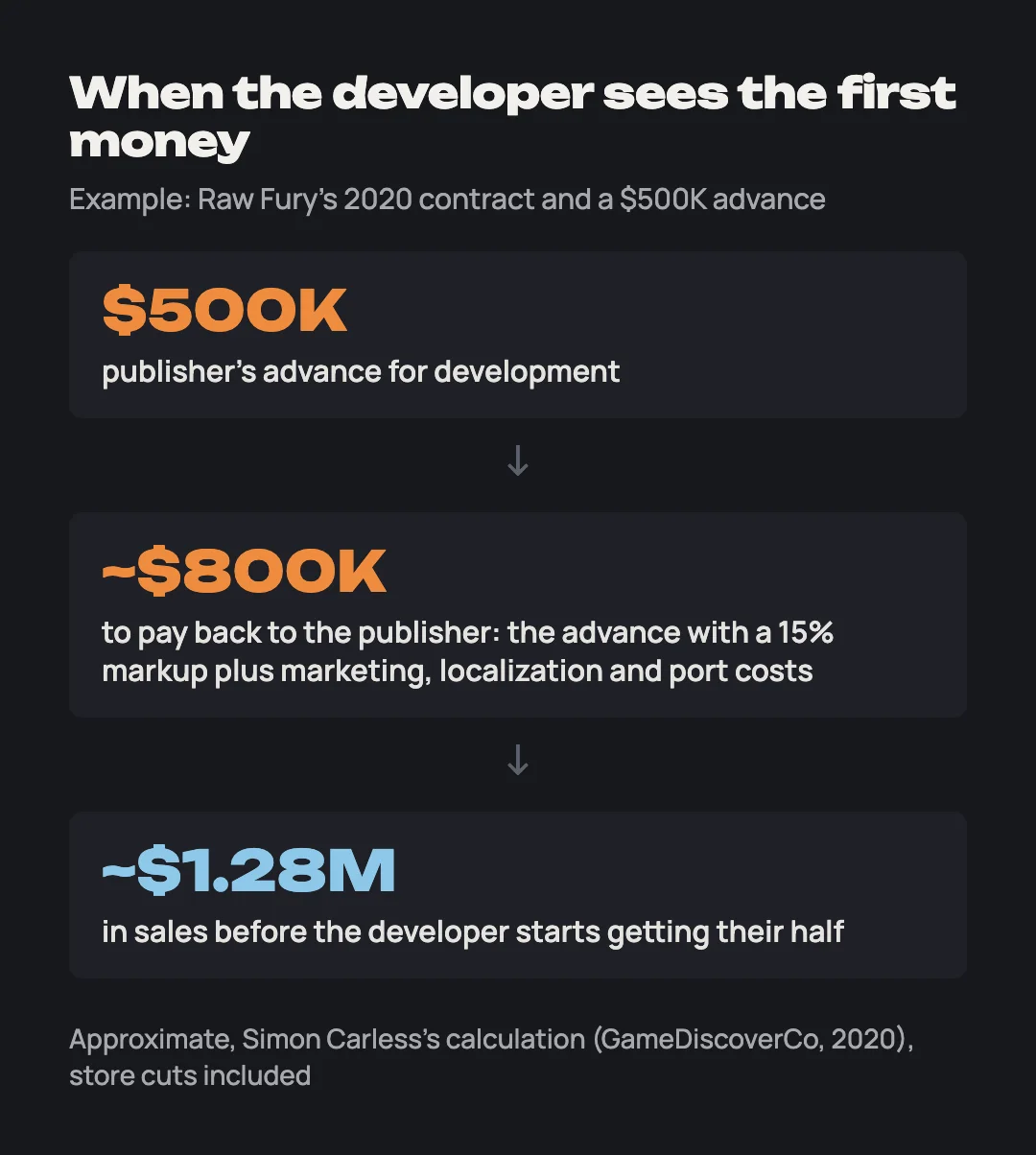
That is how Raw Fury's public 2020 contract works, which Carless analyzed. The advance goes back to the publisher with a 15% markup, marketing, localization and port costs are deducted before the developer is paid, and after recoup revenue is split 50/50. By Carless's calculation, with a $500,000 advance the publisher needs to get back about $800,000, and the developer starts getting their share after roughly $1.28M in sales.
Few games reach those sales. In September 2026, Carless estimated that out of 1,230 games released on Steam in January 2026, only about 7 (0.6%) would already have paid back $500,000 to a publisher under typical terms. These are GameDiscoverCo estimates, but the order of magnitude is clear. How many games break even at all is covered in a separate article: how much indie games make on Steam.
According to Voyer Law's 2026 data, the advance is recouped from revenue in 94.7% of contracts, but the developer has to wait for full recoup before the first payments in only 37% of cases. In the rest, revenue is split from the start, in parallel with recoup. The publisher Hooded Horse dropped recoup altogether and splits revenue 65/35.
Rami Ismail writes about percentages: "a higher Pre-Recoup percentage does not translate to higher earnings, only to faster earnings, and only if the game does well." When you compare offers, run the numbers on your own realistic sales: how many copies you need to sell for the publisher to recoup, and how much of that reaches you.
Getting a game to money, with a publisher or without one, is the main thread of what I post. I show it on our own games and publishing labels, with revenue and failures.
Getting a game to money, with a publisher and without
Evgeny on XWhat publishing looks like from the inside: our console and mobile labels
A publisher invests money and time for a long while before it starts earning: our console label Upscale Studio went into the black after 15 months, the mobile one, Apollo Publishing, after 7. The publisher takes its share for that risk too, and for work the developer would otherwise do themselves.
Console publishing
We launched Upscale Studio in January 2024 to port and release other developers' games on Switch, PlayStation and Xbox. First you need devkits, special consoles for development: the Switch devkit cost us €511.70, and getting all three took 5 months. Then we wrote our own toolkit for ports: controls, vibration, achievements, saves, UI and icons are set up out of the box. By the beginning of summer 2026 we were porting 3-4 games from other developers a month, and had learned to bring in console content creators and get game trailers onto the platforms' own YouTube channels.
Here is what it looks like on one game. In spring 2025 we released a partner's game, Cat From Hell, on Switch: the port and release took about a month, and there were 2,525 sales in the first two weeks. By our formula that came to about $8,000, and we planned to split that money in half with the developer. The scheme was: the publisher does the port at its own expense and earns a percentage of console sales.
By November 2025 the console label had made $119,000 in revenue. In August 2026 I reported for the quarter: $95,077 in revenue, $38,886 in profit and 36,374 copies sold. Rejections happen too: a console platform may not approve a game's concept, and then you have to fight for the release all over again.
I showed how things are going with consoles from the inside in a quarterly video: which partner games we released, why we built our own porting toolkit, and what happened when PlayStation blocked our account. The video is in Russian, and YouTube has an English dub track for it.
Mobile publishing
We launched Apollo Publishing in January 2025. A mobile publisher covers what is expensive for a small team to do alone: a warmed-up Google Play account with organic traffic, mediation and ad networks, install tracking, ad accounts. Apollo had all of that from launch. After 7 months the label went into the black, and payouts to partners for November 2025 came to $12,500. As I wrote back then, "for me this is the main metric for a mobile publisher": the more we pay developers, the bigger the team they can keep and the more games they can make. How much mobile games themselves make, and why it is hard there without mediation and paid installs, I covered in the article on how much mobile games make.
For browser games we have the HTML5 label Mirra Games: by the end of 2024 it had 228 games on Yandex Games, a Russian browser game platform run by Yandex. If you want to go that way yourself, I went through how to publish a game on Yandex Games and how the money comes in there.
How a Steam publisher is different
Here the publisher's job is different. In November 2025, when we were thinking about how to grow the console label, I looked at going into Steam and wrote that such a label needs completely different processes: buying wishlists, a festival manager, shows and investment in games. Back then I admitted honestly: "I really don't want to go into that. At least not now." And in July 2026 I wrote that we were slowly starting to build a publishing business and were "already handling 3 games." Now we have five published games.
A developer without a publisher does all that work themselves. Getting ready for a festival is covered in detail in the article about Steam Next Fest and the demo.
Meltopia without a publisher, Silicone Heart with one: how it went
About Meltopia I wrote that we made it "on our own, without publishers." Silicone Heart had a publisher: it helped with marketing but did not give money for development, and in the summer of 2026 we were the ones who offered to part ways.
In 2024 I put "Self-publishing only" into our company's plans and explained: "I haven't seen examples of long-term success from teams that work with publishers." And about why we fund our own projects ourselves, without investors, I added: "I don't need to get anyone's approval to start development."
Meltopia: no publisher
We did marketing, festivals and content creators ourselves; how exactly is in the article on how to market an indie game. By September 28, 2026, the game had $456,945 in Steam revenue and 89,518 copies sold. By my calculation, after taxes (about 8.5% on average), refunds with a margin, and Steam's cut, about $263,885 will reach us. That calculation step by step is in the article on how much Steam takes from a game sale. The rest goes to our own taxes, staff, ads and next games, and we do not have to share it with a publisher. What this path looks like step by step, from registering in Steamworks to the Release button, I covered in the article on how to publish a game on Steam.
Meltopia's sales outside Steam are in a separate article about China and GOG.
Silicone Heart: with a publisher
In February 2026 I said that the game had a publisher. It ran ads for our trailer on the GameTrailers YouTube channel through Google Ads, and soon after the video came out we already had 2,000+ wishlists. On Kickstarter the publisher helped with mailings. The campaign raised $65,741 from 873 backers. We hit the minimum goal but fell short of the $100,000 we were counting on, and, as I later admitted, it "brought almost no net money, just PR."
On July 30, 2026, I announced that we had terminated the contract: "We were the ones who offered the publisher to part ways. That's true. But we didn't fight or argue."
I gave the reason in the same post: "The publisher didn't give us money for development. All our hopes were on Kickstarter. And since we didn't raise the money, we'd be funding everything ourselves with or without the publisher. So what's the point?)"
Do indie games need a publisher, or can you self-publish?
Most games on Steam come out without a publisher: according to a HushCrasher study, publishers released 23% of 19,634 games from 2022-2025 with 10 or more reviews. You need a publisher when the team lacks money, consoles or people for marketing, and the share it takes is smaller than what it adds to sales.
In GDC's 2026 survey, studios and solo developers most often named their own money as the main source of funding (35%), and a publishing deal 20%. Games with a publisher have a higher median revenue: according to GameDiscoverCo and Gamalytic data for 2024, $16,222 against $3,285 for self-published ones. But the author of that count warns that publishers do not pick games at random and strong games end up with them more often, so the whole gap cannot be credited to the publisher.
Back in 2019 Carless wrote that "having a publisher is absolutely not 'a must' for releasing a successful game." And he asked: did you give away 30% of the game's lifetime revenue even though it did nothing for sales?
| Situation | What the publisher gives | What to look at |
|---|---|---|
| No money to finish the game | an advance | the recoup amount, how many sales before your first payments |
| You want to get onto consoles | devkits, port, certification, platform storefronts | a share of console revenue only, or of all platforms |
| No people or time for marketing | PR, festivals, content creators, ads | what exactly it commits to do and on what budget |
| You have money and do marketing yourself | little | what you are giving up a revenue share for |
In our experience in console publishing, Steam usually brings 60-70% of a release's revenue, and the rest comes from consoles. Getting there takes devkits, platform checks and months of paperwork, so a console publisher may take a share of console revenue only, while Steam revenue stays with the developer.
What to check in a game publishing contract before you sign
Before signing, check what goes into recoup, for how many years you give away the rights, what happens to sequels, and whether you can audit the publisher's reports. This is not legal advice: show the contract to a lawyer who works with games.
Kellen Voyer of Voyer Law explained why negotiations are hard for developers: "developers are at a two fold informational disadvantage: First, they don't know what key publishing terms mean and second developers don't know what is standard and what is not standard."
- Share before and after recoup, and what it is calculated from. Which money is the share calculated from: after the store's cut, taxes, refunds?
- What goes into recoup. Only the advance, or also marketing, localization, ports. Is there a markup: Raw Fury had 15%, while according to Voyer Law's 2026 report 96% of contracts with an advance have no markup.
- Cross-collateralization. Can the publisher cover costs for one platform or game out of another's revenue.
- Term and reversion of rights. On average a contract with an advance lasts 6.98 years, and 16% of contracts have no end date. It is good if the rights come back to you when the publisher does not deliver what it promised.
- Rights to the game, sequels and DLC. IP stays with the developer in 93.2% of contracts with an advance, but sequel clauses are common.
- Audit rights. In the Voyer Law report they are in 88.4% of contracts with an advance. Without them you cannot check that your money is counted correctly.
- The publisher's obligations. What marketing budget, which platforms and by when. You cannot write "we'll do everything" into a contract.
How to get a publisher for your indie game
Go to a publisher with a game that already has a Steam page, wishlists and a playable build. Publishers sign a small share of projects and look for proof of demand.
Developer Matt Hackett, while looking for a publisher for his game, learned this: "One publisher said straight-up that they sign with less than 1% of the developers they talk to." Russian publishers at an App2Top round table named the same things they want to see: a Steam page with wishlists and a playtest.
Chris Zukowski of How To Market A Game warns about early access: if you come to a publisher with an early access game asking for money for version 1.0, you will be turned down fast, because a publisher's business is built on promoting the launch.
I wrote about The King is Watching before. Its developers uploaded a prototype to itch and to an HTML5 games portal, "got 20k wishlists right away," and then signed with the publisher tinyBuild. According to its creator, the game sold 300,000 copies in a month and a half.
The terms we offer
Since I have taken apart so many other people's contracts, here are ours. If we give an advance, revenue is split 50/50. If there is no advance, the developer gets 70% and we get 30%.
We give up to $50,000 for making a game, and plan development for up to 6 months. We are working on 5 published games from other developers plus our own projects. We publish through our studio Garden of Dreams; its site lists our games and a contact email.
Would you go to a publisher for an advance, or release the game yourself? What do you think?)
Frequently asked questions
What does an indie game publisher do?
A publisher makes sure the finished game gets seen and bought: it gives money for development, runs marketing and PR, does ports, localization and testing, deals with platforms and works with the community at launch. In return it gets the rights to publish the game and a share of revenue for years ahead. A publisher does not guarantee sales, and it will not support the game forever either.
How much do indie game publishers take?
Usually from a third to 42% of net revenue, and much more until they earn back their investment. According to Voyer Law's 2026 report, the developer keeps 57.9% on average if the publisher paid an advance and 67.9% if it did not. In a typical deal as Carless describes it, the developer gets about 20% before recoup and 50% to 70% after. Hooded Horse splits revenue 65/35 with no recoup.
Do indie games need a publisher if you can release on Steam yourself?
Most games come out without one: according to a HushCrasher study, publishers released 23% of 2022-2025 games with 10 or more reviews. A publisher makes sense when the team has no money to finish the game, no way onto consoles or no people for marketing, and the share it takes is smaller than what it adds to sales. If you have money and do marketing yourself, ask what you are giving up a revenue share for.
What is recoup in a publishing contract?
Recoup is the publisher getting its investment back out of the game's revenue: the advance, marketing, localization, ports. Until then, the developer gets a small share or nothing. In Raw Fury's contract, with a $500,000 advance the publisher needs about $800,000 back, and the developer starts getting their share after roughly $1.28M in sales. According to Voyer Law, full recoup before first payments is required in 37% of contracts.
How do I get a publisher for my indie game?
Go to a publisher with a game that already has a Steam page, wishlists and a playable build. Publishers sign a small share of projects: one of them, according to Matt Hackett, signs with less than 1% of the developers they talk to. Russian publishers at an App2Top round table wanted the same: a Steam page with wishlists and a playtest. An early access game asking for money for version 1.0 gets turned down fast.
How big is a typical publisher advance?
In the Voyer Law 2026 report the average advance is $602,818, but large deals pull it up, and the median is noticeably lower, $270,000. The report covers the firm's own clients, so it is not a random sample of the market. A contract with an advance lasts 6.98 years on average, and the rights to the game stay with the developer in 93.2% of such contracts.
Sources
- Voyer Law, 2026 Publishing Agreement Market Report
- Simon Carless, "One step beyond: how game contracts could evolve", GameDiscoverCo, 2023
- Simon Carless, "What makes for a good game publishing contract?", GameDiscoverCo, 2020
- Simon Carless, "Is the game biz sustainable for the average indie dev?", GameDiscoverCo, 09/15/2026
- Simon Carless, "Do you need a publisher to 'make your game sell'?", GameDiscoverCo, 2019
- Rami Ismail, "The publisher's lie", Levelling The Playing Field, 2023
- Rami Ismail, "Upfronts, guarantees and recoups", Levelling The Playing Field, 2022
- Tavrox, "The ugly truths of indie publishers", 2021
- Chris Zukowski, 60 Game Marketing Mistakes, How To Market A Game, 2023
- Alissa McAloon, "A data-driven primer for publishing agreements", Game Developer, 2020
- Game Developer, "Hooded Horse co-founder says publishers should ditch 'horrible' recoup clauses to help devs", 2024
- Game World Observer, "The budget for 80% of games released on Steam since 2022 does not exceed one million dollars", HushCrasher analytics, 2025
- OP Game Marketing, "The 2024 indie and AA game market", 2025
- GDC, State of the Game Industry 2026
- Matt Hackett, "9 things I learned pitching my game to publishers", 2024
- App2Top, "What to have on hand when looking for a publisher and how much money it can give for development: a round table with publishers" (in Russian), 2025
- Evgeny Grishakov's Telegram channel "Grishakov HQ", posts #1595, #1596, #1795, #1821, #2222, #2323, #2411, #2546, #2720, #2875, #2876, #2928, #3028, #3033, #3205, #3217, #3225, #3245, #3256, #3328, #3329, #3332, #3441 (in Russian)
How Silicone Heart and Clear the Snow are getting to release
Evgeny on X