
Steam Next Fest: How to Prepare Your Demo and How Many Wishlists It Brings
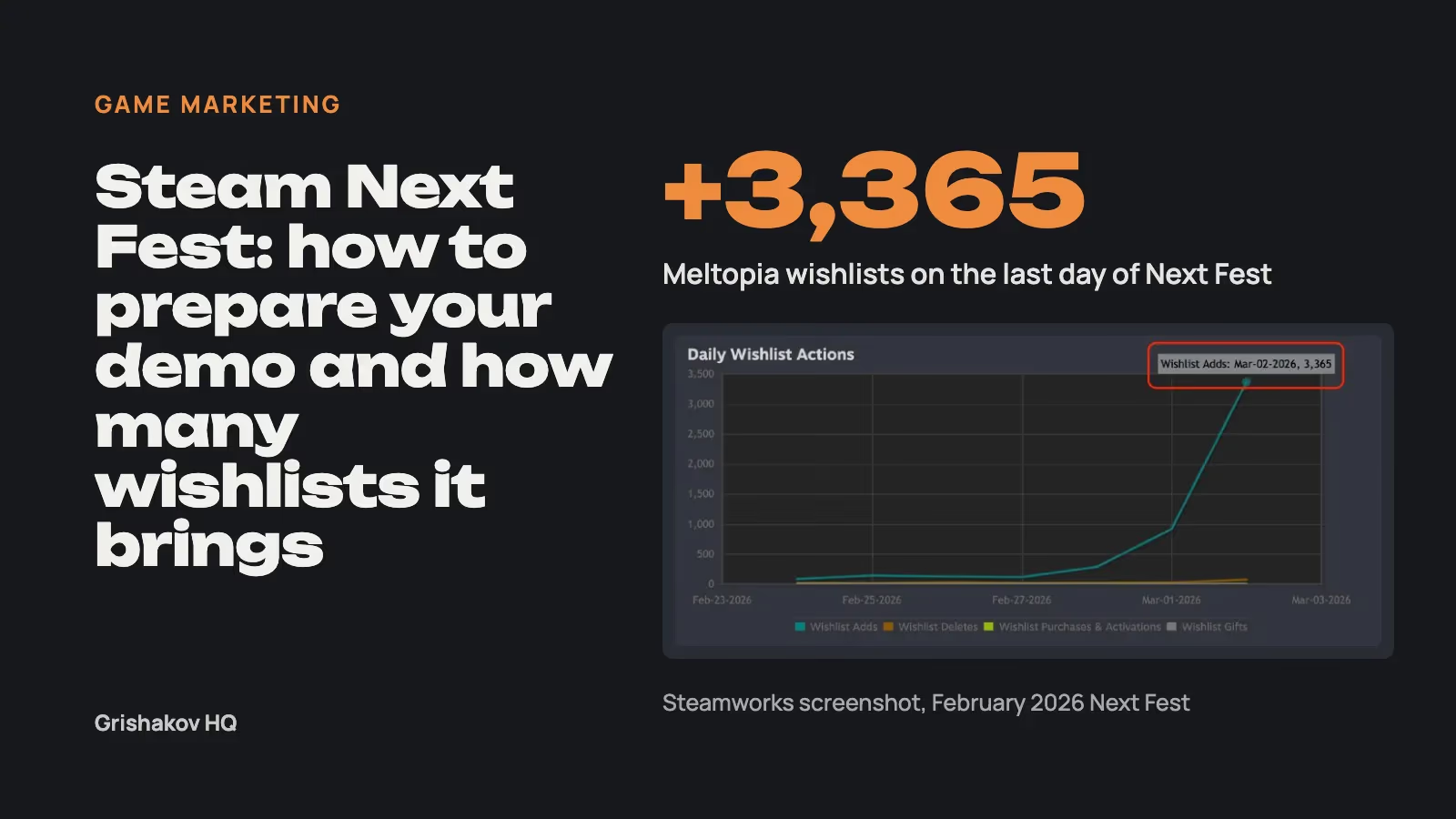
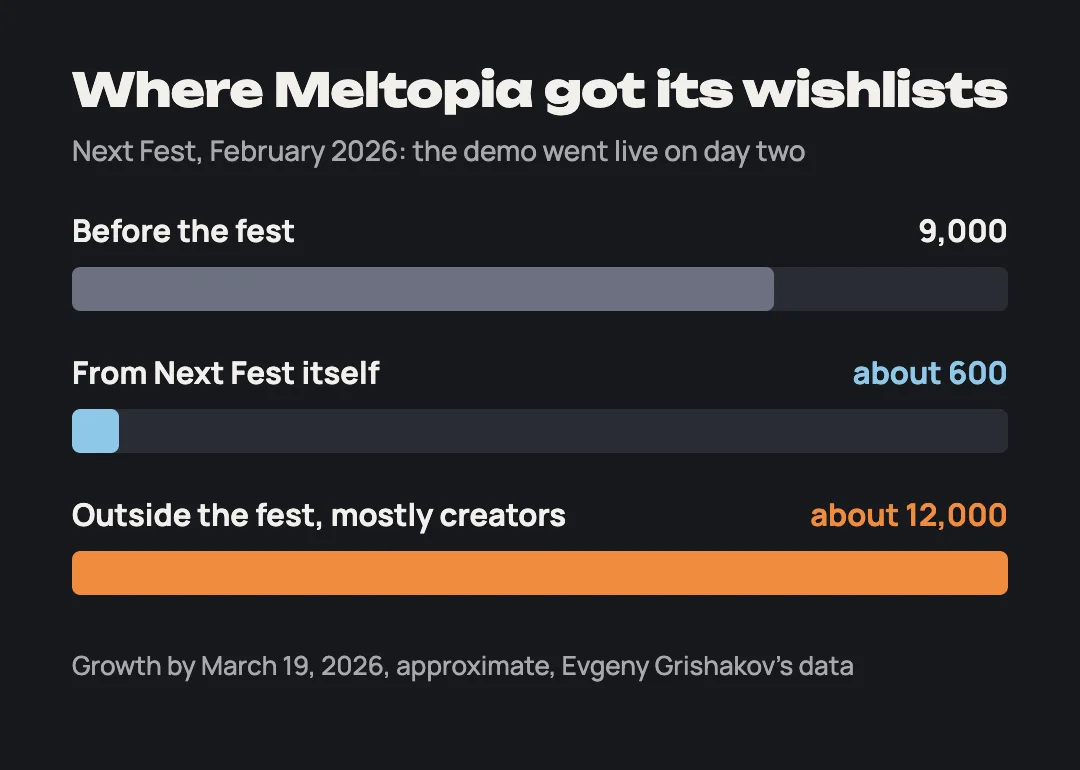
In February 2026 we took the Meltopia demo to Steam Next Fest. Over the fest the game went from 9,000 wishlists to 14,000, and by March 19 it had 23,000. Of that growth, about 600 wishlists came from the festival itself. The demo passed Valve's review only on day two of the fest, and the main wave came from content creators.
I'm Evgeny Grishakov, I make and publish games. I post the wishlist, demo and launch numbers of our games on X as they come in, including the ones that don't look good.
Our games' numbers as we go, including the awkward ones
Evgeny on XWhat is Steam Next Fest and who can join?
Steam Next Fest is a week of free demos of unreleased games on Steam that Valve runs three times a year. Any game with a published store page and a public demo can take part, but only once in its life.
Valve's requirements from the developer documentation:
- the game's store page is published and public;
- a publicly playable demo is live by the time the fest starts;
- the game does not release before the fest ends;
- the demo is not a prologue or a short version of a game already sold on Steam;
- the game has not been in a Next Fest before: "titles may only participate in ONE Next Fest".
There are no requirements on demo length, release date or exclusivity. You register the base game, the demo is not registered separately. You cannot pay for extra visibility inside the fest. There has been no official livestream since October 2024; developer streams are optional and sit on a separate tab.
When is the next Steam Next Fest?
By the Steamworks calendar, the October 2026 fest runs October 19-26, 2026, and the next two are February 22 - March 1, 2027 and June 14-21, 2027. Registration for October closed on August 31, and everything had to be submitted for review by September 28, so if you are only getting started, February 2027 is the realistic target.
A game gets one try, so pick the fest to fit your release date. More on that in the section on releasing after the fest.
How many wishlists from Steam Next Fest?
About 200 for a median game by GameDiscoverCo's estimate and 806 in Chris Zukowski's survey; games with a big base get thousands. The biggest factor is how many wishlists you had before the fest.
The two sources count differently. Simon Carless of GameDiscoverCo estimates every participant from the number of followers a game has: in February 2026 the fest had more than 3,500 demos, the median game got about 200 wishlists, and the top 5% about 7,000. Chris Zukowski (How To Market A Game) surveys developers: for the same fest he collected 182 answers, and the median was 806 wishlists. It looks like developers who did well are more willing to fill in the survey, so his numbers are higher.
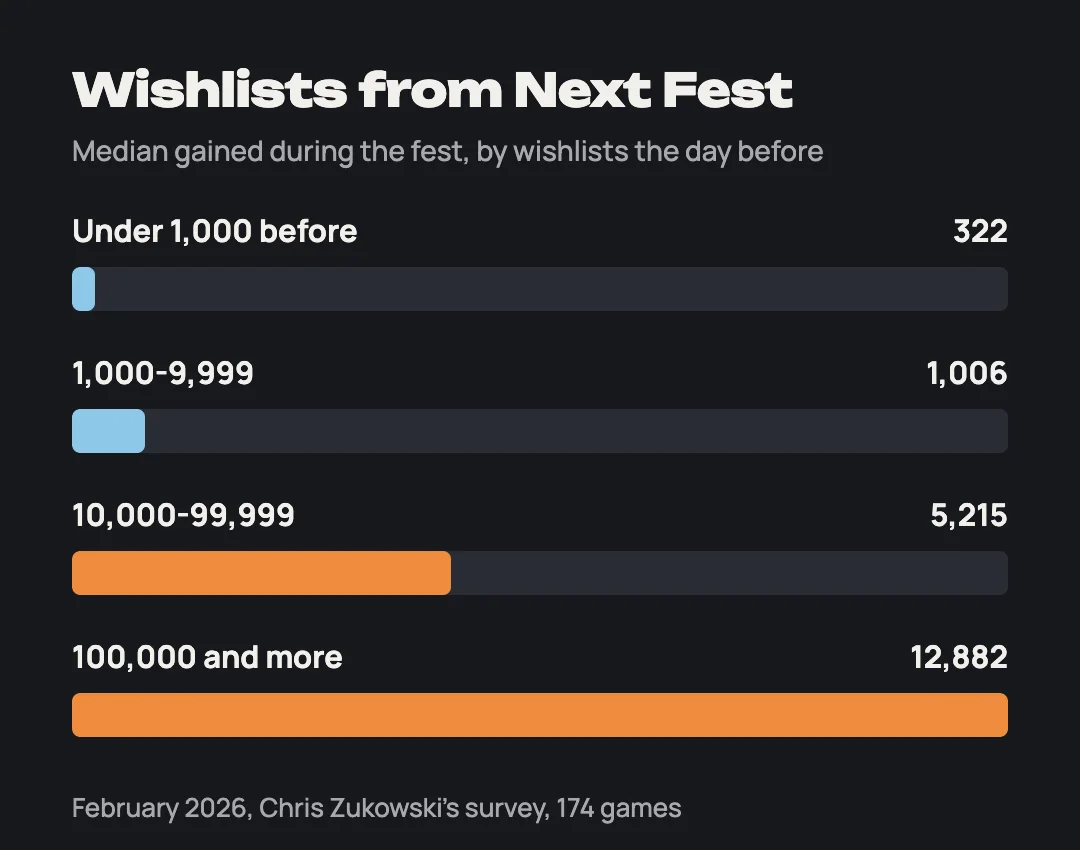
In Zukowski's data the result is strongly tied to the base: the correlation between wishlists the day before and wishlists gained during the fest is 0.825. His numbers for February 2026:
| Wishlists the day before the fest | Median gained during the fest | Middle of the sample |
|---|---|---|
| up to 999 | 322 | 179-485 |
| 1,000-9,999 | 1,006 | 549-1,722 |
| 10,000-99,999 | 5,215 | 2,584-9,633 |
| 100,000 and more | 12,882 | 9,989-27,661 |
"Middle of the sample" is the 30th to 70th percentile, which covers four games out of ten.
Small indie projects that posted their results on DTF, a Russian gaming site, show what this looks like at the low end. Sadko had about 100 wishlists before the fest and 275 by the end of it. MagiClean came to the February 2026 fest with 562 and left with 1,757. Mirealle got about 1,500 from the same fest. For games like these the fest sometimes doubles the base, but in absolute numbers that is hundreds.
It is handy to compare your result with the table row you fall into. If your game got less than the median of its row, check the demo and the store page first.
What happened with Meltopia at Next Fest in February 2026?
The demo went live on day two of the fest because we left too little time for Valve's review. The fest itself brought about 600 wishlists, and about 12,000 more came from content creators.
The plan was good. In December I wrote: "We'll release the demo a week before the festival. We'll bring in creators. On February 23 we go to the festival." The idea was to warm the demo up in advance so that on day one of the fest we already had players online and Steam would push us up in the sections.
We uploaded the demo 8 days before the start. I counted on 2-3 days of review, and that was a mistake: Valve says build review usually takes 3-5 business days and asks you to plan for at least seven.
A few days later we got a question about what the demo is about and were asked to add to the description. We did it right away, and the approval came on Tuesday, when the fest was already in its second day. By then, honestly, I had given up and decided we had missed the fest. We went live a day and a half late, so we messed up a bit, and in the video I said exactly that: "the result from Next Fest could have been much bigger and much better".
A couple of weeks after the fest I recorded a video about how the demo got stuck in review and where the wishlists came from anyway. It is in Russian, and YouTube has an English dub track for it.
The numbers:
- before the fest Meltopia had 9,000 wishlists;
- the best day was 3,365 wishlists, almost three times the best day of Silicone Heart (I wrote at the time: "Meltopia, what are you doing? 😂");
- by March 3, the day after the fest ended, 14,000;
- by March 19, 23,000, with about 500 more coming in every day;
- from Next Fest's own organic traffic, about 600, most of them on the last day.
A game with 9,000 wishlists falls into Zukowski's row with a median of about 1,000 from the fest. Zukowski asks about all wishlists gained during the fest week, and by that measure our growth (14,000 minus 9,000, about 5,000) is well above the median. If you count only what Steam itself brought, 600 is below the median, and the day and a half we lost played a part. By my estimate, with a normal start the fest would have given us several thousand more wishlists.
Next Fest is only one step of the road to a first release with wishlists: before it we had playtests, after it the launch and the first sales. On X I show how that road goes for our games: what we planned, what happened and where we got it wrong.
Our games from demo to launch, with numbers and mistakes
Evgeny on XWhere did Meltopia get wishlists, if not from Next Fest?
About 12,000 of Meltopia's wishlists came from gaming content creators, paid and free. Their videos brought outside traffic to the game on the same days the fest was running.
We bought short vertical videos through Jestr, a platform where the developer pays for every 1,000 views, but no more than a set amount. The starting rate was $5 per 1,000 views, and as the videos gained views the price went down. In the end it came to $2.29 per 1,000. What our other channels cost, from streamers to ads on X, is in the article on how to market an indie game.
We gave creators a folder of footage with captions: here we melt snow, here we fall into a tunnel, here we melt a door, here is the trailer. What to film and what to say was up to each of them, we did not check anything. One video got 800,000 views, another 480,000, and after that other creators started covering the game on their own.
At the same time we wrote to creators who had covered similar games and bought one sponsored segment in a long video, which got about 110,000 views. We handled creators and festivals ourselves. If you don't have the people or the money for that, this is usually the publisher's job, and I went through what a publisher does for its share in the article on whether an indie game needs a publisher.
It also worked because the timing matched the demo fix: after launch the demo was collecting bad reviews, more on that in the next section. The videos started taking off on the same day we released the fixed build, so people came into a game that had already become good. Concurrent players grew right in front of us: 90, 100, 107, 113, 135, 150, then 175 at once.
What to do if your demo gets bad reviews during the fest?
Fix it right away, starting with the most critical problems. Three days after the demo went live we released a fixed build, the score went up after it, and by March 3 it was 82% positive out of 63 reviews.
The playtests before the demo went well: 90% of players said they wanted to keep playing. In the demo we added new game systems, and the balance broke along with them. Negative reviews poured in and the score dropped to Mixed. For the first two days we shipped a patch a day, and nothing changed. I couldn't sit still: a Mixed score already on the demo almost certainly meant a flop at launch.
On Thursday we got everyone together with the game designer and wrote down about seven critical issues. On Friday we released the build I described at the time as: "Not tedious, pleasant. And the rating started to climb." By mid-April the demo had 91% positive out of 58 reviews in the last 30 days and an average playtime of 1.1 hours.
Don't count on Valve's review to catch problems like this. The documentation says build review only confirms that the game runs and has what you promised: "it is not a full QA process, and will not catch or even look for most bugs". Valve does not look at demo updates after review at all.
For me the fest worked like an X-ray of the game. In playtests 90% of players wanted to keep going, and the broken balance was exposed in the first two days by strangers who opened the demo. The wave of interest from the fest is wasted if the game is not ready to receive players at that moment, and what saved us was that the creators' videos landed on the fixed build.
When to release your demo and submit it for review?
Submit it for review at least three weeks before the start: that is what Valve's schedule says, and what I say after our experience. Release the demo early so you have time to fix it based on reviews before the fest.
On timing, Valve says store page and build review usually take 3-5 business days, but you should plan for at least seven. If the build is rejected, you will have to resubmit, so you need a buffer for that too. A demo may not have its own store page, but it still goes through store page review.
Opinions on the release itself differ. In the demo documentation Valve says it generally recommends waiting until launch, though there are cases when a demo before release works. In the Next Fest documentation the same Valve calls any strategy acceptable. Practitioners release earlier: by Zukowski's data, demos released well before the fest got about 2.5 times more wishlists on average, though the correlation is weak.
Zukowski does not advise beginners to drop a demo suddenly right before the start: "If this is your first game and your first Steam Next Fest, do not try to shadow drop your demo".
My plan after Meltopia: submit for review three weeks ahead, release the demo about a week and a half ahead, polish it on the first players, and a week before the start send the email to wishlisters and bring in creators.
How to join Steam Next Fest: a week-by-week plan
The countdown starts five weeks before the fest, when Valve opens the developer preview. Below is Valve's schedule with our additions. Valve publishes exact dates for each fest separately, and they can differ slightly.
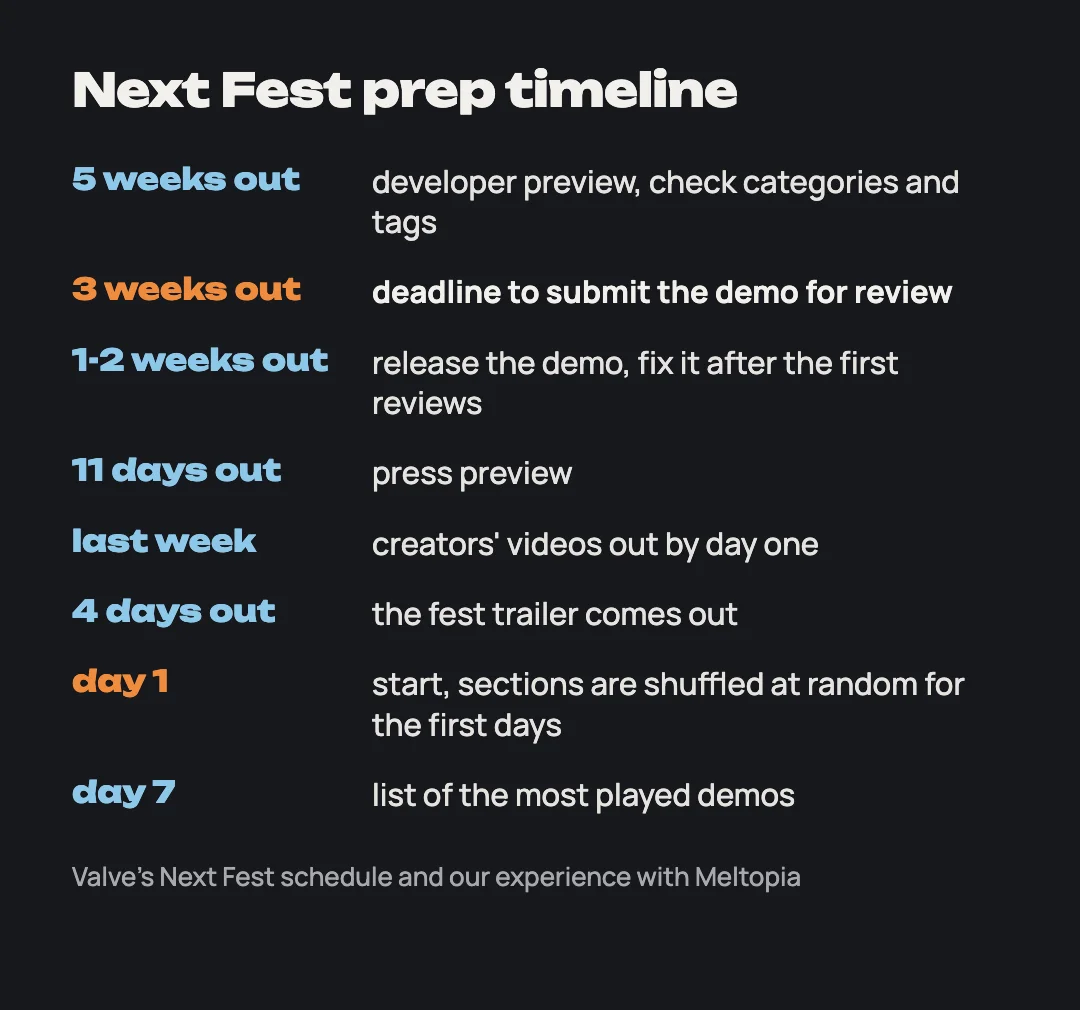
- 5 weeks out or earlier. Register the base game for the fest and check that a green participation checkmark has appeared on the app landing page in Steamworks. Pick one or two main categories and check your tags: Steam uses them to place games in the fest's sections. The developer preview shows where your game landed, and you can still fix the tags. Valve picks some games for the fest's general trailer right after registration closes, with the developer's consent. Valve only takes a public video from the store page, so a fresh trailer has to be on the page before registration ends.
- 3 weeks out, the hard deadline. Submit the demo for build and store page review. If you want the press to see the demo during the press preview, submit earlier, by the five-week mark. We submitted 8 days out and lost a day and a half of the fest.
- A separate demo store page. It needs a trailer and at least five screenshots from the demo itself. Players leave demo reviews on that separate page.
- 1-2 weeks out. Release the demo, collect the first reviews, fix the main issues. Strip everything that is not part of the demo out of its files: Mark Brown (GMTK) said players unlocked the full version of his game on day one.
- Right after the demo goes live. Republish the base game's store page, otherwise the Download Demo button will not appear on it. In the settings you can choose a prominent green box in the center of the page.
- The email to wishlisters. The button appears in Steamworks on the demo's app landing page for 14 days after the demo first launches, and it works once. If you released the demo six months before the fest and pressed the button then, there will be no second email for the fest.
- 11 and 4 days out. The press preview opens 11 days out, and the fest's general trailer comes out 4 days out.
- The last week. Line up creators so their videos come out by day one of the fest. For the first days Steam places games in sections at random, then adjusts the lists to player behavior. Ideally you want your peak player count on day one: we had 175 concurrent players only near the end of the fest, and got less organic traffic because of it.
- During the fest. Watch the reviews and ship fixes. Valve does not review updates, so a game-breaking bug goes straight to players. Streaming is optional: Valve says you can focus on the demo.
- After the fest. You can leave the demo up, Valve recommends it. A week after the start Valve publishes a list of the most played demos.
On demo length, Mark Brown suggests aiming for 30-90 minutes of play for the median player. Our Meltopia demo had an average playtime of 1.1 hours in mid-April.
Which mistakes most often eat your Next Fest result?
Almost all of them are about timing and preparation: the demo is submitted at the last minute or released raw, and the game comes to the fest with almost no wishlists and with the wishlist email already used up.
- Submitting the demo at the last minute. We uploaded ours 8 days before the start, and it cost us a day and a half of the fest. On Reddit, a team that submitted its build on deadline day found out the demo would not launch, and only Steam support saved it.
- Coming with almost no wishlists. One developer came to the February 2026 fest with fewer than 200 wishlists and left with about 400. The game has no second try, and the demo email was already spent in February.
- A demo that doesn't hold players. In one Reddit breakdown a demo had 500 players and a median playtime of 2 minutes, after which Steam showed the game less and less.
- A demo used as a playtest. Mark Brown puts it bluntly: "a demo is not a playtest build ... It's marketing". A raw demo collects reviews that stay on the page.
- Forgetting to republish the game's store page after the demo goes live. There will be no demo button, and people who open the game's page won't know they can download it.
- Panicking on day three. Zukowski notes that at this point the fest leaves Steam's top banner and impressions drop for everyone, every single time.
When should you release after Steam Next Fest?
We launched about two months later: the fest ended on March 2, and Meltopia came out on May 1 with 32,000 wishlists. That is the gap I recommend, if the game is ready by then. What else needs to be done by that point, from build review to two weeks of a Coming Soon page, is in the article on how to publish a game on Steam.
Those two months went into what the fest showed us: we finished the tutorial and a cutscene, then froze the demo and put everything into the release version. Before launch, in my opinion, you should go to Next Fest specifically, it is the main festival for indies on Steam. Zukowski advises the same, going to the last Next Fest before launch and coming with at least 2,000 wishlists. Mark Brown advises not waiting a year to launch after the demo.
Next Fest is not the only festival, though. The free Simfest, which we simply applied to, gave Silicone Heart +3,000 wishlists, and after it I wrote: "Take part in every festival!" What else besides festivals brought our games wishlists and what one wishlist cost, I put in a table in the article on Steam wishlists: how many you need before launch and where they come from.
If you want to estimate how much games with a similar number of wishlists make, see the breakdown of how much indie games make on Steam and how to estimate a game's revenue from its reviews. How much of that revenue reaches the developer after the cut, taxes and refunds, I worked out in the article on how much Steam takes from a game sale. And how we kept working on Meltopia after launch, in China and on GOG, is in a separate article.
In the video I called Next Fest a dress rehearsal before the premiere. I would go to it with a demo that has already passed review and has been live on Steam for at least a week.
Frequently asked questions
What is Steam Next Fest?
It is a week of free demos of unreleased games that Valve runs on Steam three times a year. Any game with a published store page and a public demo can take part, but only once in its life. You cannot pay for extra visibility inside the fest, so the result depends on your wishlists before the fest and on the traffic you bring yourself.
How do you join Steam Next Fest?
Register the base game for the fest in Steamworks and check that a green participation checkmark appears on the app landing page. By the start you need a public store page and a public demo that has passed build and store page review, and the game must not release before the fest ends. Submit the demo for review at least three weeks ahead: we submitted 8 days out and lost a day and a half of the fest.
When is the next Steam Next Fest?
By the Steamworks calendar, the October 2026 fest runs October 19-26, 2026, but its registration closed on August 31 and materials were due for review by September 28. The next two are February 22 - March 1, 2027 and June 14-21, 2027. If you are only starting now, February is the realistic target, and a game gets only one try, so pick the fest to fit your release date.
How many wishlists do you get from Steam Next Fest?
A median game gets hundreds: about 200 by GameDiscoverCo's estimate for all February 2026 participants and 806 in Chris Zukowski's survey, which tends to attract stronger games. The base matters most: games with up to 999 wishlists got a median of 322, games with 1,000 to 9,999 about 1,000. Meltopia, with 9,000 wishlists, got about 600 from the fest itself, and about 12,000 more came from creators on the same days.
How many times can a game take part in Next Fest?
Once in the game's life, Valve's documentation says so directly: titles may only participate in ONE Next Fest. That is why you should pick the fest to fit your release date. Zukowski advises going to the last Next Fest before launch with at least 2,000 wishlists, and we released Meltopia about two months after the fest, which is the gap I recommend.
When should you release your demo before Next Fest?
Submit it for review at least three weeks ahead: Valve says review takes 3-5 business days but asks you to plan seven, and a rejected build has to be resubmitted. Release the demo itself about a week and a half ahead so you can polish it on the first players. By Zukowski's data, demos released well before the fest got about 2.5 times more wishlists, and he advises beginners against a sudden release right before the start.
Sources
- Valve, Steam Next Fest (Steamworks documentation)
- Valve, Steam Next Fest: October 2026
- Valve, Upcoming Events (Steam events calendar)
- Valve, Demos (Steamworks documentation)
- Valve, Review Process (Steamworks documentation)
- Simon Carless, "Who 'won' February 2026's Steam Next Fest?", GameDiscoverCo, 03/03/2026
- Chris Zukowski, "Benchmarks: how many wishlists can I get from Steam Next Fest", How To Market A Game, updated 04/08/2026
- Chris Zukowski, "Making sense of the February 2026 Steam Next Fest", How To Market A Game, 04/13/2026
- Chris Zukowski, "Did AI slop ruin Steam Next Fest June 2026?", How To Market A Game, 07/13/2026
- Mark Brown, "How to make a great Steam Next Fest demo", GMTK
- "How to take part in Steam's Next Fest and how many wishlists you can get" (Sadko) (in Russian), DTF, 10/11/2025
- "How many wishlists I got from Steam Next Fest 2026" (MagiClean) (in Russian), DTF, 03/24/2026
- "Steam Next Fest results and the Mirealle demo update" (in Russian), DTF, 03/13/2026
- r/IndieDev, demo submitted on deadline day, 07/02/2026
- r/IndieDev, Next Fest with fewer than 200 wishlists, 08/23/2026
- r/gamedev, a demo with a 2-minute median playtime, 02/27/2026
- Evgeny Grishakov, "How to get the MOST wishlists from Steam Next Fest..." (in Russian, English auto-dub), YouTube, 03/19/2026
Right now we are preparing demos of Silicone Heart and Clear the Snow. How they get from demo to launch, and which of the two collects more, I share on X.
How Silicone Heart and Clear the Snow get from demo to launch
Evgeny on X