
Steam Wishlists: How Many You Need Before Launch and Where They Come From
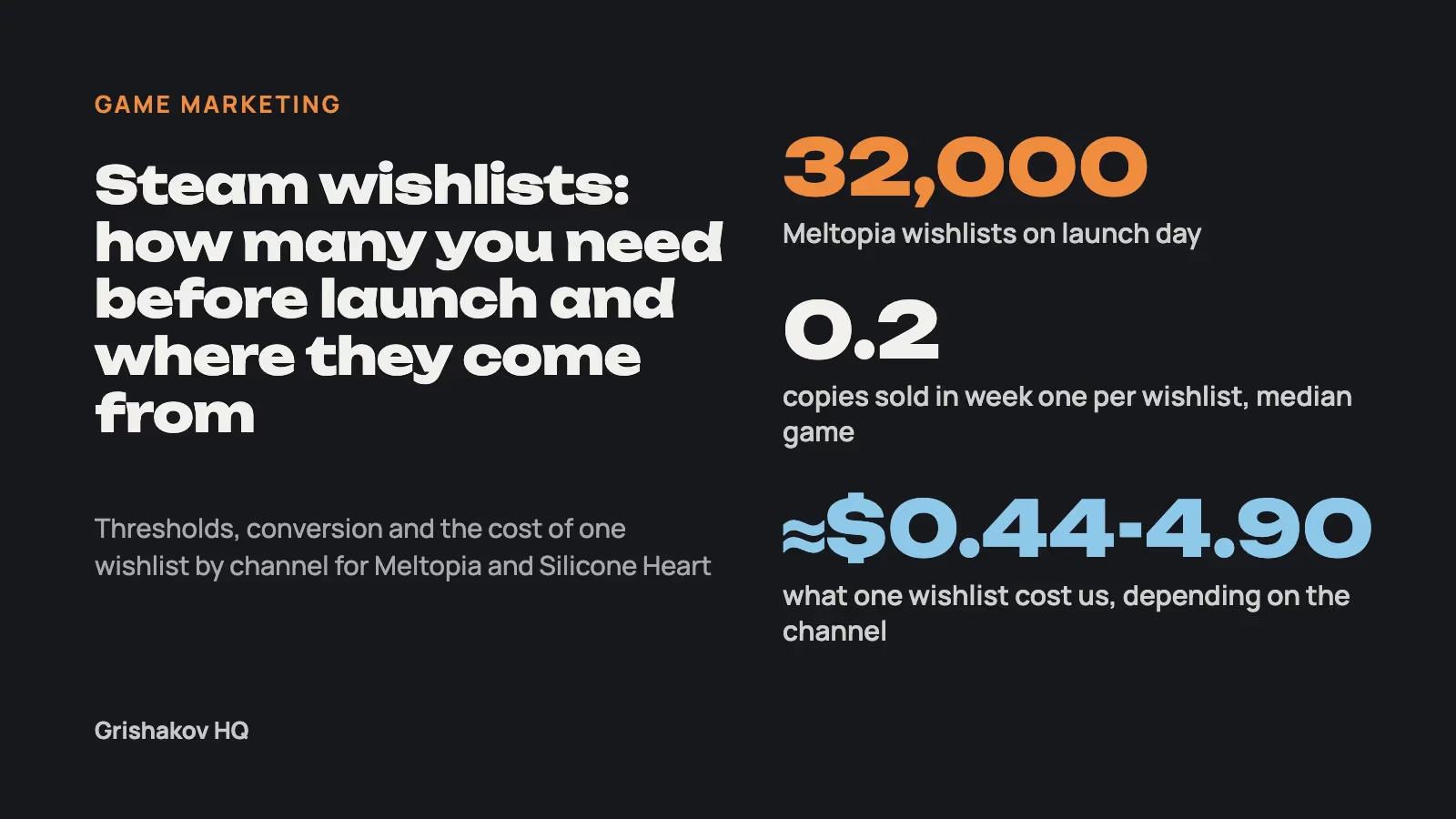
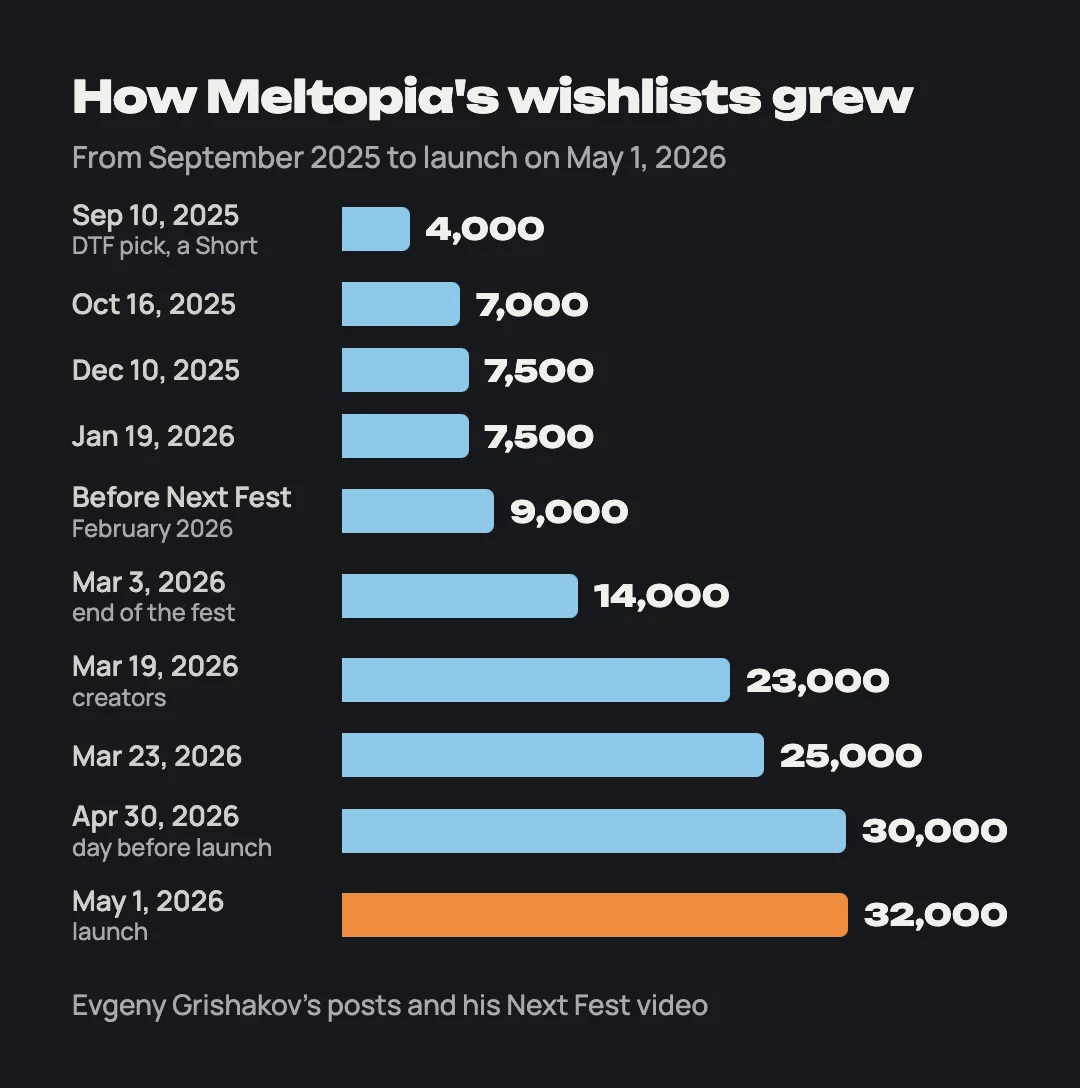
Steam wishlists are a player's subscription to your game: they click a button on the store page, and Steam tells them when the game comes out or goes on sale. A year ago, while we were preparing Meltopia, I wrote that we hoped to collect 10,000 wishlists by launch. We launched on May 1, 2026 with 32,000. Back in December I wrote that it would be "our first launch with wishlists, not on a hope and a prayer."
Below: how many wishlists you need, what they turn into and where we got ours, with the cost of one wishlist for each channel. The numbers cover two games, Silicone Heart and Meltopia, and come from my own posts.
I post fresh numbers on our games' wishlists, sales and spending as we go on X.
Our games' wishlists and sales as we go
Evgeny on XWhat Steam wishlists are and what they do for a game
A wishlist is a list of games a player is keeping an eye on. To add a game, you press "Add to your wishlist" on its Steam page. For the developer, every such click is a person Steam will remind about the game.
Valve describes in the Steamworks documentation when exactly Steam sends those reminders:
- on launch day, in Early Access or straight into full release, everyone with the game on their wishlist gets an email and/or a push notification in the mobile app;
- when the game moves from Early Access to full release, another email;
- on a discount of 20% or more, if it runs longer than 8 hours;
- once, when a free demo comes out, and you have to send that notification within two weeks of the demo's release.
Steam keeps a 1-2 week cooldown between emails about the same game, and only users with a verified email address get them.
In my Next Fest video I put it like this: "wishlists do not equal a purchase, and not even a promise to buy. It's just a subscription with a slightly extended meaning." Silicone Heart had 51,000 wishlists at the time, and all that meant was that this many people would get an email or a push on launch day, if their email was verified.
How much wishlists affect where Steam shows a game, Valve puts differently on different pages. The wishlist documentation says: "Wishlists can be an important factor in determining where your game appears on Steam." The visibility documentation is stricter: "With a few exceptions like the Popular Upcoming tab, wishlists are not a factor in your game's algorithmic visibility on Steam." Put the two pages together, and wishlists work through three things: emails, the Popular Upcoming tab and sales in the first days after launch.
How many wishlists do you need before launch?
There is no required number, and Valve says so directly. But one store section, Popular Upcoming, does have a bar, and it went up in June 2026: by Chris Zukowski's count, the median game on that list had about 13,000 wishlists.
Back in 2020, Tom Giardino of Valve explained to GamesIndustry.biz that the store does not work that way: there is no arbitrary threshold after which marketing switches on or off. The "you need 7,000" figure came from somewhere else. Zukowski, who writes the How To Market A Game blog, explained that the common advice to collect 5,000-7,000 wishlists before launch appeared because of Popular Upcoming: it showed the most anticipated games of the coming days, and that number was enough for a game to sit on the list before release.
Popular Upcoming and the Steam wishlist ranking
Popular Upcoming is a Steam store tab with the most anticipated games of the coming days. In the visibility documentation, Valve gives it as the main example of where wishlists affect what gets shown. Next to it there is the Top Wishlists list, where games are sorted by wishlist count.
According to Zukowski, in June 2026 Valve said the bar for Popular Upcoming had gone up. He looked at the list on one day in June:
| Games in Popular Upcoming | Wishlists |
|---|---|
| 30% of games had fewer than | 8,470 |
| median | 13,270 |
| 70% of games had fewer than | 20,000 |
This is a one-day snapshot; Valve does not publish official thresholds. At the same time, Steam launched a personal calendar of upcoming games, and by Zukowski's first estimates it gives 1,000-3,000 wishlists a day closer to launch, but there is too little data yet to rely on it.
For comparison with the market: according to Video Game Insights, as summarised by GameDev Reports (July 2025), 66% of games have fewer than 10,000 wishlists. So 10,000 is already more than most games have, though it may no longer be enough for Popular Upcoming.
Our own targets looked like this. For Meltopia in October 2025 I planned 10,000 by launch, before Next Fest in February I was counting on 20-25 thousand, after the fest in March I expected 35-40 thousand, and we launched with 32,000. In January 2026 I wrote that Meltopia is a small game and has no goal of reaching a million wishlists. For Silicone Heart, a bigger game, I set a goal of 100,000 wishlists, and we have not reached it yet.
Steam wishlist conversion rate: wishlists to sales
In its first week, the median game sells about 0.2 copies per launch-day wishlist, and games with a big base about 0.15. The rest of the wishlists buy later, mostly on discounts.
The first week of sales is the main measure people use to compare launches. Simon Carless of GameDiscoverCo has tracked this metric for several years: all first-week sales divided by the wishlist count on launch day. In 2020, across 50 games, the median was 0.2, with Early Access launches at 0.16 against 0.22 for full releases. In 2024, across a hundred-plus games, the median was 0.2 again, and for games with more than 10,000 wishlists 0.17. In a summary of his 2025 data, games with a base above 25,000 came out at about 0.15: roughly 15,000 first-week sales per 100,000 wishlists.
In 2020 Valve shared its own data (as retold on DTF): over 12 months, on average 19% of wishlist additions turn into a purchase, and 51% of purchases from wishlists happen on discounts. The spread is huge: a quarter of games have a yearly conversion below 11%, another quarter above 26%.
Meltopia launched with 32,000 wishlists and sold 5,657 copies in the first day and 27,135 in the first week. By Carless's method that is about 0.85, roughly four times the median. But the base alone does not explain it: in the same days the game made it into three Steam sections and gained another 24,958 new wishlists in the week, so people who only found the game after launch were buying too. In my first-week post I gave a wishlist-to-sales conversion of 15.6%: that is a different metric, not the ratio of all sales to launch-day wishlists.
After launch the report shows a lot of wishlist deletions: when a person buys the game, it leaves their list, and after Meltopia's launch there were very many such "deletions," although new wishlists came in faster. Three days after launch I estimated conversion at "50%+" and wrote right away: "No idea if you can count it like that." I went through the first hours of the launch step by step in how to publish a game on Steam, and how much of Meltopia's revenue reached us after Valve's cut and taxes in how much Steam takes from a game sale.
Do wishlists go stale?
Old wishlists buy worse than fresh ones, but with every discount of 20% or more their owners get an email again.
The team of the publisher Perelesoq looked at data from five different games (the piece was republished by App2Top). For Torn Away, the oldest wishlists converted at 6% and the newest at 9%; for CyberCorp, 2% against 8%. There was one exception: for Tavern Manager Simulator, old ones gave 21% and new ones 19%. The publisher's conclusion: "100,000 wishlists collected over a short time before release are much more valuable and effective than the same 100,000 wishlists collected over a year or more."
Sales do not stop after the first week, though. According to GameDiscoverCo's 2024 data, the median game earns 3.16 times more in its first year than in its first week. In the video I called this gradual conversion: every sale, big update or console release is a reason to put the game in front of wishlisters again, and sooner or later some of them buy it.
How to get wishlists on Steam and what one wishlist costs
Our games got wishlists from outside traffic and Steam events: festivals, content creators, short videos, trailer reveals, ads. Steam itself gave a noticeable bump when the game made it onto the front page or into featured lists. How we launched each of these channels and in what order, I covered in how to market an indie game.
In this video I walk through the Silicone Heart wishlist graph peak by peak: the reveal on DTF, a Russian gaming community site, then IGN, festivals, an interview and paid promo posts. The video is in Russian, and YouTube has an English dub track for it.
Here is what different channels gave our games. The numbers are from my posts and videos for 2025-2026, and the cost was calculated there too.
| Channel | Result | Cost per wishlist |
|---|---|---|
| Short videos made in-house, Silicone Heart, March 2025 | 100-120 thousand views a month | about $4.90, about $1.10-1.20 planned after optimisation |
| Paid ads, Silicone Heart, by August 2025 | 18,000 for $15,000 | $0.89 in spring, from $1 down to $0.5 by August |
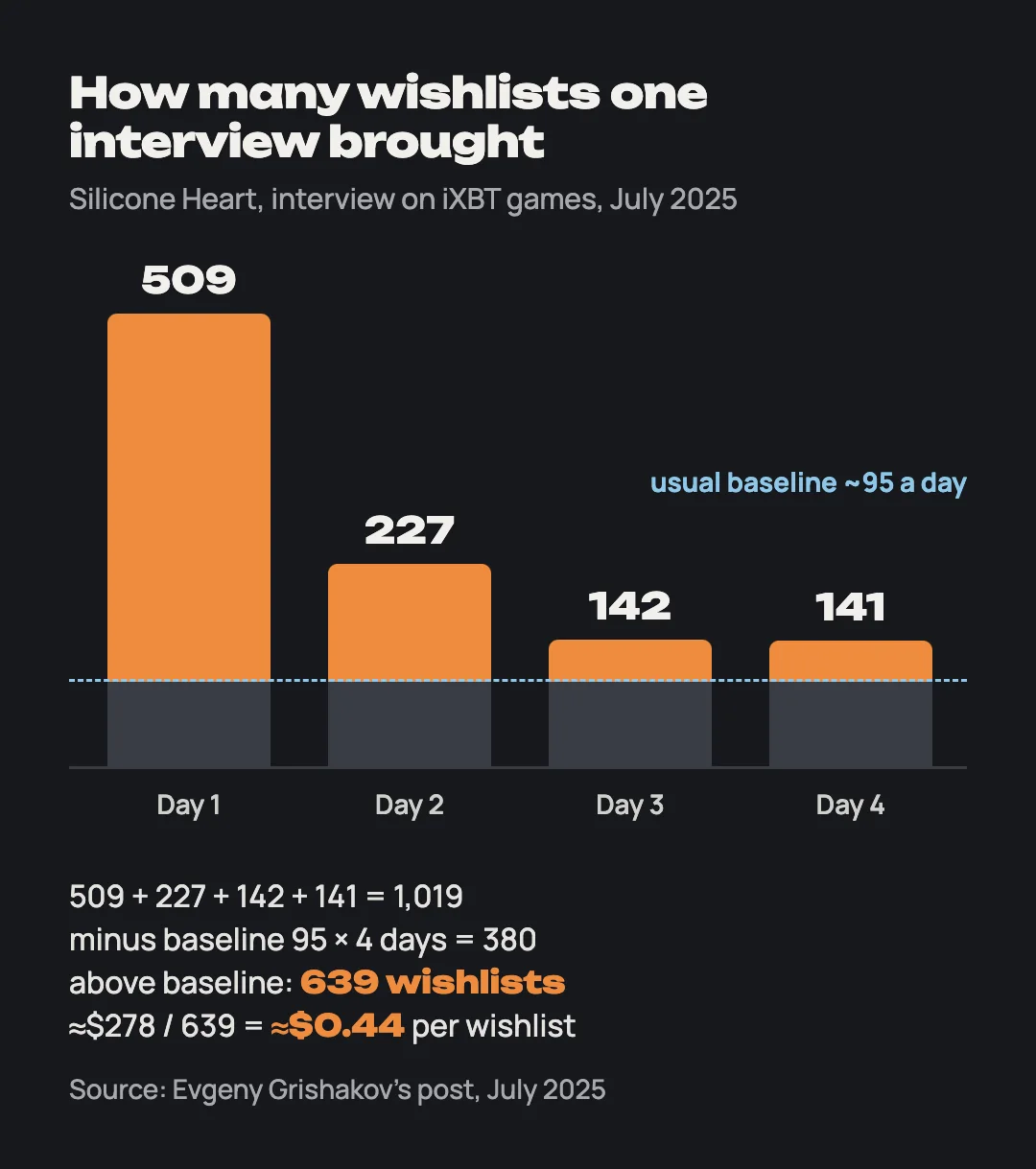
| Interview on iXBT games, Silicone Heart, July 2025 | 639 above the usual baseline | about $0.44 (about $278 spent) |
| iXBT's NASHY IGRY festival, Silicone Heart, summer 2025 | 2,000 | - |
| Trailer reveal on Games from Russia and IGN, Silicone Heart, May 2025 | +6,000 by May 22, from 16,000 to 22,500 | - |
| Simfest, Silicone Heart, July 2026 | +3,000, peak of 842 in a day | free, by application |
| Backed by Backers without the Steam front page, Silicone Heart, April 2026 | almost no effect | - |
| Kickstarter, Silicone Heart, April 2026 | 2,100+ in a week | - |
| DTF pick and a creator's Short, Meltopia, September 2025 | +2,000 in 3 days | free |
| Creators and streamers during Next Fest, Meltopia, February - March 2026 | about 12,000 | - |
| Reddit ads before launch, Meltopia, April 2026 | "Reddit Ads works," no numbers | - |
About short videos I wrote in March 2025: "Yes, no miracle happened. But it is a perfectly workable tool that keeps bringing in a new audience." The rule of thumb we got back then: a million views a month is about 1,000 wishlists a month.
You can work out the cost of a wishlist from an event the same way I did for the interview on iXBT games, a Russian gaming site. Take the wishlists by day after the event, subtract the usual baseline and divide what you spent by the difference. We got 509, 227, 142 and 141 wishlists over four days with a baseline of about 95 a day: 1,019 minus 380 is 639 wishlists from the interview, at about $0.44 each. At the time I wrote "Welll! That came out a bit pricey))", although with short videos in March of the same year a wishlist cost us about $4.90, and after optimisation we were only planning to get to about $1.10-1.20.
If you are making your first game and counting every wishlist too, I break down experiments like this on X as we go: what we tried, how much we spent and what came of it, failures included.
Our wishlist experiments, failed ones included
Evgeny on XPaid or free wishlists
Paid wishlists from ads are ordinary people who saw an ad and pressed the button themselves. Wishlists from bots and exchanges are a different thing, more on them below. Our ads brought 18,000 wishlists for $15,000. For comparison, Pavel from the Dead Weight team shared a case with us where they got 25,000 for $30,000.
By May 2025, about half of Silicone Heart's base came from ads on X (Twitter Ads), and half was free. There is a long-standing view in the developer community that free wishlists are worth more, because people subscribed on their own, without an ad, and I tend to agree.
Festivals and Steam Next Fest
Steam festivals are one of the cheapest channels in the table: for Simfest, for example, we simply applied. After Simfest, which gave Silicone Heart 3,000 wishlists, I wrote: "Festivals work. Even for free."
But festivals differ a lot. Backed by Backers in April 2026 ran without a spot on the Steam front page, and I wrote then: "This is night and day. Almost zero effect." If a festival is not put on the front page, count only on your own traffic.
The main festival for indies is Steam Next Fest. There, a lot depends on the base you bring: according to Chris Zukowski's survey about the February 2026 fest, games with up to 1,000 wishlists got a median of about 300, and games with 10-100 thousand about 5,000. Meltopia came to that fest with 9,000, the festival itself gave it about 600, and creators during the fest and a couple of weeks after it about 12,000. How to prepare a demo and what went wrong for us, I covered in detail in Steam Next Fest: how to prepare a demo.
When to open your page and how many wishlists a day is normal
Valve advises putting up a Coming Soon page as soon as you are ready and able, and Mike Rose of No More Robots has said he opens it about 4-6 months before launch. In my stages of making a game, the page is step three, right after the prototype. The second guide is speed: how many wishlists the game gets without any effort from you.
Valve's visibility documentation explains why not to wait: "Some customers may need to see your game dozens of times before it catches their attention." A page that is too early has a downside too: old wishlists buy worse, as the Perelesoq data above shows. Meltopia's page opened in summer 2025, about 10 months before launch.
From his consulting experience, Zukowski rates speed like this: around 15,000 wishlists a year is a strong signal, fewer than 4,000 a year is weak support. In summer 2025 Silicone Heart was growing by 5,000+ wishlists a month, but that figure included ads.
Without marketing, a game usually gets little. For Clear the Snow, at the end of December 2025 wishlists started coming in every day for the first time without any spending: 84 a day, and a few days later 116 and 109. A small game can also get 83 wishlists in the two weeks after opening its page, as the Russian indie Sadko did. From October 2025 to January 2026 Meltopia was nearly flat at 7,000-7,500: wishlists came in on their own, but slowly, and only the demo, Next Fest and creators gave it a jump.
What should be on the Coming Soon page and how many wishlists it brings in the first two weeks, I covered in how to publish a game on Steam.
Can you buy Steam wishlists?
You can buy ads after which people add the game themselves, we did that. But buying wishlists from bots and exchanges makes no sense: such a wishlist will not buy the game, and the launch email goes nowhere.
The Steamworks sections on wishlists and visibility have no separate point about buying wishlists, but paid reviews Valve bans directly: "Don't solicit reviews in exchange for any games, DLC, money, or other rewards." Even without a ban, the math is against it: by Valve's own words, wishlists barely affect the algorithm, except for the Popular Upcoming tab, and the main thing they give you is emails to real people on launch day and on discounts. A bot will not open that email or buy the game, but the wishlist-to-sales conversion you will later judge your game by will drop.
The same goes for giveaways like "wishlist the game and get a key." Such wishlists gather people who want a free key, and the game itself may not interest them. Zukowski puts it briefly: "wishlist conversion rate depends on how excited fans are for your game."
How to see a Steam wishlist: yours, a friend's and your game's stats
Your own wishlist opens from the profile menu in the Steam store; someone else's, only if the owner has made their game details visible in the privacy settings. A developer sees wishlist stats in Steamworks.
Whether you can see a friend's list depends on their "Game details" profile setting: public, friends only or private. You cannot hide only the wishlist; it is hidden together with the game list and playtime. If a friend's wishlist does not open, most likely their setting is private.
A developer sees wishlists in Steamworks: on the game's page in the Sales & Activation Reports there is a Wishlists section. It shows additions, deletions and purchases from wishlists by day and by region. The data updates once a day for the previous day, so you will only see today's spike tomorrow. A rough place of someone else's game by wishlists shows up in the Top Wishlists list on Steam and in services like SteamDB. How to estimate another game's sales from open data, I covered in how to estimate Steam game sales.
How many wishlists and sales indie games of different sizes get, with real examples, is in how much indie games make on Steam. And how we found Meltopia buyers after launch, in China and on GOG, is in selling games outside Steam.
Frequently asked questions
What is a Steam wishlist?
It is a list of games a player follows: they press a button on the game's page and subscribe to it. Steam then sends an email or push on launch day, when the game leaves Early Access, on a discount of 20% or more lasting over 8 hours, and once when a demo comes out. A wishlist is a subscription, and only a minority of wishlisters buy in the first week.
How many wishlists do you need on Steam?
There is no required number: Valve says directly that there is no minimum before Steam starts showing a game. The Popular Upcoming tab does have a bar: in Chris Zukowski's June 2026 snapshot, the median game there had 13,270 wishlists, and 30% of games had fewer than 8,470. 66% of Steam games have fewer than 10,000 wishlists. Meltopia launched with 32,000 against an initial plan of 10,000.
What is the Steam wishlist to sales ratio?
In the first week, the median game sells about 0.2 copies per launch-day wishlist according to GameDiscoverCo, and games with a base above 25,000 about 0.15. Over a year, Valve's 2020 data shows that on average 19% of wishlist additions turn into a purchase, and more than half of those purchases happen on discounts. The spread between games is very large.
Do Steam wishlists go stale?
Old wishlists buy worse than fresh ones: in the publisher Perelesoq's data, CyberCorp's oldest wishlists converted at 2% and the newest at 8%. Still, every discount of 20% or more lasting over 8 hours sends an email again to everyone with a verified address and the game on their list, and over its first year the median game earns 3.16 times more than in its first week.
Can you buy Steam wishlists?
You can buy ads after which people add the game themselves: that brought us 18,000 wishlists for $15,000. Wishlists from bots and exchanges are useless: wishlists barely affect the algorithm, the launch email goes to a bot that will not buy, and your wishlist-to-sales conversion drops. The Steamworks pages on wishlists and visibility say nothing separate about buying them, but Valve directly bans paid reviews.
How do you see a friend's wishlist on Steam?
Open your friend's profile and go to their wishlist. You can only see it if your friend's "Game details" privacy setting is public or friends only. The wishlist cannot be hidden on its own: it is hidden together with the game list and playtime. If the list does not open, most likely your friend's game details are set to private.
Sources
- Valve, Wishlists (Steamworks documentation)
- Valve, Visibility on Steam (Steamworks documentation)
- Valve, Wishlist Reporting (Steamworks documentation)
- Valve, User Reviews (Steamworks documentation)
- Chris Zukowski, "How many wishlists should I have when I launch my game?", How To Market A Game, updated June 2026
- Chris Zukowski, "Do wishlists matter any more?", How To Market A Game, 01/29/2024
- Simon Carless, "Steam: the new wishlists to first-week sales ratio", GameDiscoverCo, 06/15/2020
- Simon Carless, "Revealed: the state of Steam wishlist conversions", GameDiscoverCo, 04/15/2024
- GameDev Reports, summary of GameDiscoverCo on wishlist conversion, 11/03/2025
- GameDev Reports, Video Game Insights on Steam wishlists, 07/23/2025
- Chris Zukowski, "Making sense of the February 2026 Steam Next Fest", How To Market A Game, 04/13/2026
- "Why wishlists matter so much to developers and how they relate to game sales" (in Russian), DTF, 08/30/2020 (translation of a GamesIndustry.biz piece with Valve's data)
- "Do Steam wishlists go stale? Perelesoq breaks it down with cases" (in Russian), App2Top, 04/11/2025
- "How many wishlists in two weeks" (Sadko) (in Russian), DTF, 08/25/2025
- Evgeny Grishakov, "How to get the MAXIMUM wishlists from Steam Next Fest..." (in Russian), YouTube, 03/19/2026
- Evgeny Grishakov, video on the Silicone Heart trailer reveal on IGN (in Russian), YouTube, 05/22/2025
In March 2026 Silicone Heart had 51,000 wishlists. I post its fresh wishlist numbers on X.
Fresh Silicone Heart wishlist numbers
Evgeny on X